SEO and SEM both help businesses appear when potential customers search online, but they achieve this in different ways. Search Engine Optimization, or SEO, improves a website’s visibility in unpaid search results. Search Engine Marketing, or SEM, uses paid search advertisements to reach people searching for selected keywords.
The main difference comes down to time and investment. SEO usually takes longer to build momentum, but a well-ranked page can continue attracting organic traffic without a fee for every click. SEM can generate visibility shortly after a campaign launches, but businesses must continue paying for advertising to maintain that traffic.
For companies in Singapore, deciding between SEO and SEM is not always straightforward. Search competition can be high, especially in industries such as finance, legal services, healthcare, education, home services, and eCommerce. The right approach depends on your goals, budget, timeline, competition, and website readiness.
This guide explains how SEO and SEM work, how much they may cost in Singapore, and when it makes sense to use one or both.
What Is SEO and How Does It Work?
SEO is the practice of improving a website so that its pages have a better chance of appearing in organic search results. Organic results are the unpaid listings shown by search engines such as Google and Bing. A business does not pay the search engine whenever someone clicks one of these listings.
For example, a Singapore company may want to rank for searches such as:
- office cleaning company Singapore
- corporate website design Singapore
- accounting services Singapore
- commercial renovation contractor
- buy office furniture online
SEO helps search engines understand what a page is about and whether it provides a relevant, useful answer to the searcher. If you’re new to SEO, our complete SEO guide explains the fundamentals in more detail.
However, SEO involves more than inserting keywords into a page. Search engines also consider the website’s technical condition, content quality, structure, usability, authority, and how well each page matches the user’s search intent.
The goal is not simply to increase traffic. A good SEO strategy should bring the right visitors to the website and help them move toward an inquiry, booking, purchase, or other valuable action.
The Main Components of SEO
An effective SEO campaign usually covers several connected areas.
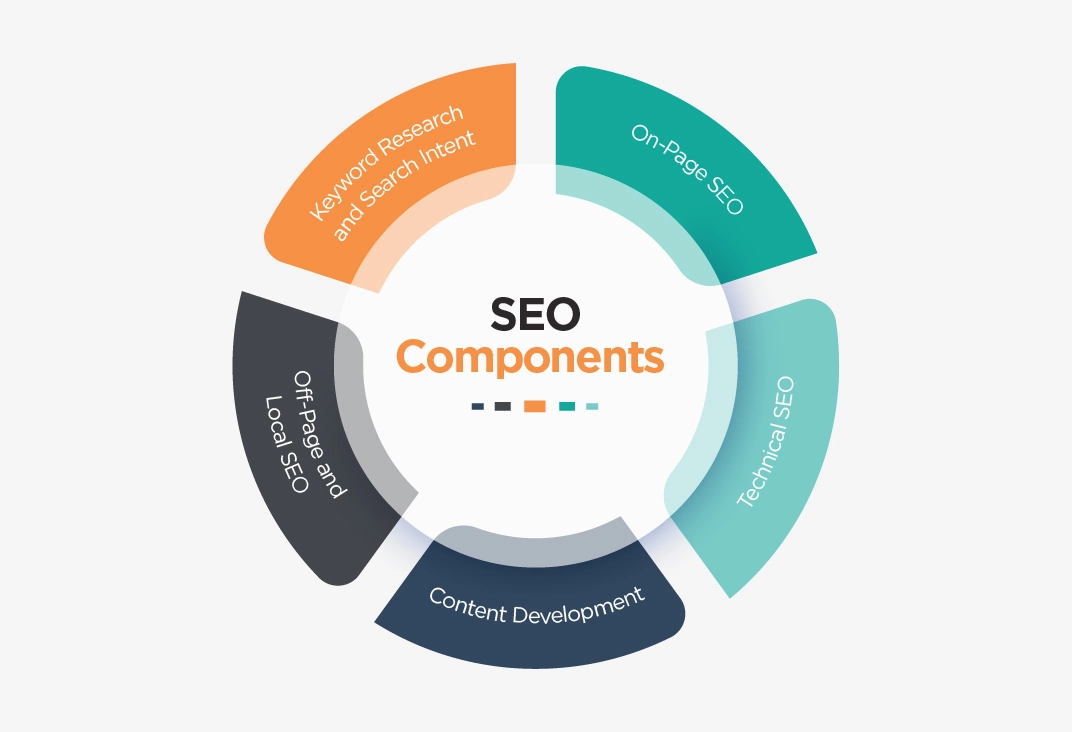
1. Keyword Research and Search Intent
Keyword research identifies what potential customers search for and why they search for it.
A keyword with high search volume is not always the best target. It must also be relevant to the business and appropriate for the page.
For example, someone searching for “what is SEO” is probably looking for general information. Someone searching for “SEO agency Singapore” is more likely to be comparing service providers.
Understanding the difference helps businesses create pages that match the reader’s needs rather than simply chasing popular phrases.
2. On-Page SEO
On-page SEO involves improving individual pages through elements such as:
- Page titles and meta descriptions
- Headings and body content
- Internal links
- Images and alternative text
- Page URLs
- Calls to action
- Structured data
These improvements help search engines interpret the page and make the content easier for visitors to understand.
The wording should still sound natural. Repeating the same keyword throughout a page will not make thin or unhelpful content rank better.
3. Technical SEO
Technical SEO makes it easier for search engines to access, crawl, and index a website. It may involve fixing:
- Slow loading speeds
- Mobile usability issues
- Broken links
- Incorrect redirects
- Duplicate pages
- Indexing problems
- Poor site structure
- Missing sitemaps
Technical improvements can also support conversions. Even if a page ranks well, visitors may leave when it loads slowly or is difficult to use on mobile devices.
4. Content Development
A website needs relevant content to rank for relevant searches.
Depending on the user’s intent, this may include service pages, product categories, location pages, blog articles, comparisons, FAQs, or case studies.
Useful content should answer the main question clearly, provide practical details, and help the reader make a decision. Length alone does not make a page valuable.
5. Off-Page and Local SEO
Off-page SEO develops a website’s authority through relevant links, mentions, directory listings, partnerships, and digital public relations.
Local SEO focuses on reaching customers in a particular area. For Singapore businesses, this may include optimizing a Google Business Profile, maintaining consistent company details, earning genuine reviews, and producing locally relevant content. Local SEO is especially useful for clinics, restaurants, retailers, professional services, and companies serving customers at specific locations.
When Should You Choose SEO?
SEO is generally the better investment when:
- You want long-term growth
- You have an established website
- Organic visibility matters
- You’re targeting informational searches
- You want to reduce paid advertising costs over time
Before launching any SEO campaign, it’s useful to follow a comprehensive SEO checklist covering technical, on-page, and content optimisation.
What Is SEM and How Does It Work?
SEM refers to paid advertising on search engines. It is also commonly called paid search or pay-per-click advertising. Businesses select relevant keywords and create advertisements that may appear when people search for those terms. The advertiser usually pays when someone clicks the ad.
Google Ads is the main platform used for paid search campaigns, although other options include Microsoft Advertising.
For example, a wedding venue in Singapore may bid on keywords such as “Malay wedding venue Singapore” or “wedding package Singapore.” Its advertisement may then appear when someone searches for those services.
Ad placement is not determined by budget alone. Search platforms consider several factors, including:
- The advertiser’s bid
- Keyword competition
- Ad relevance
- Expected performance
- Landing-page quality
- Campaign settings
SEM can produce visibility faster than SEO, but it does not guarantee immediate leads or sales. Campaigns still need suitable targeting, persuasive advertisements, accurate tracking, and landing pages that encourage visitors to act.
The Main Components of SEM
A well-managed SEM campaign involves more than choosing keywords and setting a daily budget.
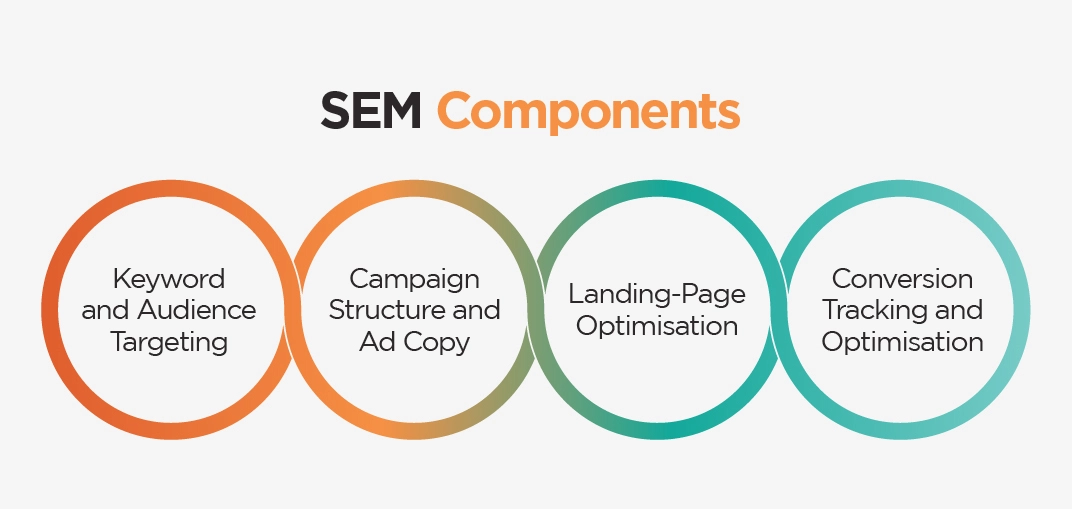
1. Keyword and Audience Targeting
Keywords determine which searches may trigger an advertisement. Campaigns should focus on terms that are relevant to the business and show suitable commercial intent.
Negative keywords are equally important. They prevent ads from appearing for irrelevant searches that may consume the budget without producing useful inquiries. Advertisers can also refine campaigns by location, device, schedule, and audience.
2. Campaign Structure and Ad Copy
Campaigns should be divided into clear groups based on services, products, or customer needs. This makes it easier to control budgets and create ads that closely match each search. The ad should explain what the company offers, why it is relevant, and what the user should do next.
3. Landing-Page Optimisation
The page someone reaches after clicking an ad can strongly influence whether the campaign succeeds. A good landing page should:
- Match the advertisement
- Explain the offer clearly
- Load quickly
- Address common concerns
- Establish trust
- Provide a clear next step
These landing page optimisation tips can help improve lead generation and Google Ads performance. Sending all paid traffic to a generic homepage may reduce conversions when the visitor is searching for a specific service.
4. Conversion Tracking and Optimisation
Campaign tracking shows whether visitors complete valuable actions, such as submitting a form, making a call, booking an appointment, or buying a product.
Without accurate tracking, a business may know how many clicks it received but not whether those clicks generated meaningful results. The campaign can then be improved by reviewing keywords, advertisements, bids, landing pages, devices, locations, and conversion data.
When Should You Choose SEM?
SEM is suitable when:
- Launching a new product
- Running seasonal campaigns
- Generating leads immediately
- Testing new markets
- Supporting promotions
SEO vs SEM Comparison
| Factor |
SEO |
SEM |
| Search placement |
Organic search results |
Paid search advertisements |
| Cost model |
No charge for each organic click, but campaign work has a cost |
Advertisers generally pay per click |
| Speed |
Usually takes several months to build |
Ads may appear soon after launch |
| Traffic duration |
Rankings may continue producing traffic, although maintenance is needed |
Traffic usually falls when advertising stops |
| Targeting |
Based on relevance, authority, location, and search intent |
Keywords, location, device, schedule, audience, and bids |
| Best use |
Sustainable visibility and long-term growth |
Immediate campaigns, lead generation, and testing |
| Main risk |
Slow progress in competitive markets |
Budget may be wasted through poor targeting or weak landing pages |
What Are the Main Differences Between SEO and SEM?
SEO Earns Visibility While SEM Pays for Placement
- SEO works by improving the website’s relevance, authority, usability, and technical quality.
- SEM pays for the opportunity to appear in an advertising position. Businesses compete through an auction influenced by their bids, ad quality, and campaign relevance.
SEO Takes Longer While SEM Provides Faster Feedback
- SEO changes may take weeks or months to influence rankings. This is why SEO is normally treated as a long-term strategy.
- SEM can begin producing impressions and clicks shortly after launch. It also allows businesses to test keywords, offers, and landing pages more quickly.
However, faster traffic should not be confused with instant success. Paid campaigns often require time to collect enough data for meaningful optimisation.
SEO Can Build Compounding Value
A useful article or optimised service page may continue attracting organic visitors after it begins ranking. Over time, a website can build visibility across multiple services, products, and stages of the customer journey. SEM depends more directly on continued advertising spend. When the campaign stops, the paid placements usually disappear.
SEM Offers Greater Immediate Control
- SEM lets businesses adjust budgets, geographic targeting, schedules, devices, keywords, and bidding strategies.
- SEO offers less direct control because search engines decide which organic pages appear and how highly they rank.
How SEO and SEM Support AI Search?
Google AI Overviews, ChatGPT and Perplexity still rely heavily on trustworthy web content. Strong SEO improves your chances of appearing as a citation in AI-generated answers, while SEM helps you capture immediate demand for commercial searches. Businesses that combine SEO, SEM and AI-focused content are better positioned to build visibility across both traditional search engines and AI-powered search experiences.
How AI Search Is Changing SEO and SEM?
Google AI Overviews, ChatGPT, Gemini and Perplexity are changing how people discover businesses online. Instead of browsing multiple websites, users increasingly receive direct answers generated from trusted sources. This means businesses should optimise not only for rankings, but also for AI citations by publishing authoritative, structured and trustworthy content. As AI-powered search evolves, businesses should prepare for both traditional rankings and AI-generated answers. Our guide to SEO from Search to Answers explains this shift in more detail.
How Much Do SEO and SEM Cost in Singapore?
SEO is sometimes described as free because businesses do not pay Google for every organic click. This is misleading. SEO still requires investment in research, content, technical work, website improvements, reporting, and campaign management.
Indicative monthly SEO costs in Singapore may look like this:
| SEO Scope |
Estimated Monthly Cost |
| Small local campaign |
S$800 to S$1,500 |
| Ongoing SME campaign |
S$1,500 to S$4,000 |
| Competitive or larger campaign |
S$4,000 to S$10,000+ |
| Enterprise or regional SEO |
Custom quotation |
SEM normally involves two separate costs:
- The advertising budget paid to the search platform
- The campaign management fee paid to the agency or specialist
Businesses may also need to budget for landing-page development, copywriting, creative work, and tracking setup.
| SEM Scope |
Estimated Monthly Ad Spend |
| Small local test campaign |
S$1,000 to S$3,000 |
| Ongoing lead-generation campaign |
S$3,000 to S$10,000 |
| eCommerce or multi-service campaign |
S$5,000 to S$20,000+ |
| Highly competitive campaign |
Depends on keyword costs and customer value |
These figures are broad planning estimates rather than fixed prices.
The cost per click can range from a few dollars to much more for competitive sectors. However, a cheaper click is not necessarily better. A high-cost click may still be worthwhile if it regularly produces valuable customers.
Businesses should compare each channel using commercial measures such as:
- Cost per lead
- Cost per sale
- Conversion rate
- Revenue
- Return on investment
- Customer lifetime value
Pros and Cons of SEO
Advantages of SEO
SEO can build long-term visibility for searches that matter to the business. Organic clicks do not carry a direct advertising charge, and pages that rank well may continue bringing in traffic over time.
SEO can also improve the overall website by strengthening content, site structure, page speed, internal linking, and mobile usability.
Disadvantages of SEO
SEO takes time, particularly for new websites and competitive industries. Rankings are never guaranteed, and results depend partly on how quickly technical and content recommendations are implemented.
It also requires ongoing attention. Competitors publish new pages, search behavior changes, and website issues can appear over time.
Verz Design SEO Case Study: Fasten Enterprises
Fasten Enterprises supplies fastening systems to industries across Southeast Asia. Despite its established B2B market position, the company had little online visibility and limited organic traffic.
Verz Design developed an SEO strategy around 10 relevant search terms. The work included keyword research and optimisation across title tags, links, website content, images, meta descriptions, URLs, and site structure. Contextual backlinks were also built to strengthen the website’s authority.
Through consistent monitoring and optimisation, all 10 target keywords reached the first page of Google. Daily search impressions also increased from 295 to 1,295, while the wider campaign generated a 200% rise in organic traffic.
The case shows why B2B companies should not dismiss SEO simply because their search volume is lower than that of consumer brands. Reaching a smaller but highly relevant audience can still create meaningful commercial opportunities.
Pros and Cons of SEM
Advantages of SEM
SEM can provide visibility quickly and target people who are actively searching for a product or service.
Businesses can control their budgets, locations, schedules, devices, and keyword targeting. They can also test advertisements and offers without waiting for organic rankings to change. This makes SEM useful for product launches, seasonal promotions, new websites, and businesses that need leads within a shorter timeframe.
Disadvantages of SEM
Paid traffic depends on an ongoing budget. Competitive keywords may be expensive, and poorly structured campaigns can waste money on irrelevant searches. SEM also depends heavily on the website experience. More clicks will not solve a slow page, weak offer, or confusing inquiry process.
Verz Design SEM Case Study: Lagun Sari
Lagun Sari wanted to generate more leads without increasing its advertising budget during a difficult period for the wedding and events industry.
Verz Design found that poor landing-page speed was affecting the website experience. The team improved the site through browser caching, media file reduction, CSS optimization, bug fixes, and other technical adjustments.
Mobile page speed improved by 100%, while desktop speed improved by almost 30%.
Over the following four months, Lagun Sari’s SEM campaign recorded:
- An 87.06% reduction in cost per click
- A 727.21% increase in clicks
- A 473.48% increase in impressions
The improved landing-page speed allowed the business to pay significantly less for website visits while gaining more visibility and leads.
This case highlights an important point. SEM performance is not determined only by the advertisement or bid. Website speed, usability, and on-page optimisation can directly affect how efficiently the campaign uses its budget.
Can SEO and SEM Work Together?
SEO and SEM are often discussed as competing strategies, but they can support each other.
Use SEM While SEO Builds Momentum
A new website may take time to rank for competitive terms. SEM can generate immediate visibility while SEO improvements are being implemented. This is useful when launching a new company, product, service, or seasonal campaign.
Use SEM Data to Guide SEO
Paid search can reveal which keywords generate inquiries, sales, or other valuable actions. If a term performs well through SEM, the business may decide to strengthen its organic page for that topic.
SEM can also uncover the language customers use, common search variations, and services that attract stronger demand.
Use SEO Improvements to Support SEM
The Lagun Sari case shows how website improvements can contribute to more efficient paid advertising. Pages built with clear content, strong usability, relevant information, and good loading speed may provide a better experience for both organic and paid visitors.
Reduce Dependence on One Channel
Relying entirely on SEM can leave a business exposed to rising advertising costs. Relying only on SEO may make it difficult to generate immediate visibility. Using both gives the business greater flexibility. SEM can capture current demand, while SEO develops longer-term visibility.
How Long Does SEO vs SEM Take to Deliver Results?
SEO commonly takes three to six months before meaningful progress becomes visible. New websites or highly competitive industries may require longer.
The timeline depends on:
- Current website authority
- Technical condition
- Competition
- Content quality
- Search demand
- Speed of implementation
SEM advertisements can begin appearing shortly after approval. However, the campaign may need several weeks of data before the business can properly assess keyword quality, conversion rates, costs, and landing-page performance.
Neither strategy should be judged using traffic alone. The real question is whether the traffic produces suitable leads, sales, and revenue.
Should Your Singapore Business Choose SEO, SEM, or Both?
Choose SEO when you want to build sustainable organic visibility and can commit to a longer-term strategy.
Choose SEM when you need faster exposure, want to test demand, or are promoting a time-sensitive offer.
Use both when search is an important source of customers, and you need immediate opportunities alongside long-term growth.
Business Situation & Recommended Approach
| Business Situation |
Recommended Approach |
| You need leads for an immediate campaign |
SEM |
| You want sustainable organic visibility |
SEO |
| You are launching a new website |
SEO and SEM |
| You want to test a new service |
SEM |
| Your paid advertising costs are rising |
Strengthen SEO |
| You sell products online |
SEO and SEM |
| You depend on local Singapore customers |
Local SEO and targeted SEM |
The website must also be ready to convert visitors. Sending more traffic to a slow, unclear, or difficult-to-use website may simply increase costs without improving results.
Conclusion
SEO and SEM are not competing strategies. They solve different business challenges. SEO builds long-term organic visibility and authority, while SEM generates immediate exposure for high-intent searches. As AI-powered search continues to evolve, businesses that combine SEO, SEM, and AI-ready content will be better positioned to attract customers across both traditional search engines and AI-generated search experiences.
Whether you’re investing in SEO, SEM, or both, the right strategy depends on your business goals, competition, and growth timeline. If you’re looking for tailored advice, explore our SEO services in Singapore or SEM services, or contact our team to discuss the best approach for your business.



 Share
Share