Quick Comparison: Which Payment Gateway Is Best?
With so many payment gateways available, choosing the right one can feel overwhelming. The best option depends on your business model, target market, and eCommerce platform. Use this quick comparison as a starting point to find the gateway that best fits your needs.
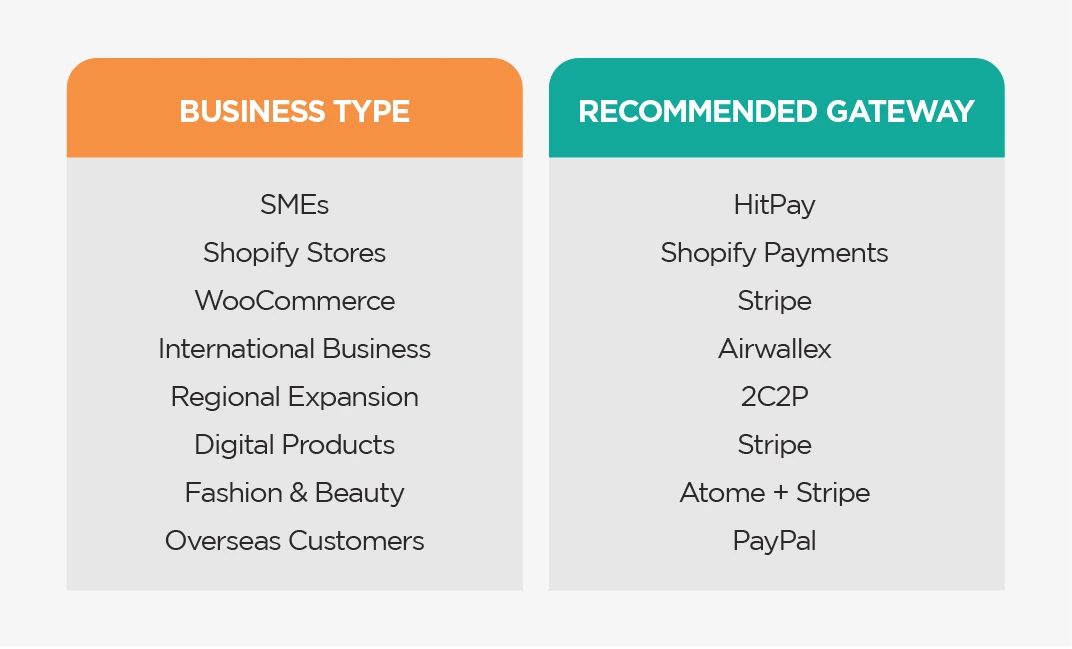
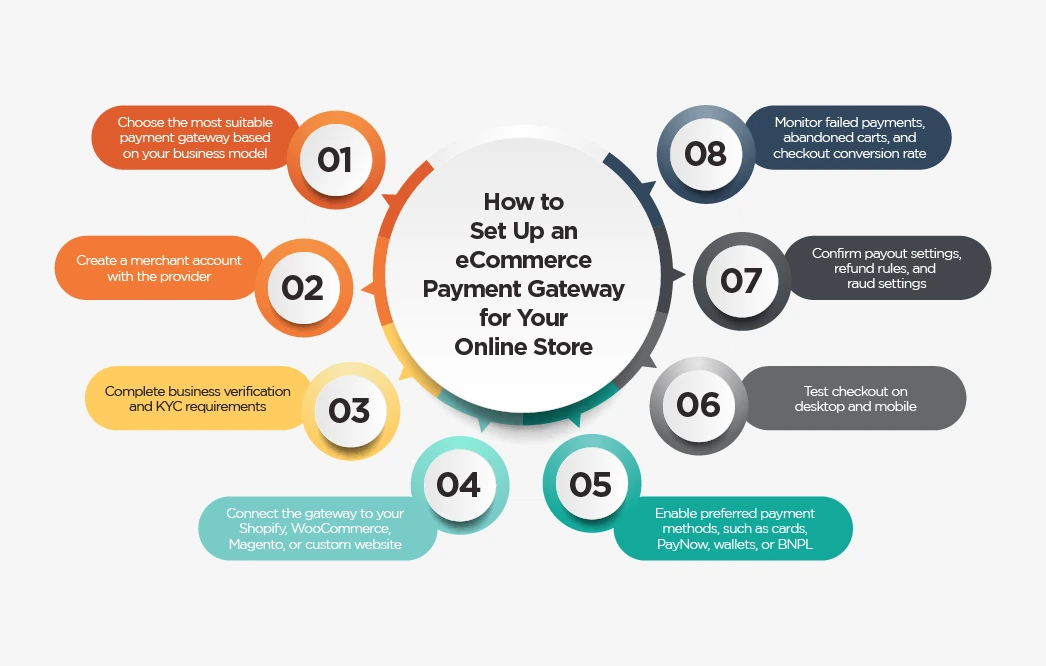
While there’s no one-size-fits-all payment gateway, selecting the right provider can improve your customers’ checkout experience and support your business growth. Consider your current needs and future expansion plans before making your decision.
Why Choosing the Right eCommerce Payment Gateway in Singapore Matters?
A payment gateway is more than a tool that processes online transactions. It affects how customers feel at checkout, how quickly your business receives funds, and how easily your store can scale. If you are unfamiliar with how payment gateways work, it is worth understanding the basics before comparing providers. A reliable eCommerce payment gateway can help your business:
Build trust at checkout
Customers are more likely to complete a purchase when they see familiar and secure payment options such as credit cards, PayNow, PayPal, Apple Pay, Google Pay, GrabPay, or Buy Now, Pay Later methods.
Improve conversion rates
Every extra step at checkout increases the chance of cart abandonment. A smooth, mobile-friendly payment flow helps customers pay quickly and confidently.
Improve cash flow
Payout time matters, especially for SMEs that need to reinvest in inventory, marketing, fulfilment, and operations. Faster payouts can support healthier day-to-day cash flow.
Support business growth
If you plan to sell overseas, your gateway should support multi-currency payments, international cards, competitive FX rates, and regional payment methods.
Checklist for Choosing the Best Payment Gateway Singapore Provider
Before choosing a payment provider, it is important to understand how to choose the right payment gateway for your eCommerce website. Compare these key factors carefully before making your decision.
1. Transaction Fees and Pricing Transparency
Look beyond the headline card fee. Some gateways charge fixed fees, percentage fees, cross-border fees, FX conversion fees, setup fees, refund fees, or chargeback fees.
A good payment gateway Singapore provider should make its pricing easy to understand. For example, Stripe lists Singapore card payment pricing on its official pricing page, while HitPay publishes domestic and international card rates for Singapore merchants.
2. Payment Methods Supported
Your gateway should support the ways your customers prefer to pay. For Singapore eCommerce stores, this may include:
- Credit and debit cards
- PayNow
- Apple Pay
- Google Pay
- GrabPay
- PayPal
- BNPL options such as Atome
- Regional wallets for Southeast Asian customers
For businesses using Shopify, integrating PayNow can provide customers with a fast and familiar local payment option while improving the checkout experience. The right mix depends on your audience, average order value, product type, and sales channels.
3. Payout Speed
Payout time affects cash flow. Some gateways offer next-business-day payouts, while others may take several days. If you run a fast-moving eCommerce business, payout speed should be one of your top selection criteria.
4. Security and Compliance
Choose a gateway that supports strong security standards such as PCI-DSS compliance, fraud monitoring, tokenisation, 3D Secure, and secure checkout flows. This protects both your business and your customers.
5. Platform Integration
Your eCommerce payment gateway should integrate smoothly with your platform. Common eCommerce platforms in Singapore include Shopify, WooCommerce, Magento, OpenCart, Wix, BigCommerce, and custom-built websites.
6. Cross-Border and Multi-Currency Support
If you sell internationally, check whether the gateway supports foreign cards, multi-currency settlement, regional payment methods, and transparent FX fees. This is especially important for Singapore merchants selling to Malaysia, Indonesia, Australia, the US, or Europe.
Top Payment Gateway Singapore Options for eCommerce
Here is a closer look at the most relevant payment gateway Singapore providers for eCommerce businesses.
1. Stripe
Stripe is a global payment platform known for strong developer tools, flexible APIs, and broad international payment support. It is a popular choice for businesses that need custom checkout experiences, subscription payments, marketplace payments, or overseas expansion.
| Pros |
Cons |
- Clean API
- Strong documentation
- Supports major cards and digital wallets
- Suitable for global expansion
|
- Payouts may take longer than some local providers, and advanced setup may require developer support.
|
Fees:
Stripe Singapore lists card payment pricing on its official pricing page. Your final cost may vary based on payment method, currency conversion, and business model.
Best for:
Global eCommerce brands, SaaS businesses, marketplaces, subscription businesses, and tech-savvy merchants.
Platforms:
Shopify, WooCommerce, Magento, BigCommerce, custom websites, and API-based builds.
2. HitPay
HitPay is a Singapore-based payment provider built for SMEs, local merchants, and omnichannel businesses. It supports online payments, in-person payments, payment links, POS, and local payment methods.
| Pros |
Cons |
- Fast onboarding, competitive card fees, PayNow support, useful for SMEs and hybrid retail businesses.
|
- May have fewer advanced API features compared with global developer-first platforms.
|
Fees:
HitPay lists domestic online card payments from 2.8% + S$0.50 and international cards from 3.65% + S$0.50. Additional fees may apply depending on payment method and foreign currency transactions.
Best for:
Local-first SMEs, retail businesses, service businesses, and hybrid online-offline stores.
Platforms:
Shopify, WooCommerce, OpenCart, Wix, payment links, POS, and other integrations.
3. Shopify Payments
Shopify Payments is Shopify’s built-in payment solution. For eligible Singapore-based Shopify merchants, it simplifies payment setup by keeping payments, orders, analytics, and fraud tools within the Shopify ecosystem.
| Pros |
Cons |
- Easy setup, no need for a separate third-party gateway, built-in Shopify checkout experience, fraud analysis tools.
|
- Only available to eligible Shopify merchants. It is not suitable for WooCommerce, Magento, or custom eCommerce websites.
|
Fees:
Fees depend on your Shopify plan and payment setup. Merchants should confirm rates directly through Shopify’s Singapore pricing and admin dashboard before publishing exact fee claims.
Best for:
Singapore-registered Shopify stores that want a simple, built-in payment setup.
Platform:
Shopify only.
4. 2C2P
2C2P is a Southeast Asia-focused payment gateway that supports regional payment methods, local payment options, and enterprise-level payment needs. It is often used by businesses operating across multiple countries in Asia.
| Pros |
Cons |
- Strong Southeast Asia coverage, supports multiple local payment methods, suitable for larger and regional businesses.
|
- Onboarding may be more complex than plug-and-play solutions. Fees may vary depending on business type, volume, country, and payment method.
|
Fees:
Often quoted on a customised basis. Businesses should request a direct quote from 2C2P before publishing exact rates.
Best for:
Regional eCommerce businesses, marketplaces, enterprise merchants, and businesses expanding across Southeast Asia.
Platforms
Shopify, WooCommerce, Magento, OpenCart, and custom API integrations.
5. PayPal
PayPal is one of the most recognised payment brands worldwide. It is useful for eCommerce stores that sell to international buyers or want to offer customers a familiar checkout method.
| Pros |
Cons |
- Strong global brand recognition, easy setup, buyer protection, useful for international customers.
|
- Higher fees than some local options, possible account holds, and slower settlement depending on account status and transaction activity.
|
Fees:
PayPal fees vary by transaction type, currency, and market. Singapore merchants should confirm current merchant fees directly with PayPal before publishing exact fee claims. Third-party fee guides commonly reference Singapore domestic and international merchant fee structures, but official PayPal pricing should be treated as the source of truth.
Best for:
International eCommerce, digital products, cross-border buyers, and stores that want a trusted alternative checkout option.
Platforms
Shopify, WooCommerce, Magento, OpenCart, and custom websites.
6. Airwallex
Airwallex is designed for businesses that need multi-currency accounts, global payments, FX management, and cross-border payment infrastructure. It is especially useful for eCommerce brands with suppliers, customers, or entities across multiple countries.
| Pros |
Cons |
- Strong multi-currency support, faster international settlement options, useful for B2B and cross-border eCommerce.
|
- Maybe more than what small local-only merchants need. Local wallet coverage may not be as broad as some Singapore-first providers.
|
Fees:
Fees may vary based on payment method, card type, currency, region, and FX conversion. Merchants should confirm rates with Airwallex before publishing final pricing.
Best for:
Cross-border eCommerce, B2B merchants, multi-currency businesses, and brands selling internationally.
Platforms:
Shopify, WooCommerce, Magento, BigCommerce, and custom API integrations.
7. Atome
Atome is a Buy Now, Pay Later provider that allows customers to split payments into installments. It is commonly used by fashion, beauty, lifestyle, and consumer goods brands that want to increase purchase flexibility.
| Pros |
Cons |
- Can increase average order value, appeals to mobile-first shoppers, supports installment payments.
|
- Merchant fees are usually higher than standard card processing. BNPL may not suit every product category or audience.
|
Fees:
Typically customised based on category, volume, and merchant agreement. Businesses should confirm exact merchant fees with Atome before publishing.
Best for:
Fashion, beauty, lifestyle, homeware, and consumer eCommerce brands with mid-to-high average order values.
Platforms
Shopify, WooCommerce, Magento, plugin integrations, API integrations, and selected offline POS setups.
How Verz Design Helps Singapore eCommerce Businesses Grow?
Selecting the right payment gateway Singapore provider is only one part of building a successful online store. Your website also needs strong UX, reliable development, fast loading speed, SEO-friendly structure, and a checkout journey that encourages customers to complete their purchase.
At Verz Design, we help Singapore businesses build, improve, and scale eCommerce websites through:
- Strategic consultation for payment gateway setup and platform integration
- Shopify, WooCommerce, Magento, and custom eCommerce development
- UI/UX optimisation for better checkout conversion
- Mobile-first design and page speed optimisation
- Website security, technical maintenance, and performance support
- Local SEO, content marketing, and paid advertising support
- Conversion-focused design for product pages, carts, and checkout flows
Our team supports Singapore eCommerce businesses with practical digital solutions that help their websites perform better, convert better, and scale with confidence.
Contact Verz Design to build an eCommerce website with the right payment setup, platform, and growth strategy for Singapore’s digital market.
This article was originally published on 31 July 2025 and has been updated on 16 July 2026 to reflect the latest information and best practices.


 Share
Share