Cloudflare co-founder and CEO Matthew Prince put a hard figure on a trend most of us only sensed. Announcing it on X in June 2026, he wrote, “Welp, that happened faster than I predicted.” He had expected the crossover point around the end of 2027. It arrived roughly 18 months early.
The data behind it is not a survey or an estimate. Cloudflare sits in front of a large share of the world’s websites, so its Radar dashboard measures real requests in real time. As of mid-2026, bots accounted for about 57.5% of all HTTP requests to web content, with humans making up the remaining 42.5%. At certain hours, the bot share climbs past 60%.
One honest caveat, because it matters for credibility. This figure measures HTTP requests, the mechanical act of loading and reading pages. By the broader measure of time actually spent online, including apps, streaming and scrolling, humans are still the majority. But for the part of the web that publishers, advertisers and ecommerce brands monetise, pages being fetched and read, machines are now in the lead.
How Did AI Agent Traffic Become the Majority?
| Year |
Major milestone |
| 2022 |
ChatGPT launched |
| 2023 |
Generative AI adoption accelerated |
| 2024 |
Google AI Overviews launched |
| 2025 |
AI search expanded globally |
| 2026 |
AI traffic surpassed human web traffic |
Why Is AI Agent Traffic Growing Faster Than Traditional Crawlers?
For years, “bot traffic” mostly meant Google indexing pages. It hovered around a fifth of requests, and nobody lost sleep over it. What changed is the type of automation. The new surge is agentic AI, assistants dispatched by people to do things such as compare prices, gather sources, fill in forms, book appointments, and research purchases. Prince offered a memorable way to picture the volume. A person buying a digital camera browses maybe five websites. An AI agent handling the same task can visit thousands. Multiply that by millions of agents running around the clock, multi-threaded, concurrent and tireless, and you get a step change in traffic, not a trickle.
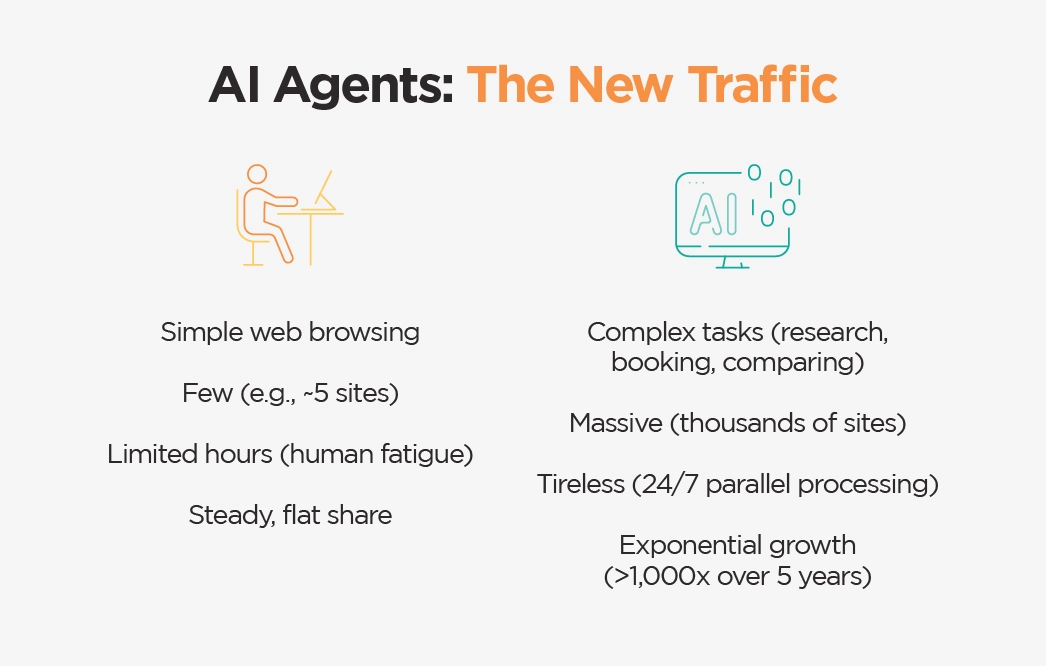
Prince framed the milestone plainly on the MAD Podcast. Agent traffic grew so fast that bots passed humans online for the first time in the internet’s history. He does not see it stabilising in the way pandemic-era traffic spiked and then levelled off. His projection is stark. Within about five years, automated traffic could be a thousand times greater than human traffic.
Why AI Agents Don’t Click Ads & Why Does That Matters?
Here’s the part that should concern anyone whose revenue touches digital advertising. The web’s economic engine for nearly three decades can be reduced to one sentence. People look at content, ads sit next to the content, and advertisers pay based on traffic. The whole system rests on a quiet assumption: that traffic is a proxy for humans because only humans buy things and only human attention is worth selling.
When 57% of traffic is not human, that equation breaks down. Bots do not click ads. When an AI agent compares products for you, it reads the specifications, the price, and the reviews. It simply ignores the “Buy Now” banner beside them. Its job is to extract information, not to be marketed to. That means the ad slot you’re monetising may be counting impressions that were never seen by a person who could act on them.
Put bluntly, advertisers are paying for 100% of traffic while a large share of page views comes from machines. That accounting will not stay hidden forever. The day a major advertiser insists on paying only for human traffic, the entire advertising market reprices, and many content sites that rely on advertising revenue will feel it immediately.
There’s a deeper shift beneath the money, too. Advertising ultimately buys attention. If an AI agent increasingly decides what you buy, watch, and subscribe to, human attention itself becomes a smaller, more contested resource. The banner was always a bet on a human being in the loop. Agents quietly remove the human from that loop.
How Publishers May Monetise AI Agent Traffic?
Prince does not pretend to have a tidy answer, but Cloudflare is openly exploring one: micropayments. The logic is simple. If a bot is genuinely using your content, not idly browsing but extracting information to make a decision, then the site that created that content arguably deserves to be paid for that use, not through an ad, but through a usage fee. Think of it as paying to call an API.
The idea is not new. People floated micropayments for the information superhighway back in the 1990s, but the conditions were not there. Transactions were too expensive, and there were too few users. Two things have changed. First, the cost of a transaction has fallen close to zero. Second, AI agents can natively handle tiny transactions such as “pay $0.003 to read this article”, something no human would process manually. Cloudflare has already shipped early moves in this direction, including a pay-per-crawl mechanism that lets publishers charge AI systems for access.
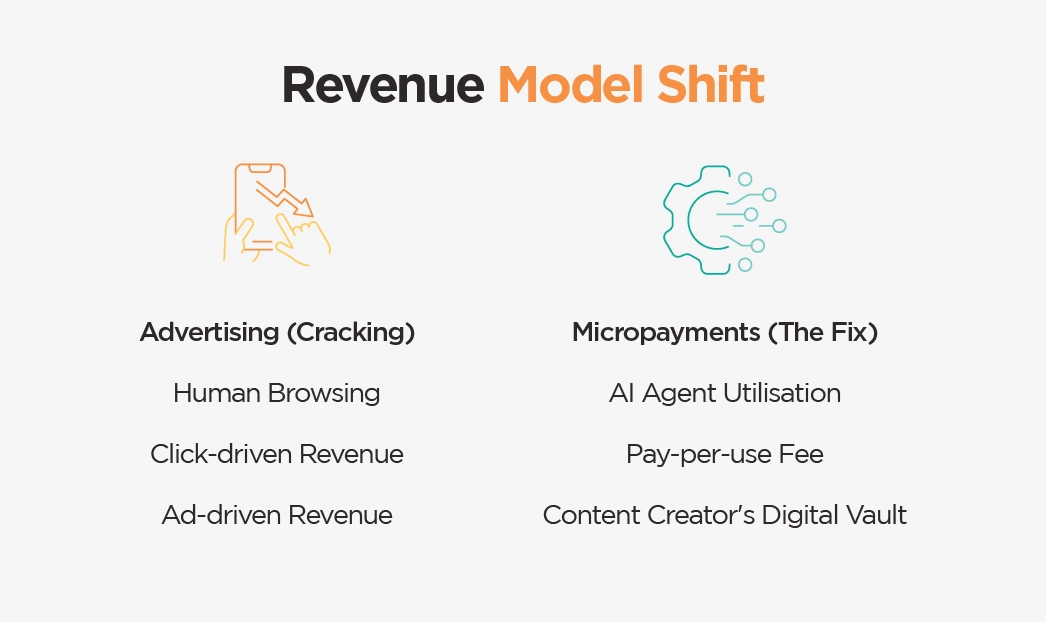
It’s worth being sceptical about the details. Who sets the price of a page? Who enforces the fee? What stops anyone from routing around it? These questions remain unanswered. But the direction of travel is the real signal. The maths the advertising model was built on is beginning to crack, and major infrastructure companies are already designing what comes next.
The Overlooked Story, An Internet Built For Machines
Beyond the money, there’s an infrastructure story that received less attention. Agent traffic behaves nothing like human traffic. A person opens a page, lingers for a few seconds, clicks a link, and moves on. An agent can open thousands of pages almost simultaneously, spending milliseconds on each. That is a completely different load profile. It’s the difference between one visitor flipping through books in a library and a machine scanning five thousand tables of contents at once. One is harmless. The other can bring the building down.
Cloudflare is building infrastructure specifically for this world, isolated, efficient sandboxes where agents can operate without overwhelming the origin sites they visit. The scale Prince describes is striking. Potentially millions of these environments could be spun up every second. Internally, the company is leaning fully into AI. A large majority of its team already uses AI tools every day, with full adoption as the goal.
Follow the trend line and a clear picture emerges. The internet is becoming less a place for people to talk to each other and more a medium for machines to exchange information, with humans increasingly at the edges rather than the centre.
How Businesses Should Prepare for an AI-First Web?
As AI agents become a primary way people discover products, services, and information, businesses need to optimise for more than traditional search rankings. Instead of focusing only on attracting clicks, brands must make their content easy for AI systems to understand, trust, and cite. The following strategies can help improve your visibility across both search engines and AI-powered platforms.
Build Authority That AI Can Trust
AI platforms are more likely to recommend information from brands that demonstrate genuine expertise and credibility. Publishing original research, sharing first-hand experience, earning high-quality backlinks, and maintaining accurate business information all strengthen your authority. The stronger your reputation across the web, the more confidence AI systems have in using your content as a source.
Structure Content for AI Extraction
AI doesn’t read a page the same way people do. It looks for information that is easy to identify and extract into a direct answer. Organise your content with descriptive headings, concise paragraphs, numbered steps, bullet lists, comparison tables, and FAQ sections. Answer important questions clearly near the beginning of each section so both users and AI systems can find the information quickly.
Implement Structured Data (Schema Markup)
Schema markup gives search engines and AI systems additional context about your website. It helps identify your business, content, services, and authors without relying solely on page text. For most business websites, Organization, Article, FAQPage, and Author schema provide a strong foundation for improving search visibility and increasing the likelihood of appearing in AI-generated answers.
Build Brand Mentions Beyond Your Website
AI systems evaluate information from multiple sources before recommending a brand. Earning mentions on reputable industry websites, news publications, business directories, and trusted third-party platforms helps reinforce your authority. Both linked and unlinked brand mentions contribute to a stronger digital presence and increase the chances of your business being recognised across AI search platforms.
Monitor Your Visibility Across AI Platforms
Ranking well on Google is no longer the only measure of online visibility. Businesses should regularly check whether their brand appears in responses generated by ChatGPT, Perplexity, Gemini, and Google AI Overviews. Tracking AI citations, brand mentions, and recommendation frequency provides valuable insight into how your business is being represented in the growing AI search ecosystem.
How AI Agents Change Customer Journeys?
For years, the online buying journey followed a predictable path. People searched on Google, visited several websites, compared their options, and then completed a purchase. AI-powered search is changing that behaviour.
Today, many customers receive recommendations, comparisons, and product summaries before they ever visit a website. In some cases, an AI assistant completes most of the research on the user’s behalf, reducing the number of websites they need to visit before making a decision.
| Traditional Customer Journey |
AI-Driven Customer Journey |
| Google Search
↓
Visit Multiple Websites
↓
Compare Products or Services
↓
Make a Purchase |
ChatGPT, Google AI, Perplexity, or Gemini
↓
AI Generates a Summary or Recommendation
↓
Customer Chooses a Preferred Brand
↓
Purchase Decision |
This shift means brands can influence purchasing decisions long before a website visit takes place. If your content is selected and cited by AI systems, your business can become part of the customer’s decision-making process even when traditional website traffic declines. As AI-powered search continues to evolve, success will depend not only on ranking in search results but also on becoming a trusted source that AI platforms consistently reference.
What This Actually Means For Your Brand?
If you work in marketing, ecommerce, or growth, the instinct is to see all this as a threat. It is more useful to see it as a relocation of the audience.
For 25 years, being findable meant ranking on a page of blue links that a human would scan. Increasingly, the first thing that reads your brand is a machine, an AI assistant summarising options, an agent shortlisting products, or a chatbot answering a buyer’s question before they ever reach your site. Those systems do not reward banners or pop-ups. They reward sources they can understand, trust and cite.
That is the entire premise behind Generative Engine Optimisation (GEO), engineering your content, data and technical setup so AI systems such as ChatGPT, Perplexity, Gemini and Google’s AI Answers surface your brand in their responses. In much the same way SEO made you legible to Google’s crawler, GEO makes you legible to the AI agent doing the buyer’s research.
There’s a local footnote worth noting for anyone operating in Southeast Asia. In Cloudflare’s country-level breakdown, Singapore is one of the most bot-heavy markets in the world, with automated traffic estimated at around three-quarters of the total. That is largely a function of the island’s concentration of data centres and hosting infrastructure. If you sell into this region, the machine-mediated web is not a future scenario. It is already your baseline.
The brands that succeed over the next decade won’t necessarily be those with the biggest advertising budgets. They’ll be the brands that AI systems can easily understand, trust, and reference in their responses.
If you’re ready to improve your visibility across AI search platforms and future-proof your digital presence, contact our team to discuss an AI SEO and GEO strategy tailored to your business.
Need a strong team specialised in SEO?
Speak to Verz today if you are looking to create a website with a
lasting impression to achieve online success.


 Share
Share