If you’ve run a Google search recently, you’ve probably noticed something new sitting above the regular blue links, a summary block that already has your answer before you’ve clicked on anything. That’s Google’s AI Overview, and it’s just one of the ways AI is rewriting the rules of search.
For Singapore businesses, this shift is real and it’s happening fast. A website that ranks well in traditional organic results doesn’t automatically show up in AI-generated answers. And a brand that isn’t visible in those AI summaries is increasingly invisible to the people who never scroll past the first AI block.
This is where AI SEO comes in. Not as a rebrand of keyword stuffing, not as a gimmick but as a genuinely different approach to search visibility that accounts for how people are actually searching in 2025 and beyond.
In this guide, we’ll break down what AI SEO actually is, what a real AI SEO agency in Singapore delivers, and how to evaluate whether you’re working with someone who understands the new landscape or one who’s just relabelled their old services.
What Is AI SEO?
AI SEO is the practice of optimising a website and its content to appear and be cited in AI-generated search experiences. This includes Google AI Overviews, Google AI Mode, ChatGPT search, Perplexity, Bing Copilot, Gemini, and any other AI-powered tool that pulls from the web to answer user queries.
It’s different from traditional SEO in an important way. Traditional SEO gets you ranking on page one of Google’s blue-link results. AI SEO gets your content extracted and referenced by AI systems that are summarising topics on behalf of users often without the user needing to click through to your site at all. There are two key terms you’ll come across in this space:
GEO (Generative Engine Optimisation)
Generative Engine Optimisation (GEO) is the discipline of optimising content so it gets cited by large language models (LLMs) and AI-powered answer engines. When someone asks ChatGPT or Perplexity ‘what’s a good web design agency in Singapore?’, which brands come up? GEO determines that. It’s about making your content machine-readable, citation-worthy, and attributable by AI systems.
AEO (Answer Engine Optimisation)
Answer Engine Optimisation (AEO) focuses on structured Q&A formats getting your content to surface in Google’s AI Overviews, People Also Ask boxes, and voice search responses. It requires content to be written in a way that directly and clearly answers specific questions, using precise, factual language that AI can extract and present.
So What Does “AI SEO” Mean in Practice?
AI SEO is the umbrella term for optimisation that covers both traditional Google rankings and AI-generated surfaces. A proper AI SEO strategy doesn’t abandon what already works, it extends it. You still need technical SEO and on-page SEO as the foundation, together with high-quality content and strong authority signals before AI-focused optimisation can deliver consistent results.
But you now also need:
- Content structured for AI passage extraction short, clear, answer-first paragraphs
- Schema markup that helps AI systems understand your entity, services, and location
- Entity clarity AI systems need to know precisely who you are and what you do
- Monitoring of AI citation presence across multiple platforms, not just Google rankings
- Brand authority signals that LLMs use when deciding whether to recommend you
Why AI Search Is Changing the Game for Singapore Businesses?
Let’s be clear about the scale of what’s happening. This isn’t a minor Google feature update. It’s a fundamental shift in how information is discovered online and it’s already affecting how Singapore businesses get found by their customers.
According to Semrush’s AI SEO Statistics report, Google AI Overviews now reach more than 2 billion monthly users across over 200 countries.
According to Previsible’s 2025 State of AI Discovery Report, ChatGPT accounted for 84.2% of AI referral traffic and expanded its referral volume by 3.26 times year over year, reinforcing its position as the leading platform for AI-powered content discovery.
According to Mary Meeker’s AI report, ChatGPT reached approximately 800 million weekly users by April 2025. Later, in September 2025, OpenAI reported that the platform had 700 million weekly active users.
What this means practically: your potential customers in Singapore are increasingly finding information through AI-generated answers before they ever reach your website. They’re asking ChatGPT for recommendations. They’re getting summaries from Google before clicking anything. They’re using Perplexity to compare their options. If your brand doesn’t appear in those AI-generated responses, you’re invisible to a fast-growing segment of high-intent searchers.
The CTR Reality Check
Organic click-through rates for position-one Google rankings have dropped significantly on queries that trigger AI Overviews. Multiple studies from Ahrefs, Seer Interactive, and Pew Research all point in the same direction. But there’s a crucial flip side:
As Google AI Overviews become more prominent, earning a citation can substantially improve organic visibility. Seer Interactive reported that pages cited within AI Overviews attracted roughly 120% more organic clicks per impression than uncited pages on comparable search results.
This is the core logic behind AI SEO: the goal isn’t to avoid AI search. The goal is to be the source that AI systems cite.
Google AI Overview Prevalence in Search Results 2025 to 2026
|
Jan 2025 (Global)
|
|
|
Jul 2025 (Peak)
|
|
|
Nov 2025 (Pullback)
|
|
|
Jan 2026 (US)
|
|
|
Mar 2026 (Commercial)
|
48% (commercial verticals)
|
What AI SEO Services Actually Cover?
This is where the confusion starts. Search for AI SEO services in Singapore and you’ll find a wide range of agencies claiming to offer them. Many are doing traditional SEO with AI tools, faster keyword research, AI-assisted content briefs, automated reporting. That’s useful, but it’s not the same as optimising for AI-generated search surfaces.
A genuine AI SEO service should cover the following:
AI Search Visibility Audit
An assessment of where your brand currently appears (or doesn’t) across ChatGPT, Perplexity, Google AI Overviews, and Gemini. This is the baseline before any other work begins.
|
Technical AI Readiness
Verifying that AI crawlers (GPTBot, ClaudeBot, PerplexityBot, Google-Extended) can access your content including robots.txt review, llms.txt setup, and JavaScript rendering checks.
|
Entity Clarity & Schema
Structuring your brand’s data so AI systems correctly identify who you are, what you offer, and where you’re located. Organisation, LocalBusiness, FAQPage, and Service schema are all critical here.
|
AI-Optimised Content Creation
Writing and restructuring content so it can be extracted and cited by AI systems’ answer-first structure, clear passage-level answers, factual language, and topic depth.
|
GEO (Generative Engine Optimisation)
Optimising for citation in LLM-powered platforms. Includes brand mention building on third-party sources, topical authority development, and content distribution strategy.
|
AEO (Answer Engine Optimisation)
Targeting People Also Ask, featured snippets, and Google AI Overviews through structured Q&A content and FAQPage schema.
|
AI Citation Monitoring
Tracking where your brand appears across AI platforms over time, not just Google rankings. Most traditional SEO dashboards don’t measure this at all.
|
Traditional SEO Foundation
Technical SEO, on-page optimisation, backlink building, and site speed are still essential, since most AI systems draw from sources that already have strong organic authority.
|
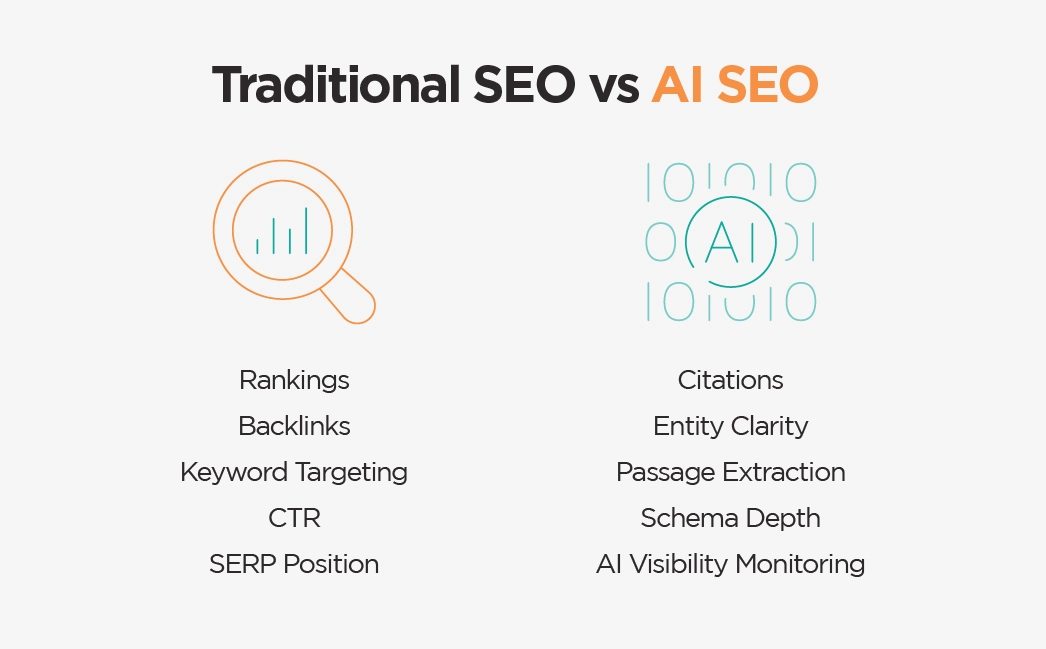
Traditional SEO vs AI SEO
| Criteria |
Traditional SEO |
AI SEO (GEO + AEO) |
| Primary Goal |
Rank in Google’s organic blue-link results |
Be cited in AI-generated answers across Google, ChatGPT, Perplexity, Gemini |
| Success Metric |
Rankings, organic traffic, CTR |
AI citations, brand mentions in LLM responses, AI-referred traffic |
| Content Strategy |
Keywords, density, length, freshness |
Passage extraction, answer-first writing, factual precision, topic depth |
| Technical Focus |
Crawlability, indexation, page speed, mobile |
AI crawler access, llms.txt, JavaScript rendering for LLMs, schema depth |
| Link Strategy |
Backlinks for domain authority |
Brand mentions (linked + unlinked) on authoritative third-party sources |
| Measurement Tools |
GSC, Ahrefs, SEMrush, rank trackers |
AI visibility trackers, LLM citation monitoring, share-of-recommendation tools |
| Foundation Needed |
Domain authority, site health, content quality |
All of the above PLUS AI extractability, entity clarity, and structured data depth |
Key insight: According to Authoritas’ research, AI Overviews frequently select sources beyond Google’s top 10 organic results, with around 40% of first-page webpages not appearing as AI citations. This reinforces the need to optimise content specifically for AI search, not just traditional SEO.
How Google AI Overviews Work And Why You Want To Be In Them?
Google AI Overviews are Gemini-powered summaries that appear at the top of search results for certain queries. They pull from multiple web sources, synthesise the information, and present it as a direct answer with citations linking back to source pages.
If your page is cited, your brand name and a link appear right at the top of the result above organic listings, above ads in many cases. If it isn’t cited, you’re competing for attention below a block that already answered the question.
What Triggers a Google AI Overview?
- Informational queries (‘how to’, ‘what is’, ‘why does’) were 91% of AIO triggers in early 2025, dropping to around 57% by late 2025 as Google expanded AI Overviews to more query types.
- Commercial queries (comparisons, ‘best X in Singapore’) grew to around 19% of AIO triggers by end of 2025.
- Queries with 8+ words are 7x more likely to trigger an AI Overview than short queries (WordStream, 2025).
- Navigational queries (brand searches) jumped from under 1% to over 10% of AIO triggers between January and November 2025.
What Gets Cited Inside a Google AI Overview?
BrightEdge research tracking 9 industries shows that 54.5% of AI Overview citations now come from pages that also rank organically, up from 32.3% 16 months earlier. But that means 45.5% of citations go to pages that don’t appear in the regular top 10.
Citation selection is influenced by:
Understanding how AI systems choose which content to cite can help businesses create content that is easier for Google AI Overviews, ChatGPT, and other AI platforms to reference confidently.
- Topical depth and expertise: does the page cover the topic comprehensively with clear authority signals?
- Passage-extractable content: can AI pull a clean, standalone answer from the text without surrounding context?
- Entity clarity: does Google’s AI understand who the author or brand is and why they’re credible on this topic?
- Schema markup: FAQPage, Article, and HowTo schemas have measurable impact on AIO citation eligibility.
- Third-party brand authority: independent mentions, reviews, and citations on external sites help AI systems validate your credibility.
What to Look for in an AI SEO Agency in Singapore
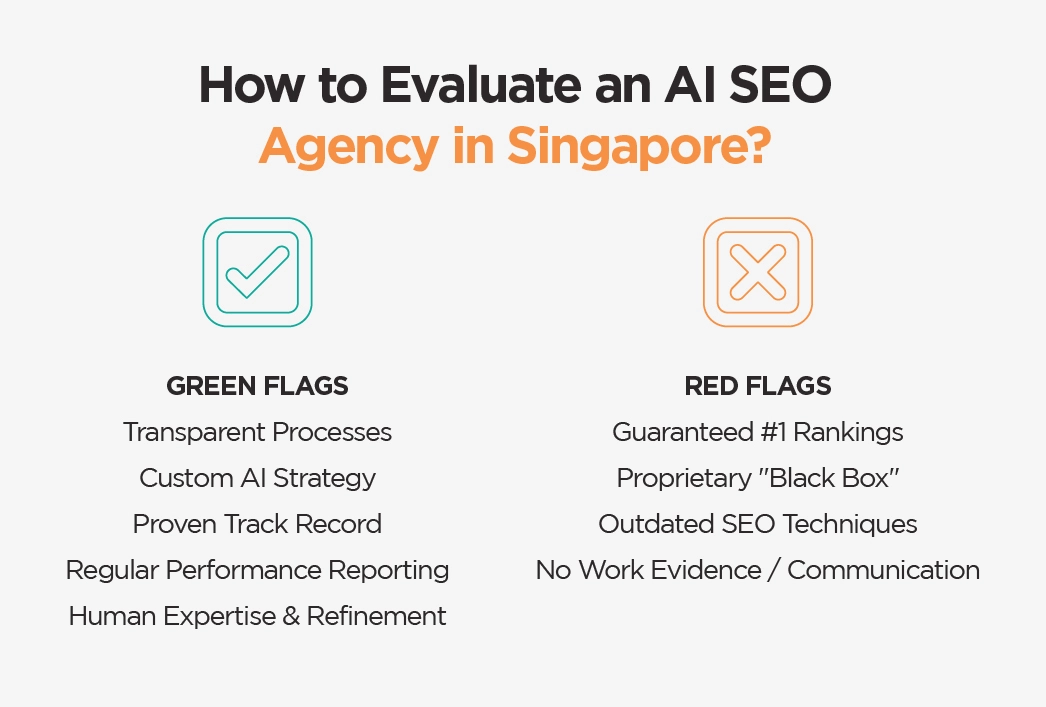
The term AI SEO agency is being applied loosely across Singapore right now. Some agencies have built genuine AI search optimisation capabilities. Many others have added AI SEO to their service page without meaningfully changing what they do.
Here’s how to tell the difference.
Signs You’re Looking at a Genuine AI SEO Agency
- They can show you cross-platform AI visibility data not just traditional rankings. Can they show where your brand currently appears in ChatGPT, Perplexity, Gemini, and Google AI Overviews? If the answer is no, they’re not measuring what matters.
- They understand the difference between GEO and AEO and can deliver both. These are distinct disciplines requiring different tactics. Conflating them is a sign they haven’t done the work.
- They talk about entity clarity, structured data depth, and content extractability the actual levers for AI citation not keyword density.
- They treat traditional SEO as a foundation, not an optional extra. AI systems still draw heavily from authoritative sites. An agency that abandons SEO fundamentals for AI-only tactics is equally misguided.
- They’re transparent about what’s proven and what’s experimental. The AI search landscape is still evolving rapidly. Agencies that claim certainty about everything should be treated with caution.
What AI SEO Can Realistically Achieve for Singapore Businesses?
A note on expectations: AI SEO is not an instant fix, and anyone who promises immediate guaranteed placement in AI results is oversimplifying. What AI SEO can achieve done properly, over time is genuinely significant.
| Timeline |
Traditional SEO Outcomes |
AI SEO Additions |
| Days 1–30 |
Technical fixes indexed, meta tag updates live |
AI crawlers unblocked, schema live, baseline AI visibility captured |
| Weeks 4–8 |
On-page signals improving, new content indexed |
Answer-optimised content published, FAQ schema live, early AI Overview appearances possible |
| Months 3–4 |
Target keyword rankings improving |
Brand mention presence growing, AI citation data showing early trends |
| Months 5–6+ |
Stable rankings, measurable organic traffic growth |
Consistent AI citation presence, brand appearing in LLM recommendations, AI-referred traffic measurable |
Singapore’s competitive landscape varies by industry. B2B technology, professional services, and healthcare sectors are seeing AI Overviews appear for up to 70% of their relevant queries (BrightEdge, 2026). For Singapore businesses in these verticals, the urgency to adapt is highest.
Ready to Get Your Brand Found in AI Search?
AI search isn’t a future trend; it’s already here, already affecting how Singapore businesses get found, and already separating brands that show up in AI-generated answers from those that don’t.
The good news is that this is an optimisation problem, and optimisation problems have solutions. A solid AI SEO strategy one that builds on strong foundations while adding the specific layers AI systems look for gives your brand a genuine shot at appearing where your competitors may not yet be.
The path forward isn’t complicated, but it does require doing the work properly: making sure AI crawlers can access your content, structuring that content so it can be extracted and cited, building your brand’s third-party authority, and tracking AI visibility over time so you know where you stand.
If you’re a Singapore business looking to build that kind of visibility across Google, ChatGPT, Perplexity, and whatever comes next, our AI SEO agency in Singapore helps businesses improve AI visibility through technical SEO, GEO, AEO, structured data, entity optimisation, and AI citation strategies. Contact us to discuss how we can help your business strengthen its presence across both traditional search and AI-powered search.
Need a strong team specialised in SEO?
Speak to Verz today if you are looking to create a website with a
lasting impression to achieve online success.


 Share
Share