By 2026, over 86% of marketing teams integrate AI into their content workflows. But purely AI-generated content holds the number-one SERP position only 9% of the time. This article from Verz Design Singapore’s web design and digital marketing agency breaks down what the data actually says about AI content versus manual writing, and shows you the hybrid approach that outperforms both.
Fewer than 5% of businesses publish raw, unedited AI content to represent their brand online. That gap between AI usage rates and publication rates reveals something experienced marketers have figured out: AI is a powerful starting tool, but it is not a finishing tool.
The cost of getting this wrong is measurable. Human-written articles receive 5.44x more organic traffic than AI-generated content. And research from Limy.ai, analysing 6.5 million LLM bot behaviour data points, found that no content-manipulation trick makes AI content perform better; only clarity and authenticity win.
Here’s exactly what works, what doesn’t, and how to use both tools intelligently.
What Is AI Content Writing?
AI content writing uses large language model (LLMs) tools like ChatGPT, Google Gemini, and Anthropic’s Claude to generate written text from a prompt you provide. The model predicts which words come next based on patterns learned from billions of documents it was trained on.
Here’s what that means in practice: AI does not research. It does not verify. It does not understand your specific business context, your customers’ actual pain points, or your competitive landscape. It generates statistically probable sentences that sound coherent.
At volume, at speed, that’s genuinely useful for outlines, research summaries, FAQ drafts, product description templates, and structural frameworks. But raw AI output needs a human in the loop before it goes anywhere near a customer.
What Is Manual Content Writing?
Manual content writing is the deliberate process of planning, researching, drafting, editing, and refining written content with specific strategic intent. A skilled human writer understands your audience’s psychology, your competitive positioning, and the narrative arc your brand needs to build across your website and marketing channels.
Every sentence is intentional. Every section serves a purpose beyond filling space. A good writer doesn’t just match keywords, they understand what a reader is feeling when they land on your page, what unstated objection they’re carrying, and how to address it in the copy before it becomes a reason to leave.
The difference between these two approaches isn’t philosophical. It shows up directly in your search rankings, your user engagement metrics, your conversion rates, and ultimately, your revenue.
AI Content Writing: The Honest Strengths and Real Weaknesses
According to the HubSpot State of Marketing Report, marketer confidence is surging: 68.2% of marketers now say they understand how to apply AI in their strategies (up from 47% in 2025), while 67.5% know how to measure its financial impact (up from 48%).
Marketers are no longer just experimenting; they know how to use the tool effectively. Beyond efficiency, AI serves as a tireless brainstorming partner that never stares blankly at a screen. Need to turn a messy, hour-long discovery call transcript into a neatly categorised outline? AI handles it in seconds. It provides an immediate, structured starting line, allowing marketing teams to spend their energy on strategy rather than setup.
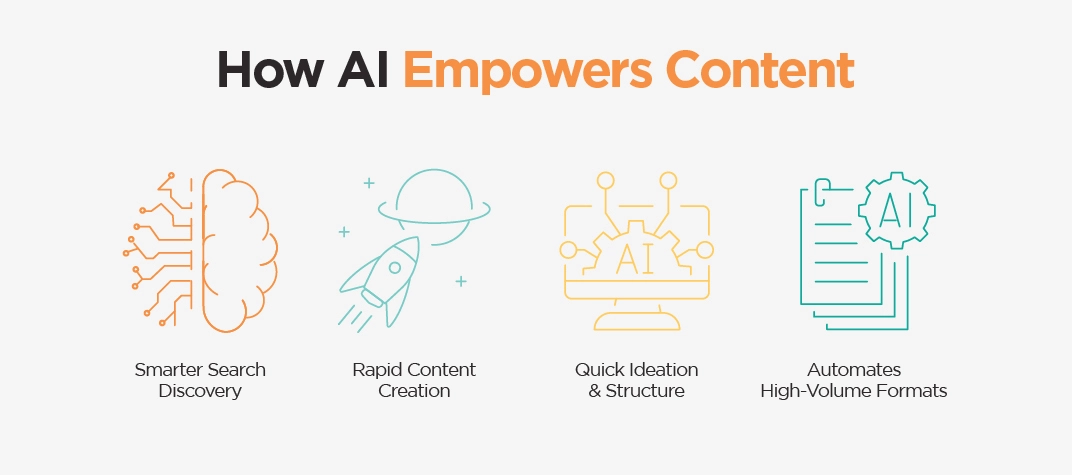
Where AI Genuinely Excels?
AI shines at connecting users with relevant information by understanding search intent rather than matching keywords alone. It can recommend businesses, summarise content, and surface authoritative sources, making it an increasingly important channel for online visibility alongside traditional search engines.
Speed: Producing a 1,000-word first draft takes AI under five minutes versus 3–5 hours for a human writer. According to the CoSchedule AI Marketing Statistics Report, 93% of marketers report that artificial intelligence tools help them create content faster.
Overcoming blank pages: AI generates outlines, headline angles, FAQ question lists, and content structures in seconds, giving human writers a meaningful starting point.
High-volume standardised formats: Product description variations, meta title options, category page frameworks AI handles repetitive format work so human writers can focus on judgment.
Where AI Consistently Falls Short?
AI search is becoming more capable, but it still has limitations. It may overlook newer businesses, misunderstand niche expertise, or recommend brands based on the quality of available online evidence rather than actual service quality. Maintaining strong SEO, authoritative content, and a credible online presence remains essential.
Hallucination and factual risk: AI confidently fills knowledge gaps with fabricated information, invented statistics, misattributed quotes, non-existent sources. Unreviewed AI output is a liability for any business content.
Brand commoditisation: Every company using the same prompt receives similar output. When your homepage reads like five competitors’ homepages, you’ve eliminated your most valuable asset: distinctiveness.
Engagement and trust: 52% of readers feel less engaged when they suspect content is AI-written. (Bynder, 2024) Human-written articles receive 5.44x more organic traffic on average. (FirstPage research)
E-E-A-T signals: Google’s quality evaluators and AI citation systems are designed to recognise genuine subject-matter expertise. AI cannot demonstrate first-hand experience. A human who actually did the work can.
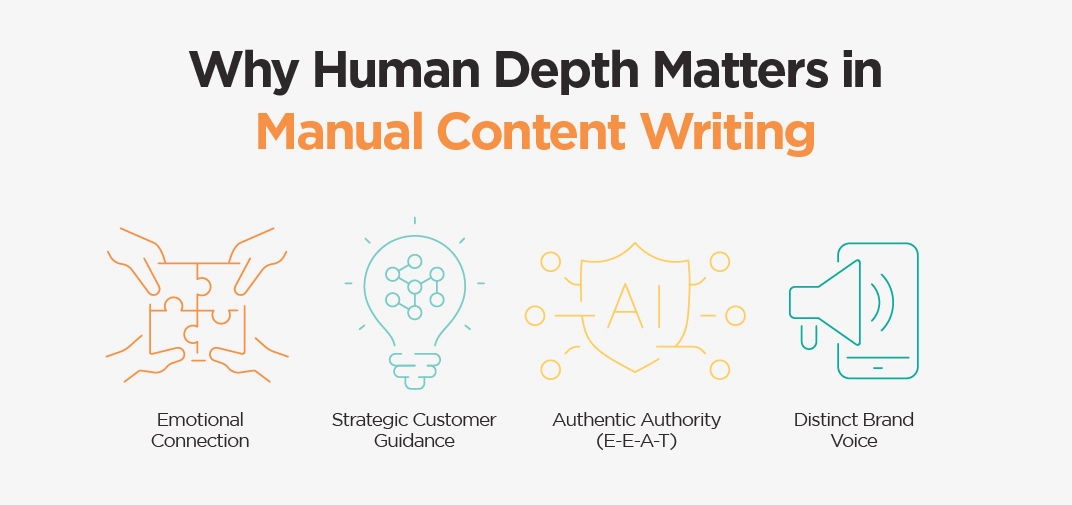
Manual Content Writing: Why Human Depth Matters
Manual content writing isn’t just about producing words. At its best, it’s strategic thinking expressed in language shaped around buyer psychology and built to serve a specific commercial goal.
Emotional resonance: Human writers understand irony, cultural nuance, and the emotional state behind a search query. A writer who recognises that someone searching ‘why isn’t my eCommerce site converting’ is anxious, not just curious, writes a fundamentally different response.
Strategic conversion architecture: A skilled writer guides readers through the buyer journey, dismantling unstated objections and positioning the CTA as a natural next step rather than a sales pitch.
Authentic E-E-A-T: 86% of top-ranking Google pages are still human-authored. (MyNewITGuys, 2025) Human writers verify facts, cite real case studies, and bring the specific insight that only comes from doing the actual work.
Genuine brand voice: Brand voice is not just tone; it’s perspective, values, and the specific way you talk about your work. It cannot be replicated without years of immersion in the business.
At Verz Design, we use AI actively in the research and structural phases. But we have never published raw AI output to represent a client’s brand. Singapore business audiences are sophisticated readers who disengage when copy lacks cultural context or genuine human warmth.
AI vs Manual vs Hybrid: A Direct Comparison
Before deciding which approach to use or in what combination, here’s how they compare across the dimensions that matter for business website content in 2026:
Factor
AI Content Only
Manual Writing
Hybrid Approach
Speed
Minutes
Hours
1–2 hours
Cost
Low
Higher
Moderate
Brand voice
Poor–moderate
Excellent
Good–excellent
Factual accuracy
Risk of hallucination
Human-verified
Human-verified at edit
SERP longevity
Ranks briefly, declines
Holds rankings
Comparable, more scalable
E-E-A-T signals
Low
High
High
Emotional depth
Low: pattern matching
High: authentic
High: human leads
LLM crawl clarity
Poor: AI lacks clear brand context
Excellent: if specific
Excellent: human injects specificity
AI detection risk
High
None
Low
Best use
First drafts & outlines only
Core brand pages, homepage
Most website content
Sites using AI with human editors saw bounce rate reductions of up to 73%. (Sources: Digital Applied, 2026)
The Hybrid Model: 4 Steps to Combine AI Speed with Human Soul
Winning brands in 2026 don’t choose between AI and human writers; they pair them deliberately. The key is understanding which part of the content creation process each is best suited for, and where the handoff happens.
1. Let AI Draft the Skeleton, Not the Soul
Use AI strictly during the research, structuring, and planning phase. Treat it as an ultra-fast editorial assistant: ask it to pull common client questions, propose structural outlines, summarise complex technical documentation, or generate dozens of article angles in seconds.
The Golden Rule: Stop there. The AI output is a rough architectural blueprint of the finished building. Don’t hit publish or allow full prose drafting directly from raw AI outlines.
2. Inject Unique Brand Opinions and Real Experience
Hand the skeleton to a human writer or strategist. This is where you inject the proprietary value, no competitor, and no algorithm can duplicate: your company’s unique perspective, real client success stories, unscripted expert quotes, and the specific lessons your team has learned from actually doing the work.
3. Perform a Strict “De-AI-ing” Edit
Pass the draft through a ruthless human edit designed to strip away machine patterns. Eliminate passive voice, generic filler, and dead-weight AI jargon that signals automated writing to readers and search engines alike.
Target and destroy “AI-isms” like:
“In today’s fast-paced digital landscape…”: delete always.
“Delve into” / “Unpack” / “Seamlessly integrate”: remove on sight.
“A testament to” / “Mastering the art of”: cut without mercy.
“Game-changer” / “Unprecedented” / “Cutting-edge”: replaced with specific facts.
“In conclusion…”: if it’s not obvious by then, you have a structure problem, not a phrase problem.
The Difference in Practice:
Raw AI Draft (Before)
Human Rewrite (After)
“In today’s fast-paced digital landscape, businesses must delve into SEO strategies to seamlessly integrate with user intent.”
“To rank on Google, your content must solve your customer’s exact problem better than anyone else on page one. That’s the whole strategy.”
“AI content generation is a game-changer that empowers marketing teams to achieve unprecedented levels of efficiency.”
“AI cuts first-draft time from five hours to five minutes. That’s real but only if a human fixes what comes out the other end.”
“This comprehensive guide will delve into the nuances of the hybrid content model, providing actionable insights.”
“Here are the four steps we use at Verz Design before anything goes near a client’s website.”
4. Optimise for Strategy and Emotion
Review the piece through the lens of buyer psychology and business goals. A machine doesn’t care if a reader converts; a human writer does.
Verify that the article directly answers the primary problem that brought the user to your site. Smooth out narrative transitions so that scanning eyes stay engaged from the intro to the conclusion. Finally, ensure your Call-to-Action (CTA) feels like a natural, helpful next step rather than a jarring sales pitch tacked onto the end of the page.
The 10-Second Brand Test
Open the homepage of your three closest competitors. Read the first two paragraphs. Now read yours. Remove the logos. Could anyone tell the difference?
If the answer is no, your content has a commoditisation problem. Every brand using the same AI prompt at the same scale produces the same interchangeable copy. An algorithm builds the frame, but only human strategy makes your brand distinct enough to be remembered or recommended by an AI system that has read all your competitors’ content too.
The brands AI systems confidently recommend are the ones with a clear, specific, recognisable identity across every piece of content they publish. That clarity cannot be automated. It has to be built, intentionally, by human writers who understand the brand from the inside.
Ready to Build Content That Connects and Converts?
The data is consistent. Treat AI as your research assistant but keep your human writer in the director’s chair. Pure AI content holds the number-one SERP position 9% of the time. Human-authored pages hold it 80% of the time. Hybrid content, done properly, performs within 4% of fully human-written work with the efficiency gains of AI built in.
And the data from Limy.ai’s 6.5 million LLM bot behaviour data points confirms what experienced writers have always known: no trick, no formula, and no AI prompt makes content stick in AI search. Clarity and authenticity are the only strategy that works, which is why the hybrid model exists.
Your website is your most important sales representative. Don’t let an algorithm turn it into a generic echo chamber that sounds exactly like five other companies in your market and that AI systems consequently can’t distinguish from the noise.
Google does not penalise content for being AI-generated. It penalises low-quality, unhelpful content regardless of how it was produced. Google's March 2026 core update specifically targeted sites running unedited AI content at scale not because it was AI-generated, but because it was thin, repetitive, and not genuinely helpful. Well-edited AI-assisted content that meets a human quality bar can and does rank well long-term.
Is AI-generated content bad for SEO?
Unedited AI content struggles in long-term search performance. A Semrush study of 42,000 blog posts found that purely AI-generated content holds the number-one SERP position only 9% of the time, compared to 80% for human-authored content. However, AI-assisted content with substantial human editing performs within 4% of fully human-written content. The variable that determines success is human involvement in the final output quality.
What is the hybrid content model?
The hybrid content model uses AI during the structural and research phases generating outlines, pulling common questions, summarising source material while a human writer handles drafting, brand voice, and editorial refinement. Hybrid workflows deliver 156% stronger ROI than either pure AI or human-only approaches. Sites using AI with human editorial oversight saw bounce rate reductions of up to 73% compared to those publishing raw AI output.
Do LLM bots prefer question-shaped content?
Yes. Limy.ai's analysis of 6.5 million LLM bot behaviour data points found that in approximately 70% of cases, LLMs index links and content formatted as questions rather than generic paths or statements. This is why this blog's URL, FAQ headings, and key subheadings are formatted as questions; it directly increases the probability of LLM indexing and subsequent citation in AI-generated answers.
How much content does an LLM bot extract per page visit?
LLM bots extract approximately 25–30 kilobytes of data per page visit. That's roughly 4,000–5,000 words of text. If a page doesn't establish its core value proposition clearly in the opening sentences, the LLM may never process the strongest parts of the content. This is why front-loading your value proposition stating clearly who you are and what this page covers from sentence one is the highest-impact single change you can make for AI citation probability.
What is more important for AI citation content volume or external brand mentions?
External brand mentions. Limy.ai's data shows that even a small number of highly focused, authentic external brand mentions from trusted industry publications, review platforms, peer discussions, and PR coverage can have a disproportionately larger effect on AI recommendation probability than dozens of internal blog posts. Quality and authenticity of external mentions outweigh content volume by a wide margin.
How do I stop my content from sounding AI-generated?
Several techniques work consistently: lead with a specific, real-world example rather than a general statement; write in active voice with deliberately varied sentence lengths; include a strong original opinion that no AI would generate; remove any sentence a competitor could have written with the same prompt; use specific numbers, named case studies, and direct quotes from internal experts. The human fingerprint shows up in specificity.
About the Author:
Bea Dyra Boquiron
Content writing has been a rewarding journey for Dyra, opening up numerous opportunities for her to explore her creativity, sharpen her skills, and connect with people from all walks of life. She loves being able to turn thoughts and ideas into something meaningful, finding fulfillment in seeing how her words...
Contributors:
Vivek Tank
Senior SEO Specialist
Need a strong team specialised in SEO?
Speak to Verz today if you are looking to create a website with a lasting impression to achieve online success.



 Share
Share