Every few years, something comes along that sounds technical and obscure until suddenly it’s standard practice. Remember when having a sitemap was optional? Or when mobile-responsive design was a nice-to-have?
llms.txt might be that file. Most Singapore business owners have never heard of it. And yet the companies that build the AI tools your customers are increasingly using Anthropic (makers of Claude), Stripe, Cloudflare, Perplexity, Vercel already have one. Shopify quietly added it to every single store on its platform in April and May 2026, without even telling merchants.
This article explains what llms.txt is, what it does and what it doesn’t do (we’ll be straight about that), and why it’s worth 30 minutes of your time to add it to your Singapore business website now rather than later.
What Is llms.txt?
The simplest way to explain it: llms.txt is a short text file that sits at the root of your website yoursite.com/llms.txt and gives AI systems a clean, structured summary of what your business does and where to find your most important pages.
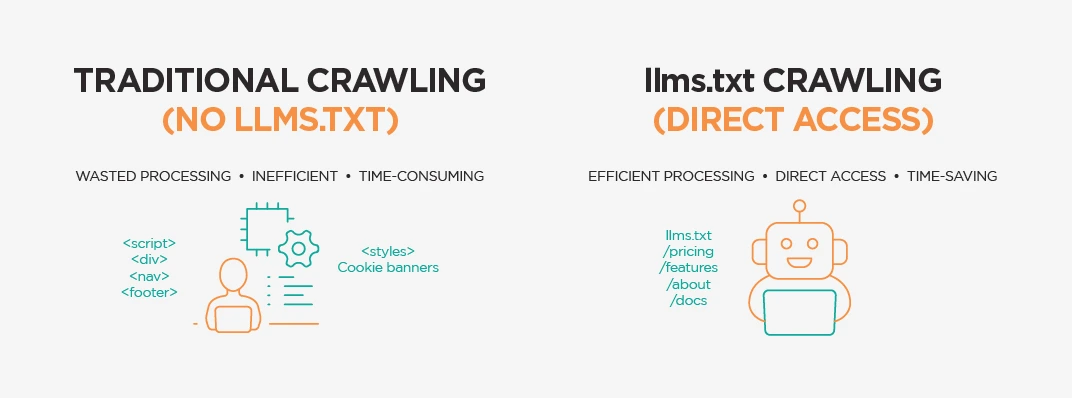
Think of it as a cheat sheet you leave at the front door for any AI system that comes visiting. Instead of an AI having to wade through your navigation menus, cookie banners, JavaScript pop-ups, and promotional widgets just to figure out what your business does, it can read your llms.txt first and immediately understand: here’s who we are, here are our main services, here’s how to get in touch.
The file is written in Markdown, a simple, lightweight text format that AI systems find easy to read and process. It contains links to your key pages, a brief description of each, and a short summary of your business at the top.
llms.txt was proposed by Jeremy Howard, co-founder of FastAI and founder of Answer.AI, on September 3, 2024. The thinking behind it was straightforward: modern websites are built for human experience visual design, animations, JavaScript interactivity. AI systems have to process all of that underlying code just to extract the actual content, which wastes their processing capacity and often causes them to miss important information in the noise.
Three Files Every Website Has (Or Should Have)
Before going deeper, it helps to understand how llms.txt sits alongside two files you may already know about:
| File |
What It Does |
Who It’s For |
| robots.txt |
Tells search engine crawlers which pages they’re allowed to access. It’s an access control file that says yes or no to certain bots. Has been a web standard for decades. |
Search engine crawlers (Googlebot, Bingbot, etc.) and AI crawlers (GPTBot, ClaudeBot) |
| sitemap.xml |
Lists all the indexable URLs on your site, a comprehensive directory that helps search engines find and crawl every page. It aims for completeness, not curation. |
Search engines primarily. Helps ensure every page gets found and indexed. |
| llms.txt |
A curated, human-readable summary of your most important pages and content. Not a list of everything, a carefully chosen selection with descriptions of what each page covers. |
AI language models, AI agents, and developer tools that fetch your site’s content |
Notice the key difference: A sitemap lists everything. llms.txt lists the things that matter most. A good llms.txt is an editorial decision, not an automated export. Someone has thought about what an AI system should know about the business and presented it clearly.
What an llms.txt File Actually Looks Like?
Here’s a real example of what an llms.txt file might look like for a Singapore web design company. Every line you see is plain text. No code, no HTML, no styling. Just structured information.
Example: llms.txt for a Singapore Web Design Agency
# Verz Design

> Verz Design is an award-winning web design and digital marketing company
> based in Singapore, founded in 2009. We have built over 5,000 websites for
> Singapore businesses and regional brands across eCommerce, corporate, and
> digital marketing.

## Core Services

- [Corporate Website Design](https://www.verzdesign.com/corporate-website-design)
  Custom professional websites for Singapore SMEs and enterprises
- [eCommerce Website Design](https://www.verzdesign.com/ecommerce-website-design)
  Shopify and Shopify Plus online stores for Singapore and regional markets
- [SEO Services Singapore](https://www.verzdesign.com/seo)
  Search engine optimisation for Singapore businesses, including AI Overviews
- [Generative Engine Optimisation (GEO)](https://www.verzdesign.com/generative-engine-optimisation)
  Visibility in ChatGPT, Perplexity, Google AI Overviews, and Bing Copilot
- [Digital Marketing Singapore](https://www.verzdesign.com/digital-marketing)
  SEM, social media marketing, and email marketing services

## About

- [About Verz Design](https://www.verzdesign.com/about-verz)
  Company history, team, awards, and 15+ year milestones
- [Our Work](https://www.verzdesign.com/our-work)
  Case studies and portfolio across eCommerce, corporate, and digital marketing
- [Client Testimonials](https://www.verzdesign.com/our-clients/clients-testimonials)
  Reviews from Singapore businesses and regional clients

## Optional

- [Blog](https://www.verzdesign.com/blog)
  Guides on SEO, web design, GEO, and digital marketing for Singapore businesses
---
Contact: enquiry@verzdesign.com | +65 6841 1680
Address: 56 Kallang Pudding Road, #07-05/06, Singapore 349328
Notice what’s not in there: every single page on the site. A good llms.txt is curated, not comprehensive. Think of it as your business’s elevator pitch to any AI system concise, structured, and pointing only to what matters most. Twenty to fifty links is ideal. More than that and you’ve defeated the purpose.
What llms.txt Does (and Doesn’t Do)?
A lot of content about llms.txt glosses over an important reality. Let’s be direct about it. As of mid-2026, no major AI platform Google, OpenAI, Anthropic, or Meta has publicly confirmed that they read or act on llms.txt when deciding which brands to cite in their AI-generated results.
During Google’s Search Central Deep Dive in July 2025, Gary Illyes confirmed that Google does not support llms.txt and has no plans to adopt it, a statement documented by Kenichi Suzuki on LinkedIn. John Mueller has similarly compared llms.txt to the obsolete meta keywords tag, reinforcing Google’s position that standard SEO practices remain the recommended approach for AI Overviews.
A 300,000-domain study by SE Ranking (November 2025) found no measurable difference in AI citation rates between sites that had llms.txt and those that didn’t. An XGBoost model trained on AI-citation data actually performed better when the llms.txt variable was removed meaning the file added noise rather than signal.
According to Limy.ai analysis,Across 500M+ AI bot visits monitored over 90 days, only 408 directly targeted /llms.txta negligible share of total AI crawler traffic for search purposes.
So why are we recommending it? Because the value of llms.txt isn’t primarily about today’s AI search citations. It’s about what AI is becoming and how fast it’s getting there. And there’s one area where llms.txt already delivers clear, measurable value today.
The Real Reason It Matters: The Agentic Web
The conversation about llms.txt tends to focus on AI search getting cited in ChatGPT answers or Google AI Overviews. That’s not where llms.txt currently delivers its clearest value.
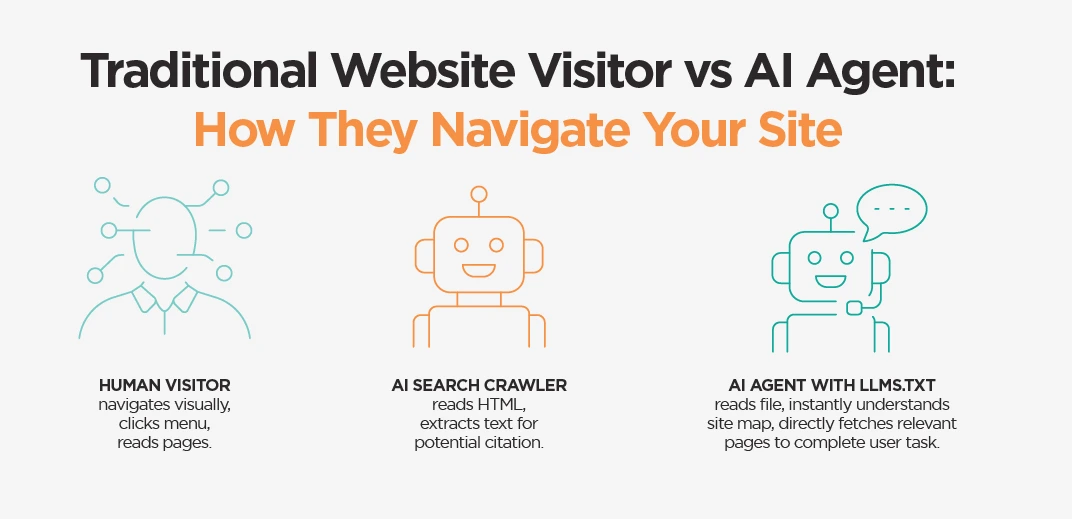
Where it genuinely helps is in what’s called the agentic web: AI systems that don’t just answer questions but actually take actions on behalf of users. They browse websites, compare pricing, fill out enquiry forms, book appointments, and retrieve detailed information all autonomously, on behalf of a user who has delegated the task to an AI.
Think of it this way: a customer asks their AI assistant to research the best web design agencies in Singapore, compare their services and pricing, and shortlist three to contact. The AI agent visits websites to do this research. When it lands on a site with no llms.txt, it has to parse menus, HTML code, pop-ups, and cookie banners to piece together what the business does. When it lands on a site with a clear llms.txt, it can understand the business’s structure and most important pages in seconds.
These agents include tools like Cursor, Claude Code, GitHub Copilot, Windsurf, and increasingly autonomous shopping and research assistants actively fetch /llms.txt when they visit a site. It’s how they orient themselves before deciding what to fetch next.
The agentic use case is already the dominant reason the most technically-sophisticated companies in the world have implemented llms.txt. It’s the direction AI is heading and llms.txt is the cheapest, fastest piece of agent-readable infrastructure a business can publish.
Who’s Already Using llms.txt?
The companies that have implemented llms.txt are telling us something worth paying attention to. These are not speculative startups hedging bets; they are some of the world’s most technically-informed organisations.
Anthropic
Maker of Claude. Has llms.txt on its developer documentation site, the one that AI coding tools actively read.
|
Stripe
Global payment infrastructure used by millions of businesses. Implemented llms.txt for their developer docs.
|
Cloudflare
Internet security and CDN provider. Has llms.txt in place on their developer platform.
|
Vercel
Web deployment platform used by developers worldwide. Early adopter of the standard.
|
Perplexity
AI search engine. Has llms.txt on their developer documentation an AI platform preparing for AI agents.
|
McDonald’s
One of the world’s largest consumer brands. Confirmed llms.txt adopter (top 1,000 globally).
|
Adobe
Enterprise software and design tools company. Has llms.txt in the top 1,000 global sites.
|
Cleveland Clinic
Major US healthcare providers demonstrate that non-tech businesses see the value.
|
The Shopify Story: The Signal You Shouldn’t Ignore
In April and May 2026, Shopify quietly rolled out /llms.txt, /llms-full.txt, /agents.md, and several other AI agent-facing files to every store on its platform. As highlighted in Craftshift’s analysis, the rollout happened automatically, without an opt-in process or a formal public announcement. As a result, every Shopify merchant now has these files enabled by default.
Shopify didn’t do this on a whim. They run 4.6 million stores and employ some of the best-resourced engineers in eCommerce. When a platform of that scale quietly rolls out a file type to every store on its network, it’s making a calculated bet about where the web is going. As a result, 78.1% of Shopify-powered sites in the top 10,000 websites now have a valid llms.txt file, the highest adoption rate of any major platform by a wide margin.
llms.txt Adoption by CMS/Platform Top 10,000 Websites (June 2026)
| Shopify (platform rollout) |
78.1% auto-deployed to all stores
|
| Contentful (enterprise CMS) |
|
| Adobe Experience Manager |
|
| WordPress |
8.7% organic human adoption
|
| All websites (top 10,000) |
5.61% (5.4x growth from July 2025)
|
| Drupal |
|
How to Create an llms.txt for Your Singapore Website?
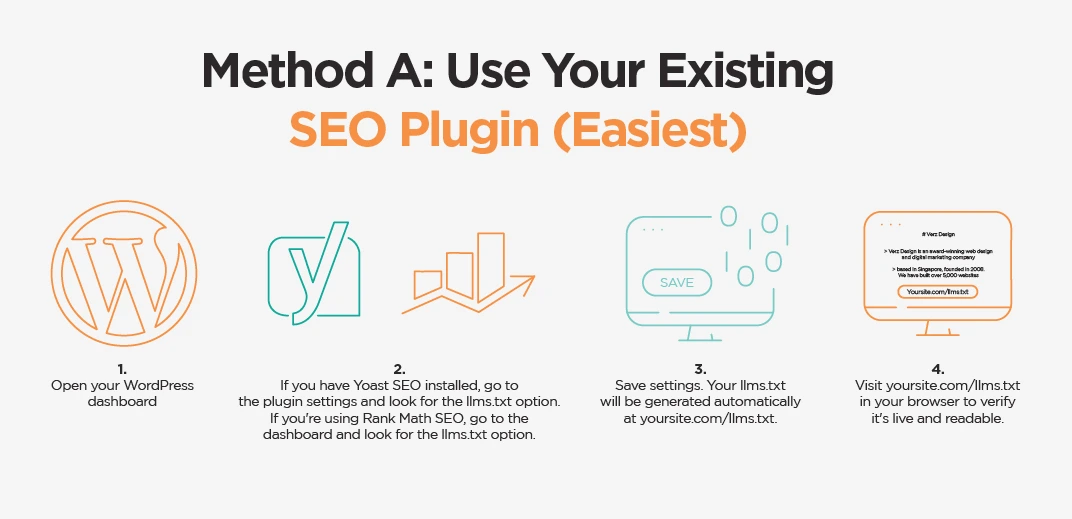
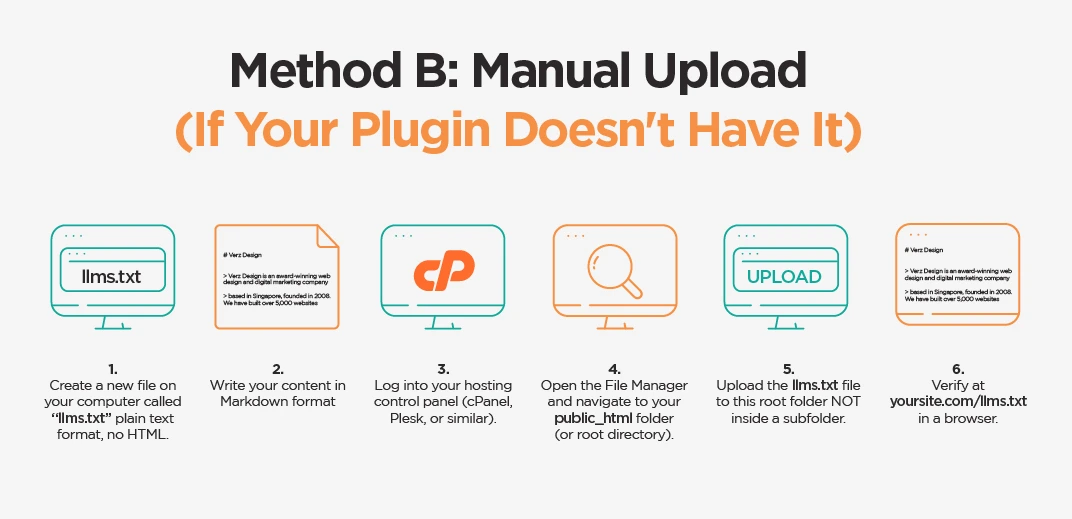
Creating an llms.txt file doesn’t require a developer. For most Singapore businesses, it’s a 20–30 minute task. Here’s how to do it on the three most common platforms.
Option 1: WordPress (Most Common in Singapore)
Option 2: Shopify (Already Done But Review It)
If you’re running a Shopify store, llms.txt was automatically added to your site in April/May 2026 as part of Shopify’s platform-wide rollout. Visit yourdomain.com/llms.txt to see what was generated.
The auto-generated version is functional but generic. We recommend reviewing it and asking your developer to customise it, especially the site description (the blockquote at the top) and the section descriptions for your collections, policies, and key pages. A customised file tells a much clearer story about your brand than the default output.
Option 3: Custom-Built Websites
If your Singapore website was custom-built, ask your web developer to create a plain text file at /llms.txt in the root directory. It should be served as text/plain with UTF-8 encoding. Most developers can do this in under 30 minutes.
Alternatively, if your site uses a Node.js or PHP backend, the file can be served dynamically via a controller useful if you want to auto-update it when you add new service pages.
Verification tip: After creating your llms.txt, visit yoursite.com/llms.txt in a browser. You should see plain text with Markdown formatting headings (# and ##), links, and descriptions. If you see an HTML page or get a 404 error, the file isn’t being served correctly. Ask your developer to check the root directory placement and server configuration.
Do’s and Don’ts for llms.txt
Writing a good llms.txt isn’t hard, but there are mistakes that reduce its value. Here’s what works and what to avoid:
| Do |
|
Don’t |
| Keep it to 20–50 links. Curation is the whole point. |
|
List every page on your site. That’s what your sitemap is for. |
Write descriptions that explain what each page is about:
“Our pricing for Singapore eCommerce websites (3 tiers)”. |
|
Write keyword-stuffed descriptions:
“Affordable web design services Singapore 2026 best price”. |
| Group pages logically: Services, About, Case Studies, Blog, Contact. |
|
Dump all links in one flat, unorganised list. |
| Use a clear 1–3 sentence description of your business in the blockquote at the top |
|
Skip the site summary. Without it, AI has no context for interpreting your links. |
| Update quarterly or when you launch major new service pages |
|
Set it and forget it. A link to a deleted or moved page damages your credibility with AI systems. |
| Include factual, plain-language descriptions: who you are, where you’re based, what you do |
|
Include promotional language: “Singapore’s #1 best-rated agency” (unverifiable claims confuse AI systems). |
| Use the correct format: # for site name, > for description, ## for sections, – for links |
|
Create an llms.txt that’s actually an HTML file renamed to plain text. |
| Verify the file is accessible at yoursite.com/llms.txt and returns a 200 HTTP status |
|
Assume it’s working without checking. Wrong paths and server misconfigs are common. |
Why Singapore Businesses Should Move Now?
Most of your Singapore competitors don’t have an llms.txt file. That’s exactly the reason to add one now rather than wait. Singapore’s digital landscape is moving quickly. We’re already seeing local businesses get discovered through AI tools users asking ChatGPT for service recommendations, potential clients using Perplexity to compare providers, procurement teams using AI agents to research vendor options before making contact. This is the reality of B2B discovery in 2026.
According to the SE Ranking AI Traffic Research Study, AI-generated referral traffic accounted for 0.32% of total website visits in 2026, compared with 0.24% in 2025 and just 0.02% in 2024. While AI referrals still represent a relatively small share of overall traffic, they have grown 16-fold in under two years, highlighting the rapid adoption of AI-powered search platforms.
llms.txt is not a magic solution that will suddenly put your brand in AI-generated answers tomorrow. What it does is ensure that any AI system that visits your website today or in the future finds a clear, structured, accurate representation of your business. That costs 30 minutes. The alternative is paying that cost later under more competitive conditions.
Conclusion
llms.txt isn’t going to transform your AI search rankings overnight. Anyone who tells you otherwise is overstating what the current evidence supports. Google doesn’t use it. The major AI platforms haven’t confirmed they do either.
But here’s what we know: the companies building the AI tools your customers use have already implemented it. The world’s largest eCommerce platform added it to every store without telling merchants. Adoption in the top 10,000 websites has grown 5.4x in twelve months. And AI agents which do actively read these files when they visit websites to complete tasks on behalf of users are an increasingly real part of how businesses get discovered.
The case for having an llms.txt file isn’t built on search ranking theory. It’s built on the observation that the smartest, most technically-informed companies in the world have already decided it’s worth having. The cost is 30 minutes. The downside of not having one grows slightly every month as the agentic web becomes more real.
For Singapore businesses, the window to be among the early adopters is still open. It takes 30 minutes. Add the file. Then spend your energy on the things that drive AI visibility today: well-structured content, schema markup, entity clarity, and topical authority. If you need help with any of that, Verz Design’s GEO service covers the full picture. Work with our team to future-proof your online visibility in the age of AI search.
Need a strong team specialised in SEO?
Speak to Verz today if you are looking to create a website with a
lasting impression to achieve online success.



 Share
Share