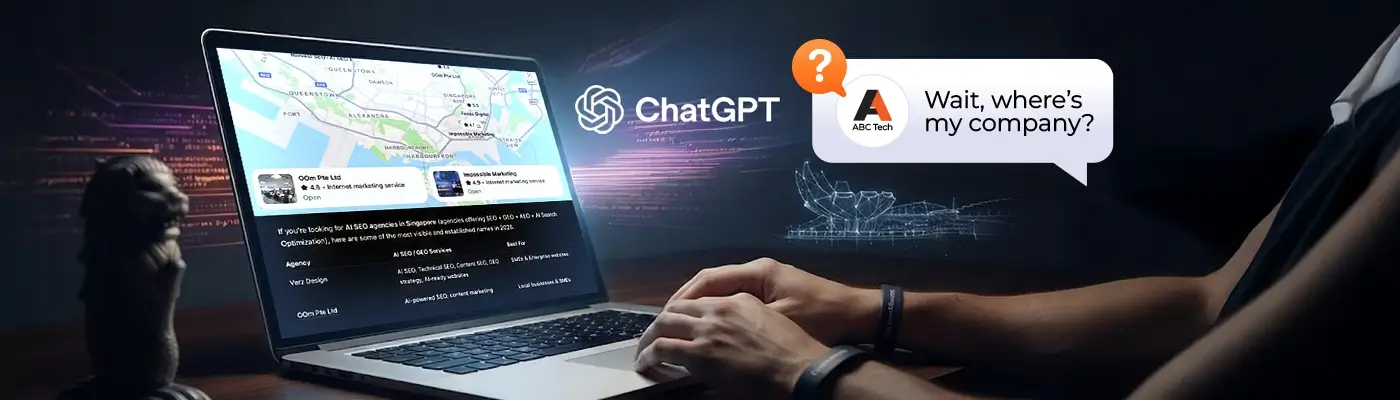
You open ChatGPT, type something like: ‘What are the best web design companies in Singapore?’ and you watch a list of your competitors appear. Professionally described. Confidently recommended. Your company isn’t mentioned once.
You try Perplexity. Same result. Google AI Overviews. Same result. As AI-powered search continues to evolve, businesses should also understand the best AI tools for SEO and how they influence content creation, optimisation, and search visibility.
This isn’t a glitch. It’s not because your competitors paid for placement. And it’s not arbitrary. There are specific, identifiable reasons why ChatGPT recommends some brands and not others, and almost all of them are fixable.
In this guide, we’ll explain exactly how ChatGPT decides which brands to mention, why your competitors are probably ahead of you right now, and the step-by-step playbook to get your Singapore business into those AI-generated recommendations.
How ChatGPT Actually Decides Which Brands to Mention?
The first thing to understand is that ChatGPT doesn’t have a curated list of approved businesses. It doesn’t accept payments for mentions. It doesn’t run a popularity contest based on your Google rankings.
ChatGPT makes brand recommendations based on a combination of two things: what it learned during training (patterns from billions of web pages, articles, forums, and publications up to its knowledge cutoff date) and, for newer versions with web access, what it can find and verify in real time through live web retrieval.
In both cases, the underlying logic is the same: ChatGPT mentions brands it can find reliable, relevant, and consistent evidence for. Evidence that matches what the user is asking about.
According to Anagram.ai’s 2026 research, ChatGPT is more likely to recommend brands that provide reliable, relevant, up-to-date, and well-structured information. Strong signals include crawlable website content, clear page structure, third-party mentions, authentic reviews, and concise descriptions that help AI understand what a business offers.
That evidence comes from:
Articles, blog posts, and publications that mention the brand
Review platforms (Google, Trustpilot, G2, Capterra) AI reads these
Reddit threads, forums, and community discussions
Comparison pages and ‘best of’ lists on third-party sites
The brand’s own website if AI crawlers can access it
Social media profiles and consistent presence across platforms
Critically, better content often beats better products when AI lacks usable proof. If your competitor has clearer evidence, a comparison page, product reviews, a detailed Wikipedia entry, mentions in industry publications they will get recommended over you, regardless of the actual quality of your work.
The 5 Real Reasons Your Competitors Show Up (And You Don’t)
Reason 1: They Have More Third-Party Mentions
This is the biggest factor. AI systems don’t just read your website, they draw from across the entire web. If your brand is mentioned in industry publications, business directories, news articles, client case studies on third-party sites, and forum discussions, AI systems encounter your name repeatedly and in multiple contexts. That repetition and cross-referencing builds citation confidence.
Your competitor who appears on three ‘Best Web Design Agencies in Singapore’ listicles, is quoted in a Marketing In Asia article, and has active Reddit mentions will consistently beat the company that only publishes content on its own website even if that company’s website is technically superior.
According to Reporter Outreach’s AI Search Optimisation guide, brand mentions have a much stronger relationship with AI visibility than traditional backlinks. Drawing on findings from the Ahrefs study of 75,000 brands and the 2025 Omnius GEO Industry Report, the research found that brand mentions showed a correlation score of 0.664 compared with 0.218 for backlinks, while brands in the top 25% for web mentions achieved up to 10 times greater AI visibility.
Reason 2: Their Website Is More AI-Readable
AI crawlers read websites differently from human visitors. If your site is heavy with JavaScript, blocked by robots.txt settings that exclude AI bots, or structured in a way that makes the actual content hard to extract from the surrounding code, AI systems will struggle to understand what you offer and that makes them less likely to mention you.
Specifically: if OAI-SearchBot (ChatGPT’s crawler) or PerplexityBot is blocked in your robots.txt even accidentally ChatGPT is working with outdated training data about your business or no current data at all.
AI crawlers need access: OAI-SearchBot, PerplexityBot, ClaudeBot, Google-Extended should all be allowed
Content should be extractable: key service descriptions, pricing indicators, and contact details should be in clean HTML text, not hidden in JavaScript
llms.txt helps: A curated llms.txt file at yoursite.com/llms.txt can help AI systems navigate your site more efficiently.
Reason 3: They Have Structured Data (Schema Markup)
Schema markup is code you add to your website that explicitly tells AI systems and search engines what your business is, what services you offer, where you’re located, and what your credentials are. It removes ambiguity.
Without it, AI has to infer your business category, services, and authority from the text of your pages. With it, you’ve provided the vocabulary AI systems use to understand and describe you.
According to Searchlab’s AI Overviews Statistics 2026, citing BrightEdge’s 2026 research, pages that implement structured data (schema markup) are 2.1 times more likely to be cited in Google AI Overviews than pages without schema, making structured data an important signal for improving AI search visibility.
Reason 4: They’re on Review and Listing Platforms
AI systems read review platforms extensively. Your Google Business Profile, your Trustpilot or Clutch page, your G2 or Capterra profile, your presence in business directories these are all sources AI models treat as independent, third-party validation of your brand.
A competitor with 50 detailed Google reviews and a well-maintained Clutch profile with client case studies is far more AI-visible than a competitor with an excellent website and no review trail. AI systems use review platforms the same way consumers do as external confirmation that you’re real, active, and trustworthy.
Yext’s analysis of 6.8 million AI citations found that 44% came from first-party websites, and 42% from business listings meaning brand-managed sources account for 86% of AI citations. This is good news: it means you have real control over most of the inputs.
Reason 5: Their Content Answers Buyer Prompts Directly
When a user asks ChatGPT ‘What’s the best web design company in Singapore for eCommerce?’, ChatGPT is searching for content that directly and specifically addresses that question. A competitor with a dedicated page that says exactly who they serve, what they deliver, and who their eCommerce clients are will match that prompt far better than a generic ‘we do everything’ service page.
The content that gets cited in AI answers tends to be:
Specific and declarative: it states clear facts about the business, not vague marketing language
Answer-first: it leads with the answer, not the build-up
Rich in verifiable details: specific numbers, client names (with permission), project outcomes
Fresh: AI systems prefer content published or updated in the past 12–24 months
Why This Matters More Than You Might Think?
The stakes of AI visibility are not small. The numbers are growing fast, and the conversion rates from AI-referred traffic are considerably higher than from traditional search.
AI Search & Brand Visibility: Key Data Points (2025–2026)
ChatGPT weekly users (2026)
900 million weekly users (OpenAI, Feb 2026)
Consumer product discovery via AI
36% discovered brands through ChatGPT (Adobe, 2025)
AI users: AI as primary source
44% say AI is primary source for discovery (Jarred Smith)
AI referral traffic growth
527% YoY increase in AI-referred sessions (Omnibound 2026)
Brand mentions vs backlinks
3x stronger correlation with AI visibility (Ahrefs, 75K brands)
That 15.9% conversion rate from ChatGPT-referred visitors versus 1.76% from organic search deserves a moment. People who click through from an AI-generated recommendation have already received a curated suggestion from a tool they trust. They arrive at your website with higher intent and lower scepticism than the average Google searcher.
For Singapore businesses, the practical question isn’t whether AI visibility matters, it clearly does. The question is whether you’re building it now while most of your competitors haven’t started, or waiting until everyone has caught up.
54% of U.S. marketers plan to implement GEO within 3–6 months (eMarketer, 2026).
How AI Brand Visibility Differs From Google Rankings?
This is the point that surprises most Singapore business owners: good Google rankings do not reliably predict AI visibility. This shift is changing how businesses approach optimisation. Instead of focusing solely on traditional rankings, marketers should also understand how ChatGPT is transforming SEO strategies and the growing role of AI-driven search experiences.
Factor
Traditional SEO
GEO (AI Brand Visibility)
Primary goal
Rank on page one of Google organic results
Be mentioned, cited, or recommended by ChatGPT, Perplexity, Gemini, and Google AI Overviews
Success metric
Keyword rankings, organic traffic, CTR
Brand mention rate, citation frequency, Share of AI Voice
Backlinks
Critical ranking factor the core of domain authority
Useful foundation but 3x less predictive of AI visibility than brand mentions
Useful for link building; linked mentions matter most
Critical unlinked brand mentions count strongly for AI citation
Schema markup
Helps with rich snippets; moderately important
Directly improves AI entity understanding; 30–40% visibility lift
Review platforms
Minor signal for local SEO
Major signal AI reads reviews as third-party validation
Overlap
Strong: 54.5% of AI Overview citations come from pages that also rank organically
Yes good SEO is the foundation; GEO is the additional layer built on top
Important: According to an Ahrefs study, 28.3% of ChatGPT’s most-cited pages have no organic visibility in Google, showing that AI platforms often rely on authoritative, relevant sources beyond traditional search rankings. A separate Ahrefs analysis also found that fewer than 12% of pages cited by ChatGPT, Gemini, and Microsoft Copilot rank in Google’s top 10 for the same query.
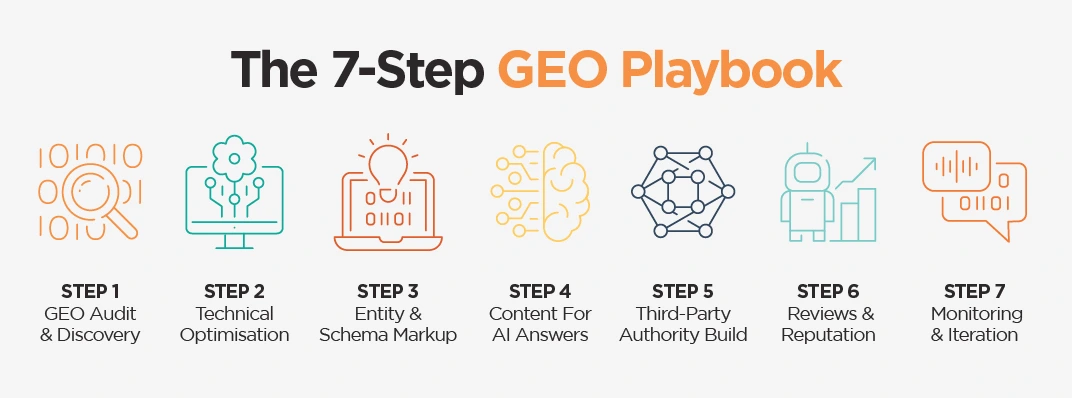
7-Step GEO Playbook to Get Your Brand into ChatGPT
None of this requires a large budget or a complete website rebuild. Most of it is a matter of systematically closing the gaps between where your brand stands today and what AI systems need to confidently recommend it.
1. Audit Your Current AI Visibility
Before fixing anything, you need to know where you actually stand. Open ChatGPT, Perplexity, and Google AI Overviews and run 10–15 queries that your ideal customers would ask “best web design company in Singapore”, “Singapore SEO agency for eCommerce”, “who does corporate website design in Singapore”. Document which brands appear, how they’re described, and whether your brand shows up at all. This is your baseline. It tells you the size of the gap and which competitors are currently winning.
2. Fix Your Technical AI Readiness
Check three things:
robots.txt: make sure OAI-SearchBot, PerplexityBot, ClaudeBot, and Google-Extended are not blocked.
llms.txt: Create an llms.txt file at yoursite.com/llms.txt with a curated summary of your business and key pages.
JavaScript rendering: ensure your core content (services, about, contact) is in clean HTML that AI crawlers can read without executing complex JavaScript. These are foundational. Without them, AI systems are working with incomplete or outdated information about your business.
3. Build Entity Clarity Through Schema Markup
Add Organization/LocalBusiness schema to your homepage with your full business name, physical address in Singapore, phone number, email, services, and founding year. Add FAQPage schema to your FAQ sections. Add Service schema to each service page. This is the vocabulary AI systems use to understand and describe your business. Schema markup has been shown to increase AI visibility by 30–40%. It’s one of the highest-ROI technical changes you can make.
4. Restructure Your Content for AI Extraction
Review your key service pages and ask: could AI extract a clear, complete description of this service from this page? If not, restructure. Lead with the answer what is this service, who is it for, what results does it deliver. Use specific, verifiable language: “5,000+ websites built since 2008” not “trusted by hundreds of clients”. Add FAQ sections to every service page; these are the most frequently extracted content formats for AI answers. Include statistics, case study data, and specific outcome descriptions. Freshness matters: update your key pages at least every 6 months.
5. Build Your Third-Party Brand Mention Footprint
This is the highest-impact long-term lever. AI systems treat third-party mentions as independent validation the more places your brand is mentioned on authoritative, independent sources, the more confidently AI systems will recommend you. Target: industry publications (Marketing In Asia, Business Times technology columns, Singapore Business Review), ‘Best of Singapore’ listicles in your category, professional directories (IMDA vendor listings, Chamber of Commerce), guest articles on relevant blogs, podcast appearances, and PR coverage. Distributing content across a wide range of third-party publications increases AI citations by up to 325%.
6. Build Your Review and Listing Platform Presence
AI reads review platforms as independent third-party evidence. Target:
Optimise your Google Business Profile: Ensure your profile is complete with accurate business information, services, photos, and opening hours. A fully optimised Google Business Profile improves local visibility and helps AI systems better understand your business.
Clutch.co: create a profile and get client reviews Clutch is heavily cited by AI for professional services queries
LinkedIn Company Page: keep it active and complete, TechBehemoths or DesignRush for web design agencies in Singapore, Trustpilot if applicable.
For Singapore-specific visibility: STB business directories, IMDA listings, and BizSafe/certifications that are publicly indexed.
Each platform adds another crawlable, verifiable source that AI systems can cross-reference.
7. Create Comparison and Category Content
When users ask “best web design companies in Singapore”, AI pulls from pages that directly address that query, not generic service pages. Create content that participates in category conversations: comparison guides (how to choose a web design agency in Singapore criteria checklist), alternative-style pages (‘web design agency comparison: what to look for’), and case studies that mention specific outcomes and client sectors. This positions your brand as a participant in the category-level conversation AI systems are being asked to summarise.
How to Track Whether Your Fixes Are Working?
GEO results don’t show up in traditional rank trackers. You need different measurement approaches to know if your efforts are paying off.
Manual AI Query Testing (Free, Monthly)
Once a month, run your 15 baseline queries across ChatGPT, Perplexity, Gemini, and Google AI Overviews. Track: (a) does your brand appear? (b) how is it described? (c) in what position relative to competitors? (d) what sources are being cited? Record this in a simple spreadsheet. Changes won’t be instant except to see movement at the 6–12 week mark if you’ve made significant content and third-party mention improvements.
AI Referral Traffic in Google Analytics 4
Set up a custom channel in GA4 to track referral traffic from AI platforms. The source domains to watch: chat.openai.com (ChatGPT), perplexity.ai, gemini.google.com, copilot.microsoft.com, claude.ai. AI-referred traffic currently converts at 14.2% on average nearly 5x higher than standard organic. Even small amounts of AI-referred traffic are worth tracking closely.
AI Visibility Tools (Paid, Recommended for Scale)
Semrush’s AI Visibility Toolkit, Ahrefs Brand Radar, Peec AI, and SE Ranking’s AI Visibility Monitor all now track brand mentions across major AI platforms. These are worth considering once you’ve established your baseline through manual testing and want to scale up tracking across more queries and platforms.
Metric
What to Track
Brand mention rate
% of your 15 core queries where your brand appears across ChatGPT, Perplexity and Gemini.
Share of AI Voice
How often you appear vs. top 3 competitors on the same prompts
AI citation sources
Which sites are being cited alongside your mentions target to appear there
Sentiment
How is your brand described? Neutral, positive, or qualified?
AI referral traffic
GA4 sessions from ChatGPT, Perplexity, Gemini domains
AI traffic conversion
Compare conversion rate of AI-referred visitors vs. organic
The Window Is Open But Not For Long
The gap between your competitors being mentioned in ChatGPT and you not being mentioned is not a mystery. It’s a specific set of identifiable, fixable problems: AI crawlers that can’t fully access your site, schema that doesn’t tell AI what your business is, content that doesn’t match how buyers ask AI questions, and a thin third-party mention footprint that gives AI systems nothing to cross-reference.
Every step in the playbook above is achievable. None requires a complete rebuild. The technical fixes take days. The content restructuring takes weeks. The third-party mention building takes months, but every month you wait, your competitors are adding another article, another review, another directory listing to their AI evidence trail.
The fortunate reality for Singapore businesses is that most haven’t started yet. The AI visibility gap that exists between you and your currently-cited competitors is still closeable. The first-mover advantage in GEO showing up in AI recommendations before your market saturates is still available in most Singapore industries. But the window is open now, not indefinitely.
Ready to close the AI visibility gap? Contact Verz Design and let our team help you get there.
Frequently Asked Questions
Why does ChatGPT recommend my competitors and not me?
ChatGPT recommends brands it can find clear, reliable evidence for. If your competitors have more third-party mentions on authoritative sites, are present on review platforms like Clutch or Google, have AI-readable websites, and produce structured content that directly answers buyer questions, AI will recommend them over you. It's not about advertising spend or your actual quality. It's about the strength and breadth of your public digital evidence trail.
Can I pay to get my brand mentioned in ChatGPT?
No. ChatGPT does not accept payment for brand mentions in its AI-generated answers. This is not an advertising channel, it's an AI system making inferences based on what it has learned and retrieved from across the web. The only way to appear is through earned visibility: building a strong brand presence across authoritative third-party sources, review platforms, and your own well-structured website.
How long does it take to start appearing in ChatGPT recommendations?
Technical changes (fixing AI crawler access, adding schema markup, creating llms.txt) can take effect within weeks AI crawlers can re-index your site relatively quickly. Content changes that improve extractability typically show impact in 4–8 weeks. Third-party brand mention building takes 2–4 months to accumulate sufficient coverage for AI systems to begin cross-referencing your brand confidently. Expect measurable improvement in your AI mention rate within 90 days of consistent GEO implementation.
What is GEO (Generative Engine Optimisation) and is it different from SEO?
GEO is the practice of optimising your brand and content to be cited and recommended by AI platforms like ChatGPT, Perplexity, Gemini, and Google AI Overviews. It differs from traditional SEO in important ways: while SEO optimises for keyword rankings in Google's blue-link results, GEO optimises for brand citations in AI-generated answers. The two are complementary. Strong SEO is a useful foundation for GEO but they require different tactics and measure different outcomes.
Which AI platforms should I focus on for brand visibility?
Start with ChatGPT (800+ million weekly users, accounts for 77% of AI referral traffic) and Google AI Overviews (2 billion monthly users, appears in 48% of tracked queries). Then add Perplexity (highly transparent citation behaviour, sensitive to GEO changes) and Gemini. The good news: strong GEO fundamentals, entity clarity, structured content, third-party authority, schema markup work across all platforms. You don't need a separate strategy for each.
Does my Google ranking affect my ChatGPT visibility?
Partially. Pages that rank well in Google are somewhat more likely to be cited in AI Overviews BrightEdge data shows pages ranking at position one have a 58% chance of being cited, dropping to 14% at position ten. However, 28.3% of ChatGPT's most-cited pages have zero organic visibility in Google. Fewer than 10% of sources cited by ChatGPT match Google's top 10 results for the same query. Strong Google rankings help but do not guarantee AI visibility; the two require different, overlapping optimisation.
What content works best for getting mentioned in AI answers?
Content that is specific, declarative, and fact-dense performs best. Avoiding vague marketing language “trusted by hundreds of clients” is less AI-visible than “we've built 5,000+ websites for Singapore businesses since 2009”. Include verifiable statistics, specific client outcomes, and clear definitions of who your service is for. FAQ-format content, comparison guides, and structured service descriptions are heavily extracted by AI systems. Content freshness also matters AI platforms prefer content updated within the last 12–24 months.
About the Author:
Vivek Tank
Senior SEO Specialist with a strong background in digital marketing and content strategy. With expertise in keyword research, on-page SEO, and backlink building, Vivek creates results-driven strategies tailored to each brand’s goals.
Contributors:
Jean Cabico
Need a strong team specialised in SEO?
Speak to Verz today if you are looking to create a website with a lasting impression to achieve online success.

 Share
Share