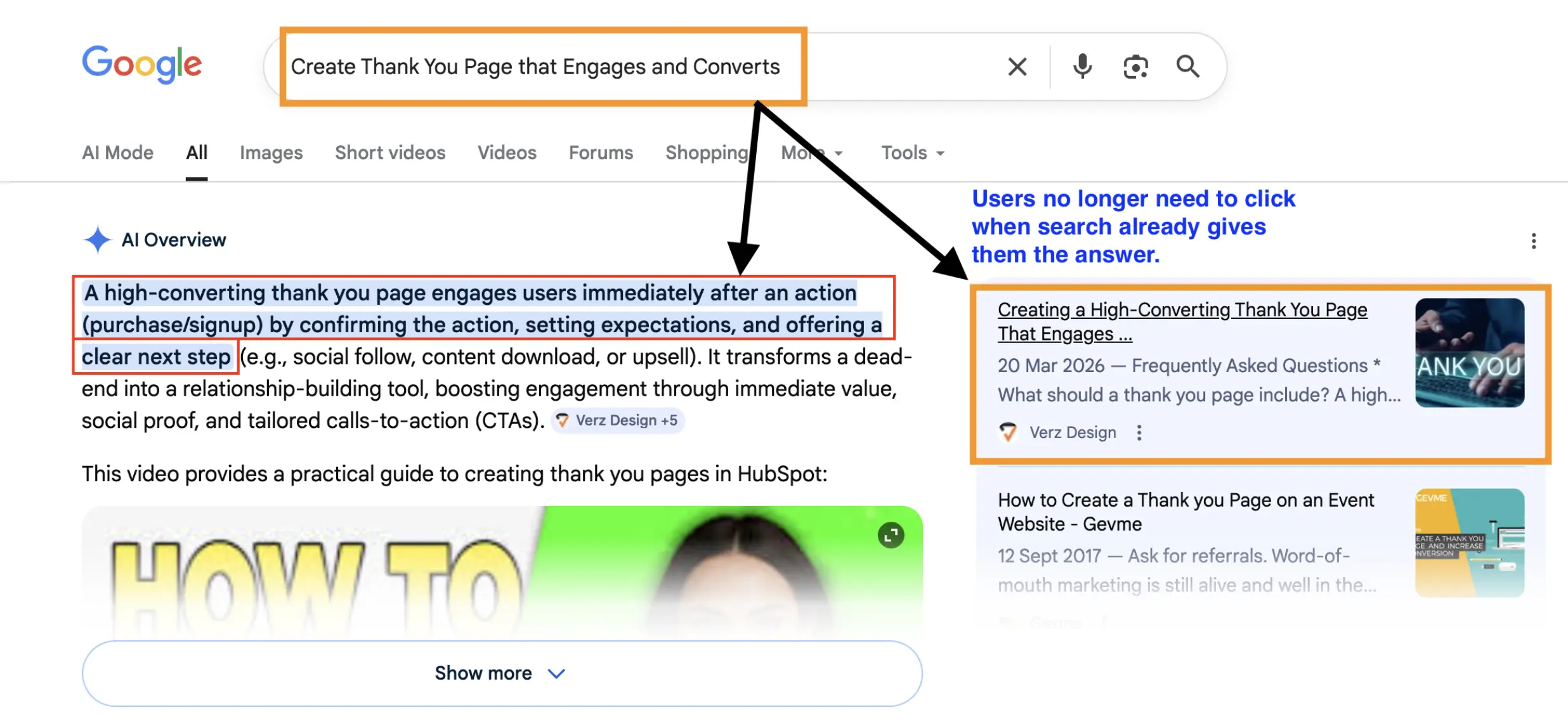
Search in 2026 continues to evolve rapidly, building on shifts that began years earlier. What started with featured snippets and structured results has expanded into more dynamic search experiences. Today, platforms like Google deliver instant answers directly on the results page through featured snippets, People Also Ask boxes, and local packs.
This shift has accelerated the rise of zero-click searches, where users get what they need without leaving the results page. For marketers, this is not a new concept, but it now carries greater impact. SEO is no longer just about earning clicks. It is about owning visibility, building authority, and influencing decisions directly within search.
What Are Zero-Click Searches (And Why They Matter)?
A zero-click search occurs when a user’s query is answered directly on the search engine results page, removing the need to click any result.
These features are now a standard part of how search engines deliver information to users.
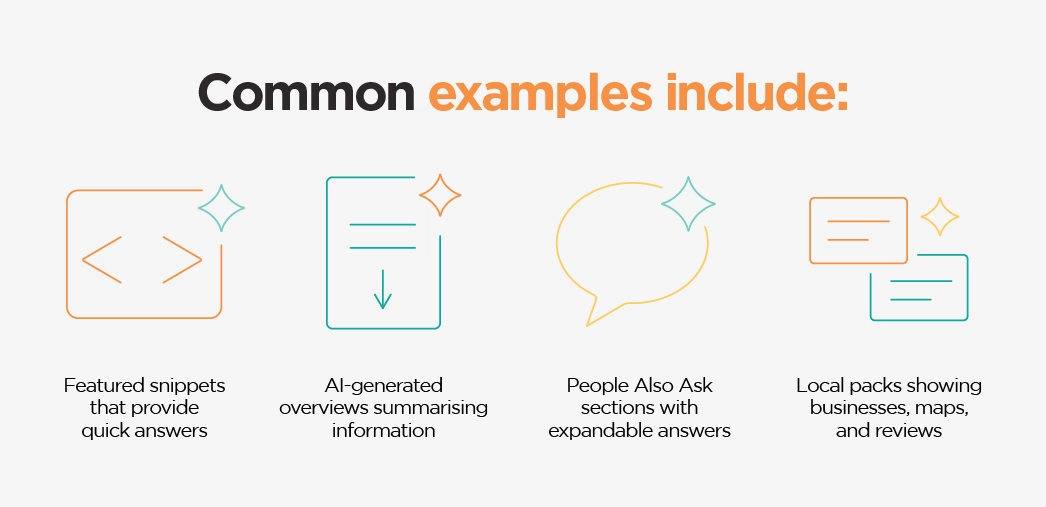
Each of these elements is designed to reduce friction and provide immediate value to the user.
Recent studies suggest that more than half of all searches end without a click. This means your content must perform even when users never visit your website.
Why zero-click searches matter:
- Visibility is happening before the click
- Brand exposure is increasing on SERP features
- Traditional traffic metrics are becoming less reliable
Studies indicate that over 50% of searches are now zero-click, making it essential to optimise beyond rankings.
What’s Driving the Rise of Zero-Click Searches?
1. Shift Toward Instant Gratification
Today’s users expect answers instantly, especially with faster mobile internet and constant on-the-go browsing. Instead of clicking through multiple sites, they prefer information that appears directly in search results. This behaviour fuels the growth of zero-click searches, as convenience often outweighs the need for deeper exploration. Businesses must adapt to capture attention within these brief on-SERP moments.
2. AI-Powered Search Evolution
Google’s advanced AI algorithms, like MUM (Multitask Unified Model) and the evolving Search Generative Experience (SGE), are transforming how search results are delivered.
Rather than simply listing websites, these systems pull data from multiple trusted sources to create direct, context-rich answers. This reduces the need for users to click through, while raising the bar for businesses to produce content that earns inclusion in these AI-driven summaries.
3. Voice Search & Smart Assistants
With the rise of devices like Alexa, Google Assistant, and Siri, more users are getting answers spoken back to them instantly eliminating the need to visit a website. Voice search queries are often short, conversational, and intent-driven, meaning the assistant delivers one definitive answer.
As adoption of smart speakers and mobile voice assistants continues to grow, click-based traffic will steadily decline, pushing businesses to optimise for voice-friendly, concise responses.
4. Mobile-First Indexing
With mobile-first indexing, Google primarily uses the mobile version of your site for ranking and indexing. Mobile SERPs are more compact, displaying fewer results and prioritising quick, concise answers at the very top.
This layout improves user experience by reducing the need to scroll but can limit organic clicks for businesses. To stay competitive, content must be mobile-friendly, fast-loading, and structured for instant comprehension.
5. Google’s Monetisation Strategy
Google benefits financially from keeping users on its search results pages longer, as this boosts ad impressions and engagement with its own products like Google Shopping, Flights, and Hotels.
By integrating these tools directly into SERPs, Google reduces the need for users to click through to external sites. This commercial approach not only fuels the growth of zero-click searches but also increases competition for the limited organic space that remains. Businesses must adapt by optimising for visibility within these built-in features.
How Zero-Click Searches Are Changing SEO?
From Traffic to Visibility and Influence
SEO is no longer just about driving traffic. It is about building visibility across different parts of the search results page.
Businesses investing in SEO services must now prioritise visibility across SERP features, not just rankings, ensuring their content appears where users are already finding answers.
As more queries are answered directly on SERP features, users often engage with content without clicking through. This shifts the focus from visits to presence and recognition.
Appearing across multiple SERP elements increases your reach and credibility:
- Featured snippets
- People Also Ask boxes
- Knowledge panels
These placements allow your content to be seen at key moments in the search journey. Even without clicks, consistent visibility helps build trust and reinforces your authority over time.
Why Rankings Alone Are Not Enough?
Ranking number one does not always translate to traffic. When search features provide complete answers, users may not explore further results.
This changes how rankings should be interpreted:
- Position zero can outperform position one
- SERP features can reduce organic CTR
- Content format matters as much as ranking
Understanding this shift helps prioritise visibility alongside rankings.
The Importance of E-E-A-T in Zero-Click SEO
Search engines prioritise content that demonstrates strong credibility signals. This is especially important for topics where accuracy and trust matter.
E-E-A-T reflects how reliable and useful your content is:
- Experience (real insights)
- Expertise (knowledge depth)
- Authoritativeness (industry credibility)
- Trustworthiness (accuracy and transparency)
These factors influence whether your content is selected, surfaced, and trusted by users.
How to improve E-E-A-T:
- Include clear author profiles and credentials
- Reference credible and relevant sources
- Keep content accurate, updated, and easy to understand
- Build consistent brand authority across platforms
Strong E-E-A-T signals help your content stand out, improving both visibility and user trust over time.
AEO vs SEO: Optimising for Zero-Click Searches
Answer Engine Optimisation (AEO) focuses on structuring content so it can be easily extracted and displayed as direct answers. Traditional SEO focuses on improving rankings and driving traffic through search results.
As search behaviour shifts toward faster answers, understanding the difference between these two approaches becomes more important. This reflects a broader shift in SEO from driving clicks to delivering answers directly within search.
Key differences include:
| Traditional SEO |
AEO |
| Focus on rankings |
Focus on answers |
| Keyword targeting |
Query intent targeting |
| Long-form content |
Structured, concise answers |
| Click-driven success |
Visibility-driven success |
This comparison shows how success is no longer based on rankings alone, but also on how well your content can be surfaced directly on the results page.
How is content evaluated differently?
Search engines now assess content based on how clearly and quickly it delivers value. It is no longer enough to include the right keywords. Content must also be easy to scan, understand, and extract.
Key factors include:
- Clarity of answers
- Structure of content
- Relevance to user intent
- Authority signals
Well-performing content answers the query early, uses clear formatting, and avoids unnecessary complexity. Sections that can stand alone as complete answers are more likely to be featured.
Why both strategies must work together?
SEO helps your content get indexed and ranked, while AEO improves its chances of being selected and displayed within search features.
Relying on only one approach can limit your results. Ranking without clear answers reduces visibility, while structured answers without strong SEO may not get discovered.
A strong strategy should include:
- Effective keyword research to target relevant queries
- Clear answer formatting to improve extractability
- Technical optimisation to support indexing and performance
- Authority building to strengthen credibility
When combined, these elements help your content rank, get featured, and remain visible across different stages of the search journey.
How to Optimise for Zero-Click Searches (Step-by-Step)?
Step 1: Identify Zero-Click Keywords
Not all keywords behave the same. Some are more likely to trigger search features that provide answers directly on the results page.
To identify the right keywords, focus on:
- Informational searches
- Question-based keywords
- Long-tail queries
These types of queries are more likely to generate featured snippets and People Also Ask results.
You should also review how the search results page is structured for each keyword. This helps you understand whether clicks are likely or if visibility is the main opportunity.
This includes checking:
- Featured snippet presence
- PAA sections
- Knowledge panels or local packs
By analysing these elements, you can prioritise keywords where appearing on the results page matters more than driving clicks.
Step 2: Optimise & Structure Content for Answers
Content structure plays a critical role in whether it gets featured.
To improve clarity and extractability:
- Provide clear answers within 40 to 60 words
- Use headings that match search queries
- Include bullet points and lists
- Keep language simple and direct
Each section should function as a complete and standalone answer.
Step 3: Implement Schema Markup
Schema markup helps search engines understand your content more clearly. It adds structure to your pages, making it easier for your content to appear in rich results and answer-based features.
In a zero-click environment, this improves your chances of being surfaced in snippets, PAA, and AI-generated summaries.
Key schema types include:
- FAQPage Schema: Best for question-based content. Helps your answers appear in FAQ results and PAA sections.
- HowTo Schema: Ideal for step-by-step guides. Allows search engines to display structured instructions directly on the SERP.
- LocalBusiness Schema: Important for local visibility. Supports appearance in map results and local packs.
Use schema based on your content type, not just for the sake of adding it. Always ensure it matches what is visible on the page.
To get the most value from schema markup:
- Ensure your structured data matches the visible content on the page
- Keep answers clear, accurate, and aligned with user intent
- Use Google’s Rich Results Test to validate implementation
- Regularly review and update schema as content evolves
When implemented correctly, schema improves how your content is interpreted and increases your chances of being featured.
Step 4: Target PAA and Conversational Queries
People Also Ask sections reflect how users explore topics in more depth.
To improve your presence in these areas:
- Expand your content with related questions
- Build topic clusters
- Answer follow-up queries clearly
This approach increases the likelihood of appearing multiple times within a single search journey.
Step 5: Build Authority and Trust Signals
Authority is a key factor in determining whether your content is selected for search features.
To strengthen your credibility:
- Highlight author credentials
- Earn high-quality backlinks
- Build consistent brand mentions
- Publish regularly
These signals help search engines and users trust your content.
When to Target vs Avoid Zero-Click Keywords?
When to Target Them?
Zero-click keywords can be valuable when used strategically within your content plan. They are most effective when your goal is visibility rather than immediate conversions.
These keywords often appear in early-stage searches where users are still exploring a topic.
They are particularly useful for:
- Brand visibility
- Top-of-funnel awareness
- Establishing authority
Targeting these queries helps position your brand as a reliable source. Even without clicks, repeated exposure can build familiarity and trust over time.
When to Avoid Them?
Not all zero-click keywords align with business goals. Some queries require users to visit your site to take action, making visibility alone less valuable.
You should be more selective when dealing with:
- High-intent transactional keywords
- Queries where clicks are essential for conversion
- Keywords with low business value
In these cases, focus on keywords that drive meaningful actions rather than impressions alone. Balancing visibility and conversion ensures your strategy supports both reach and results.
How to Measure Success in a Zero-Click Search World?
You can’t adapt effectively without first understanding how zero-click searches are affecting your current traffic and conversions.
1. Track Impressions vs. Clicks in Google Search Console
Monitor the relationship between impressions and clicks closely. If impressions are rising but clicks remain flat or drop, it’s a strong indicator that users are getting answers directly from the SERP instead of visiting your site. This pattern often signals zero-click searches, prompting a need to optimise for on-SERP visibility and engagement.
2. Monitor On-SERP Actions
Use GBP insights and analytics to measure:
- Calls made directly from search.
- Direction requests from Google Maps.
- Menu views or bookings without site visits.
3. Analyse CTR by Query Type
Break down your click-through rates based on query intent. A sharp CTR drop for informational searches often means featured snippets or AI overviews are answering users before they click. In contrast, stable or growing CTR for branded queries suggests that your SERP presence is strengthening brand awareness and recall.
4. Benchmark Against Industry Trends
Regularly compare your impressions, CTR, and traffic patterns with trusted industry benchmarks. This helps you understand whether zero-click search impacts are unique to your site or part of a broader market shift. By spotting these trends early, you can adjust your SEO strategy to stay competitive.
Future Trends in Zero-Click Searches
Search behaviour continues to shift toward faster, more direct access to information. Understanding these trends helps guide long-term strategy.
AI-Generated Answers Will Dominate
Search results are increasingly focused on delivering direct answers. Content that is clear, accurate, and well-structured is more likely to be surfaced.
Brand Visibility Will Outperform Traffic
Users may not always click, but repeated exposure builds familiarity. Being consistently visible can influence future searches and decisions.
AEO Will Become Essential
AEO is becoming a core part of search strategy. Structuring content for clarity and direct answers improves your chances of being featured.
Search Beyond Google
Search is no longer limited to traditional engines. Users now look for information across multiple platforms.
This includes:
- YouTube
- TikTok
- Voice assistants
- Chat-based search tools
Each platform has its own format and behaviour. Optimising for different channels helps expand your reach and keeps your content discoverable in more places.
Action Plan to Win More Zero-Click Searches
To stay competitive in a zero-click search world, practical improvements are essential. Small changes in how your content is structured and presented can significantly improve visibility across search features.
Start by focusing on the following actions:
- Audit your existing content for snippet opportunities
- Add schema markup to key pages
- Optimise top-performing pages for direct answers
- Expand content with PAA-style questions
- Track visibility, not just traffic
Each of these steps helps improve how your content is understood and surfaced on the results page. Focus first on pages that already perform well, as they are more likely to gain additional visibility with optimisation.
Consistent refinement over time will strengthen both your reach and your overall search performance.
Key Takeaways
To succeed in a zero-click environment, it is important to shift your mindset and approach:
- Visibility matters as much as traffic
- Clear and structured content performs better
- Not all keywords should be treated the same
- Authority and trust signals influence selection
- Measuring success requires looking beyond clicks
Applying these principles will help your content stay competitive as search continues to evolve.
Ready to Optimise for Zero-Click Searches?
If you want to stay visible in today’s search landscape, your strategy needs to align with how users consume information directly on the results page. A focused approach can help your brand appear across key search features, ensuring you remain present at critical decision-making moments.
Whether you are refining existing content or building new pages, prioritising clarity, structured formatting, and search intent will improve how your content performs within zero-click environments.
Get in touch with our team to build a strategy that aligns with zero-click search behaviour and supports long-term growth.
This article was originally published on 20 Aug 2025 and has been updated on 17 April 2026 to reflect the latest information and best practices.

 Share
Share