Can an AI build your business website in 60 seconds? Yes. Should it? That is a different question entirely, and the difference matters more than most people realise when they first start researching it.
AI website builders have gone from novelty to mainstream in 2026. Tools like Durable, Framer AI, Wix ADI, and GoDaddy Airo can generate complete website layouts, copy, images, and navigation in under five minutes from a single-sentence prompt. The AI website builder market hit $5 billion in 2025 and is growing at over 26% annually.
Meanwhile, WordPress still powers 43% of all websites on the internet and holds nearly 60% of the CMS market. Both sides of this debate are bigger than they’ve ever been, which is exactly why the choice deserves more than a quick answer.
This guide from Verz Design breaks down the AI vs WordPress decision honestly, with real data from authoritative 2025–2026 sources, for Singapore businesses building digital presences that actually need to perform.
What Are AI Website Builders?
AI website builders are tools that use machine learning and generative AI to create a complete website from a simple text description. You type something like ‘I run a law firm in Singapore and need a professional site with a contact form. Within minutes, the tool produces structured pages with layouts, copy, images, and navigation automatically generated.
They are different from traditional website builders (like Wix or Squarespace used manually) in that they don’t require you to drag, drop, or make design decisions. The AI handles the creative and structural work based on its training on existing websites across the internet.
Popular AI Website Builders in 2026
Durable: marketed as ‘the world’s fastest website builder’. A complete website from one sentence in under 30 seconds.
Framer AI: design-focused AI builder generating visually polished websites from prompts.
Wix ADI (AI Design Intelligence): Wix’s AI-powered site generator, integrated into the Wix platform.
GoDaddy Airo: AI builder with built-in email marketing and social tools for small businesses.
Hostinger AI Website Builder: affordable AI builder targeting first-time website owners.
10Web: an AI builder that generates WordPress sites (a hybrid category worth noting).
B12: AI builder with optional human design assistance layered on top.
Important distinction: Some AI tools (like 10Web) generate WordPress sites using AI assistance. These are different from standalone AI builders; they produce a WordPress foundation that a developer can extend and customise. When this guide talks about ‘AI website builders’, it refers to the standalone platforms that generate and host their own sites.
What Is WordPress?
WordPress is an open-source content management system (CMS) that powers 43% of all websites on the internet, a number that has remained roughly consistent for years despite the explosive growth of AI builders, dedicated eCommerce platforms, and no-code tools. According to W3Techs data from June 2026, WordPress holds 59.4% of the CMS market, nearly nine times the share of its closest competitor.
Unlike AI website builders, WordPress doesn’t generate your website for you. It provides a flexible, open-source platform on which a professionally built website is constructed by a developer, working to your specific brief, creating a site that looks and functions exactly as your business requires.
The tradeoff is deliberate: WordPress requires more upfront investment (time, budget, and a qualified developer). In exchange, you get complete ownership of your data, unlimited customisation, a plugin ecosystem of over 60,000 free extensions, and a platform that grows without constraint from a 5-page brochure site to a 500-page enterprise digital platform.
WordPress powers 43% of all websites on the internet as of 2026, down slightly from its 2025 peak of 43.6%, not because of competition from Wix or Squarespace, but because AI-generated static sites in the ‘No CMS’ category grew from 28.6% to 29%.(Source: W3Techs, June 2026)
AI vs WordPress: Key Differences at a Glance
Before going deep on either platform, here’s a direct, side-by-side comparison across every dimension that matters for a serious business website in 2026:
Requires active maintenance (but fully controllable)
Long-term value
Risky platform can change or shut down
Your asset: no third-party dependency
Best for
Quick tests, digital business cards
Any serious business building for long-term growth
A few things in that table deserve more than a cell entry. The next four sections break down the most important dimensions in detail.
When AI Website Builders Actually Make Sense?
This guide is honest. AI website builders are not a scam, and they’re not universally wrong. There are specific situations where they are the most practical choice, and pretending otherwise would be disingenuous.
AI Builders Are Genuinely Useful When:
You are testing a business idea and need a web presence before you’ve validated the concept. A durable site in 30 seconds is a perfectly sensible way to get something online while you figure out whether the business is viable.
You need a simple ‘digital business card’, a single-page or 3-page site with your name, services, and contact details, and you have no intention of investing in SEO, blogging, or growth marketing.
You are running a short-term promotion or event and need a dedicated landing page live within hours, not weeks.
Your budget is genuinely zero, and the alternative is no website at all. A free or $10/month AI builder is better than nothing.
You are a developer or designer using AI to prototype and experiment with layouts before building the real thing.
The businesses that regret choosing an AI builder aren’t the ones who needed a simple site. They’re the ones who started simple and outgrew the platform in 12–18 months, then faced the painful, expensive process of migrating everything to a platform that should have been the starting choice. (Source: Thorn Creative, 2026)
Why WordPress Wins for Serious Business Websites?
For any business that cares about search visibility, brand credibility, long-term growth, or the ability to add functionality as the business evolves, WordPress is not just better than AI builders. For most Singapore businesses, it’s the only rational long-term choice. Here’s why:
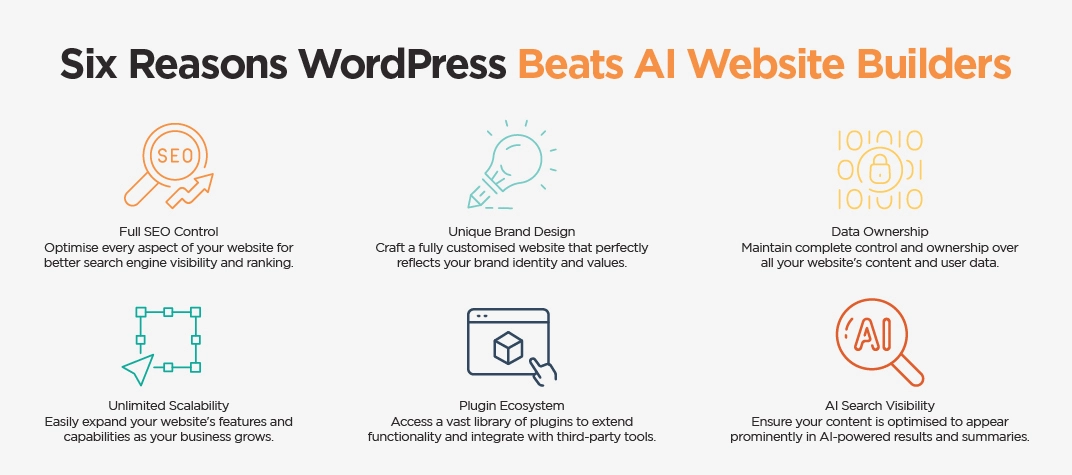
Reason 1: Full SEO Control
This is where AI builders lose the most ground. WordPress gives you complete technical SEO control: custom URLs and slugs, meta titles and descriptions, schema markup (Organisation, FAQPage, Article, LocalBusiness), robots.txt editing, sitemap configuration, canonical tags, and page speed optimisation.
AI builders restrict most of this. You typically get limited or no access to the underlying code, restricted meta tag editing, no schema markup capability, and little control over how search engines read your page structure. For a business that plans to appear in Google and increasingly in Google AI Overviews, this limitation is not minor. It is fundamental.
According to W3Techs data from 2026, WordPress is described as ‘widely considered the strongest platform for SEO’ specifically because of its full technical control supporting advanced plugins like Yoast SEO and RankMath, full schema markup, robots.txt editing, and .htaccess access.
Reason 2: Your Brand Looks Like Your Brand, Not Like Everyone Else
Every business using the same AI builder using similar prompts gets similar results. The visual output of an AI builder reflects the aggregate of what the AI was trained on, which means it reflects the average of the internet, not the specificity of your brand.
A professionally built WordPress site starts from your brand identity, your competitive positioning, your target audience, and your specific business goals. No two Verz Design builds look alike because each one is designed from scratch for the specific client, not adapted from a generated template.
In a market where brand differentiation is increasingly difficult, a generic AI-generated design actively works against you.
Reason 3: You Own Everything
WordPress is open source. Your website files, your database, your content all of it lives on your hosting server and belongs entirely to you. If you want to move to a different hosting provider tomorrow, you take everything with you. If you want to hand the codebase to a different developer, you can. If the platform ever shuts down or changes its pricing, your website keeps running.
AI website builders work differently. Your site exists on their servers, running on their proprietary platform. If the company changes its pricing, restricts features, or shuts down, your website is at risk. This is not a hypothetical; multiple ‘free website’ platforms have closed with little warning, leaving businesses scrambling.
AI website builders can be very useful for quick, throwaway landing pages where SEO and scalability do not matter. For anything you are building a business on, they are the wrong tool.
Reason 4: WordPress Grows With Your Business
A Singapore business that starts with a 5-page corporate website often ends up needing a member portal, an appointment booking system, a product catalogue, a multilingual version for regional expansion, and an integrated CRM. WordPress handles all of this typically through the plugin ecosystem, sometimes through custom development on the same codebase.
AI builders hit scalability walls quickly. Adding complex functionality usually means an expensive migration to a different platform, a painful rebuild, and losing any SEO equity built on the old URLs.
Reason 5: 60,000+ Plugins for Any Functionality You’ll Ever Need
Need a booking system? WooCommerce? A membership portal? Multilingual support? Advanced analytics? Custom forms? Live chat? Payment integration with specific Singapore gateways? There are mature, well-supported WordPress plugins for all of these, most available free or at minimal cost.
This ecosystem is one of WordPress’s most significant competitive advantages. When you choose WordPress, you’re not just choosing a CMS. You’re choosing access to the largest community-built extension ecosystem in the history of web development.
Reason 6: WordPress Wins for AI Search Visibility in 2026
As AI-generated answers become a mainstream discovery channel, the platform your website runs on increasingly affects whether you appear in those answers. Businesses looking to improve their visibility across AI-powered search platforms can also explore AI SEO and GEO strategies. WordPress’s full technical control, including schema markup, structured data depth, and the ability to implement an llms.txt file, makes it significantly more GEO-ready than any AI website builder on the market.
Research from Limy.ai analysing LLM bot behaviour data found that sites with deep structured data are crawled 17% more deeply, with content extracted 12% more reliably and crawled at a 13% higher return rate. WordPress enables complete structured data implementation. AI builders typically cannot.
The Security Reality: What AI Builders Get Right (and What to Do About It)
There’s one area where AI website builders have a genuine structural advantage over WordPress: the security attack surface.
A 2025 Sucuri report found that WordPress accounted for over 90% of cleaned hacked CMS sites a staggering statistic that reflects WordPress’s popularity rather than its inherent insecurity, but still a reality that managed hosting and plugin discipline can address.
AI builders have no plugins to update, no database to inject into, and no PHP vulnerabilities to exploit. Their smaller technical footprint means fewer attack vectors by default.
The honest answer: WordPress is not insecure by nature it is insecure when not properly maintained. A professional WordPress build with managed hosting, a security plugin (like Wordfence or Sucuri), automatic updates, and regular backups addresses the security gap comprehensively. When Verz Design builds WordPress sites, security configuration is part of the handover not an afterthought.
The Hidden Costs of Choosing the Wrong Platform
The upfront cost comparison between AI builders (near-zero) and WordPress (professional build) is real. But the more important comparison is the total cost of ownership over three to five years and the cost of getting it wrong.
Cost Scenario
AI Website Builder
WordPress (Professional Build)
Year 1 launch cost
SGD $0 to $600/year subscription
SGD $5,000–$15,000+ one-time build
Year 1 traffic
Minimal poor SEO out of the box
Grows with SEO investment organic traffic compounds
Year 2 growth needs
Hit platform limits; add-ons cost more
Same platform handles new features via plugins
Year 3 rebrand
Full rebuild on same limited platform OR expensive migration
Design update on existing codebase fraction of rebuild cost
SEO value accumulated
Low AI builders lag on technical SEO
High compounds over time; every article, every link builds equity
Platform risk
Company could change pricing, terms, or shut down
Open source no dependency on any single company
True 3-year cost
Often comparable to WordPress once subscription and limitations are added
Higher upfront, lower risk, higher ROI long-term
What About AI + WordPress Together?
Here’s a nuance most comparisons miss: AI and WordPress are not mutually exclusive. In 2026, the smartest approach for many businesses is to use AI within a WordPress workflow not as a replacement for it.
What this looks like in practice at Verz Design:
AI is used to generate content outlines and first drafts, and to propose site structure during the planning phase, saving research and briefing time.
AI tools help with initial design direction and moodboard exploration, speeding up the early creative brief stage.
AI-assisted plugins within WordPress (like Bertha AI or WP AI Writer) can help content editors produce first drafts for blog posts without leaving the WordPress editor.
AI image generation tools produce visual assets faster than stock photography searching, which are then optimised and placed by the design team.
The result: faster delivery, lower cost, and a genuinely custom WordPress website, not a compromise. This is the approach Verz Design uses on all new builds. AI speeds up the work. Human expertise ensures the output meets professional standards.
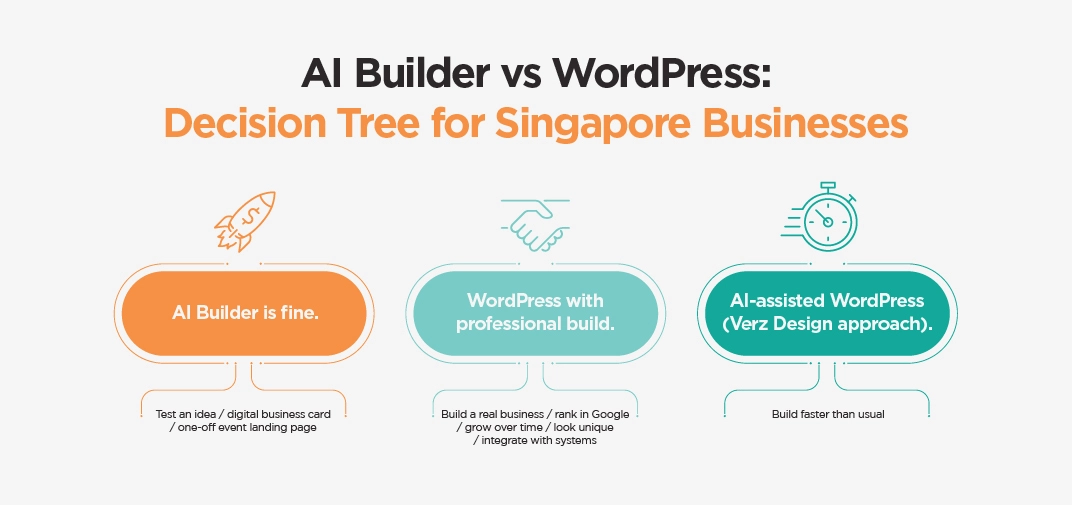
Which Platform Should Singapore Businesses Choose?
Here is the honest answer to the question this article set out to address:
Your Situation
Best Choice
Testing a new business idea before investing seriously
AI Builder (Durable, Framer, Wix ADI): fast, cheap, disposable
Simple 3-page digital business card with no growth plan
AI Builder: adequate for this specific, limited need
Serious corporate website for Singapore SME or enterprise
WordPress (professional custom build): every time
Website where Google rankings and organic traffic matter
WordPress: AI builders cannot compete on technical SEO control
Unique brand design that differentiates from competitors
WordPress: AI generates the average of the internet, not your brand
Need specific functionality (booking, portal, eCommerce, LMS)
WordPress: 60,000+ plugins. AI builders can’t match this.
Business that will need to grow and scale over 3–5 years
WordPress: scales without limits. AI builders hit ceilings.
Website that needs to appear in Google AI Overviews and ChatGPT
WordPress: full schema, structured data, GEO-ready from day one
Fastest route to a professional-grade custom website
How Your Platform Choice Affects AI Search Visibility in 2026?
Understanding how AI systems decide what content to cite can help explain why technical structure, relevance, clarity, and authority all matter beyond traditional search rankings.
What AI Search Engines Need From Your Website?
Schema markup (structured data): AI systems extract structured data 12% more reliably and crawl 17% deeper on sites with proper schema implementation. WordPress enables complete schema control. AI builders typically cannot implement Product, Organisation, FAQPage, or LocalBusiness schema.
Question-format content: LLM bots index question-shaped links 70% more often than generic paths. WordPress gives you full URL control to format questions naturally. AI builders often use generated slugs you cannot customise.
Clear, front-loaded content: LLM bots extract approximately 25–30 kilobytes of content per page visit. Your opening paragraph must immediately establish what your business is, what this page covers, and why you should be recommended. This is why creating content that LLMs can trust, mention, and cite is becoming an important part of AI search optimisation. WordPress gives you full editorial control over this. AI builders auto-generate openings from their training data.
Authentic external brand mentions: Limy.ai data shows that a small number of focused, authentic external mentions from Google Reviews, Clutch, and industry publications have a disproportionate effect on AI recommendation probability. This is not platform-specific, but WordPress’s flexibility to embed review widgets, link to external profiles, and build trust signals is significantly greater.
AI crawler access: 27% of companies block at least one major LLM crawler via robots.txt or CDN security settings, often by accident. WordPress gives you direct robots.txt access to verify that GPTBot, ClaudeBot, PerplexityBot, OAI-SearchBot, and Google-Extended are all allowed. AI builders often do not provide robots.txt access at all.
GEO takeaway for Singapore businesses: If you want your website to appear in AI-generated search answers in Google AI Overviews, ChatGPT responses, and Perplexity results, the platform you choose is a technical prerequisite, not just a design preference. WordPress gives you the tools. AI builders typically don’t.
Which Is Better for Business Websites?
The answer the data actually supports: AI website builders are genuinely useful for a narrow, specific category of need: quick tests, throwaway landing pages, and simple digital business cards for businesses with no growth plans. For everything else, WordPress wins.
Not because WordPress is perfect. It requires more upfront investment, more maintenance discipline, and a qualified developer to set up properly. But those costs buy you something AI builders categorically cannot provide: a website you own, a design that’s uniquely yours, SEO control that compounds over time, and a platform that grows without hitting arbitrary limits.
The AI builder growth story is real; the market is growing at 26% annually, and the tools are getting better. But the data on what AI builders actually produce, and how they perform in real business use over time, consistently points to the same conclusion: they are tools for getting something online, not tools for building a business online.
If your goal is to build a business website that ranks in Google, gets cited by AI search systems, reflects your brand authentically, and supports your growth over the next five years, you already know the answer. Ready to build for growth? Talk to Verz Design today.
Frequently Asked Questions
Is an AI website builder good for SEO?
Not really, at least not for anything beyond basic on-page elements. AI website builders typically offer limited access to technical SEO controls: you may be able to edit meta titles and descriptions, but full schema markup, robots.txt access, URL architecture control, canonical tags, and structured data implementation are either restricted or entirely unavailable. For a business that wants to rank in Google or appear in AI-generated search results, these limitations are significant. WordPress gives you complete technical SEO control with no restrictions.
Can AI replace web designers and developers?
For simple websites with minimal customisation requirements, AI builders can produce functional results without a designer or developer. For business websites that need to be unique, scalable, SEO-optimised, and integrated with business systems, the answer is no. AI generates from patterns in existing data. It cannot produce truly original brand-aligned design, understand your specific business context, write authentic expert copy, or build the custom functionality your business will need as it grows. AI works best as a tool for skilled humans, not a replacement for them.
How long does it take to build a WordPress website?
A professionally custom-built WordPress website from Verz Design typically takes 3–6 weeks from kickoff to launch, depending on the number of pages, complexity of design, and amount of custom functionality required. This includes discovery and strategy, wireframing, custom design, WordPress development, content integration, SEO setup, and testing. For comparison, an AI builder produces a basic site in minutes, but that speed comes at the cost of customisation, brand differentiation, and long-term performance.
Is WordPress too complicated for a Singapore small business to manage?
Modern WordPress is significantly more accessible than it was five years ago. Block editors (Gutenberg), page builders, and a well-structured site handover from a developer make day-to-day content editing manageable for non-technical users. The 'complicated' part is the initial setup and configuration, which is exactly what a professional developer handles. Once your site is built and handed over with basic training, editing content, adding pages, and updating images are typically straightforward tasks that any marketing or admin team member can handle.
Why is WordPress still so popular when AI builders are growing so fast?
WordPress's slight decline from its 2025 peak of 43.6% to 41.9% in June 2026 is not being driven by Wix, Squarespace, or any traditional competitor. It is being driven by the growth of AI-generated throwaway static sites in the 'No CMS' category, websites built with no intention of ranking, scaling, or representing a serious business long-term. Among businesses that are serious about digital growth, WordPress remains the dominant platform by an enormous margin: 59.4% of the CMS market as of June 2026.
What does an AI website builder actually generate? Is the content unique?
AI website builders generate content based on patterns from their training data, which includes millions of existing websites. This means the copy they produce for your plumbing business in Singapore is generated from patterns observed across thousands of other plumbing businesses and potentially thousands of competitors who used the same prompt. The result is text that sounds plausible and grammatically correct, but lacks genuine expertise, original perspective, and the specific details that make your business different. Google's quality algorithms and AI citation systems actively deprioritise this kind of generic, non-distinctive content.
Is it expensive to move from an AI builder to WordPress later?
Yes, and this is one of the most underestimated risks of starting with an AI builder for a serious business. AI builders typically use proprietary systems that don't export cleanly to WordPress or other platforms. Content, design, and any built-in functionality generally cannot be migrated directly. In practice, moving from an AI builder to WordPress usually means rebuilding from scratch losing both the time invested in the original site and any SEO equity it had accumulated. Starting on WordPress from the beginning avoids this cost entirely.
Does WordPress work well for Singapore businesses specifically?
Yes. WordPress is platform-agnostic by design it works as well in Singapore as anywhere else in the world. For Singapore-specific needs, it handles multi-currency if integrated with WooCommerce, supports multilingual sites (important for brands serving English, Mandarin, Malay, and Tamil-speaking audiences), integrates with Singapore-specific payment gateways (PayNow, GrabPay, NETS), and can connect to government platforms and grant applications like IMDA's pre-approved solution requirements. Verz Design has been building WordPress sites for Singapore businesses for 16+ years and can configure all of this as part of a standard build.
What is the AI-assisted WordPress approach and how does it work?
The AI-assisted WordPress approach which Verz Design uses on all new builds uses AI during the planning, content drafting, and design exploration phases to compress the time and cost of the discovery process, while still delivering a fully custom WordPress site. AI generates outlines, first drafts, and design direction; human strategists and developers refine, customise, and build the actual site. The result: a professionally built, brand-specific WordPress website delivered faster and at better value than a fully manual process, without the compromises of a pure AI-generated site.
About the Author:
Vivek Tank
Senior SEO Specialist with a strong background in digital marketing and content strategy. With expertise in keyword research, on-page SEO, and backlink building, Vivek creates results-driven strategies tailored to each brand’s goals.
Need a strong team specialised in SEO?
Speak to Verz today if you are looking to create a website with a lasting impression to achieve online success.

 Share
Share