Build a Permission-First WhatsApp Marketing Strategy
If there is one principle businesses need to understand about WhatsApp marketing, it is that consent directly affects performance. Opt-in is not simply a legal or policy requirement. It is one of the strongest predictors of deliverability, engagement quality, and long-term sender reputation. Businesses that treat consent casually often struggle with low reply rates, high block rates, and inconsistent campaign performance.
A strong opt-in process should clearly explain what type of content customers will receive, how frequently messages may be sent, and how users can opt out if they no longer wish to hear from the business. This creates transparency from the beginning and reduces the likelihood of frustration later in the customer journey. More importantly, it ensures customers actually expect your messages rather than feeling interrupted by them.
Businesses should also be able to trace consent back to a legitimate source, such as a website form, QR code, checkout flow, in-store registration, or event sign-up. If your database consists of old contact lists, imported spreadsheets, or numbers collected informally by sales staff, you are already introducing risk into the channel. Poor-quality data may initially appear usable, but over time, it damages both campaign performance and customer trust.
Choose the Right WhatsApp Solution for Your Business
Most SMEs begin with the WhatsApp Business App because it is simple to set up and requires very little technical investment. For businesses handling relatively low message volume with one or two staff members managing conversations manually, the App is often enough in the early stages. It works particularly well for reactive customer support and straightforward inbound enquiries.
The challenge begins when WhatsApp becomes an important acquisition or revenue channel. Once businesses start running click-to-WhatsApp campaigns, managing multiple sales agents, or automating customer journeys, the limitations of the App become more obvious. At that point, the WhatsApp Business Platform becomes significantly more valuable because it allows deeper integrations, automation, analytics, and operational oversight.
The platform supports features such as CRM integration, agent routing, lifecycle automation, conversation tracking, and audit trails. These capabilities become increasingly important once businesses need to measure performance properly or scale their workflows across larger teams. Businesses that understand their customer journey can identify where WhatsApp conversations support lead generation, sales, customer service, and retention more effectively.
Understand WhatsApp Templates and the 24-Hour Customer Service Window
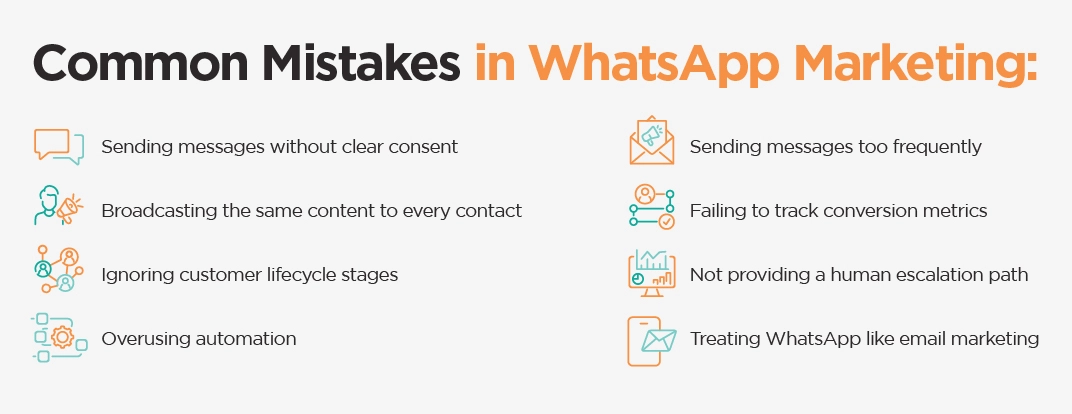
WhatsApp marketing operates very differently from email marketing. Businesses cannot simply upload contact lists and send promotional campaigns whenever they choose. The platform has structured rules around outbound communication, customer service windows, and approved templates, all of which affect both compliance and campaign costs.
Outside the customer service window, businesses typically rely on approved templates to initiate outbound messaging. These templates are categorised according to message type, such as marketing or utility communication, and businesses must use them carefully. Many companies mistakenly view templates as an administrative hurdle, but in reality, they play an important role in maintaining message quality and protecting the overall customer experience.
The 24-hour customer service window is often where the most valuable conversations happen. This is the period where businesses answer objections, qualify leads, confirm appointments, negotiate pricing, and close transactions. For many SMEs, the most effective WhatsApp strategy is not aggressive outbound promotion, but rather generating legitimate inbound intent and then using skilled human conversations to convert those leads efficiently while the service window remains open.
WhatsApp Marketing Best Practices
The strongest WhatsApp programmes are not necessarily the ones sending the highest volume of messages. Instead, they are the programmes that maintain relevance, consistency, and customer trust over time. Businesses that approach WhatsApp strategically tend to see stronger engagement, healthier list quality, and more sustainable ROI. For businesses using customer data and marketing automation, WhatsApp can also support more personalised customer journeys through segmentation, retention campaigns, and behavioural messaging strategies.
One of the most important best practices is aligning opt-in pathways with customer intent. Whether customers join through website forms, QR codes, social campaigns, or checkout pages, the messaging must accurately reflect what they are signing up for. If promotional content is part of the strategy, businesses should communicate that upfront instead of hiding it behind vague wording.
The following best practices consistently separate high-performing WhatsApp programmes from expensive messaging noise:
- Build opt-in pathways that match customer intent and clearly explain what users will receive
- Segment audiences before broadcasting rather than sending broad campaigns to every contact
- Treat templates as conversion assets with one objective and a clear reply path
- Warm up messaging gradually instead of pushing aggressive send frequency immediately
- Create smooth human handoff processes for conversations involving money, urgency, or risk
- Measure qualified conversations and conversion outcomes rather than message volume alone
Businesses that consistently follow these operational fundamentals tend to maintain stronger customer trust while improving both conversion efficiency and long-term channel performance.
1. Segment Your Audience
A WhatsApp message can feel highly personal, which means poor targeting becomes far more noticeable than it would in channels such as display advertising or email. Customers quickly recognise when messaging lacks relevance, and repeated irrelevant communication often results in blocks or opt-outs. That is why segmentation is one of the most important operational disciplines in WhatsApp marketing.
Rather than thinking in broad campaign categories, SMEs should focus on lifecycle-based segments that can be operationalised effectively. These may include new opt-ins, high-intent leads, abandoned carts or quotations, repeat customers, and lapsed buyers. Each segment should receive messaging aligned with its likely next action rather than generic promotional content.
For example, a high-intent lead who recently requested pricing may respond well to fast follow-up and qualification messaging. A repeat customer may be more receptive to upsell recommendations or educational content that improves product usage. The more accurately businesses align messaging with customer context, the more conversational and valuable WhatsApp becomes.
A simple rule that keeps many SMEs disciplined is this: if the message does not clearly support the segment’s next likely action, it probably should not be sent.
2. Control Your Messaging Frequency
Many WhatsApp programmes begin with strong engagement and then gradually decline because businesses become overly aggressive with frequency. Teams often focus on campaign output and assume that more messaging automatically creates more opportunities. In reality, excessive communication usually damages engagement quality before revenue decline becomes visible in reporting.
The real KPI is not the number of messages sent, but whether customers continue welcoming those messages over time. When frequency becomes excessive or poorly targeted, customers stop replying, opt-out rates increase, and block rates rise. Once that behaviour becomes consistent, campaign efficiency declines and sender quality may eventually be affected as well.
To maintain healthier engagement and stronger long-term performance, businesses should establish clear frequency guardrails, such as:
- Starting conservatively with promotional campaigns
- Suppressing inactive or non-engaged contacts
- Coordinating WhatsApp messaging with email and SMS campaigns
- Gradually warming up larger contact lists instead of scaling too quickly
- Monitoring opt-outs and block rates closely after every major campaign
Sustainable WhatsApp marketing depends far more on trust and relevance than on sheer message volume. Businesses that protect customer experience consistently outperform those chasing short-term reach.
3. Use Click-to-WhatsApp Ads
For SMEs already investing in paid social advertising, click-to-WhatsApp campaigns can become a highly effective bridge between interest and conversion. Unlike traditional lead forms, WhatsApp creates immediate conversation opportunities that allow businesses to qualify, educate, and convert prospects in real time. This makes it particularly useful for service businesses, consultations, quotations, and higher-consideration purchases.
The strongest campaigns use a simple but structured approach that guides users naturally into conversion-focused conversations. Businesses that rely entirely on generic chatbot interactions often struggle to maintain lead quality because the experience lacks direction and urgency.
A high-performing click-to-WhatsApp setup usually includes:
- One clear promise within the advertisement
- One focused opening message that guides the customer
- Structured reply options for qualification
- Fast escalation to a real person for high-intent conversations
- Tracking systems that attribute conversations to campaigns and conversion outcomes
Instead of opening conversations with broad questions such as “How can we help?”, businesses should use structured prompts that double as qualification tools. For example, customers could be asked whether they are looking to request pricing, schedule a consultation, or check eligibility for a service. This improves operational efficiency while also giving businesses clearer reporting on customer intent and conversion quality.
4. Automate Without Losing the Human Touch
Automation is extremely useful when applied to repetitive and time-sensitive workflows. Welcome sequences, lead qualification, reminders, appointment confirmations, post-purchase education, and reactivation campaigns are all areas where automation can improve operational efficiency without harming customer experience. For many SMEs, automation creates consistency that would otherwise be difficult to maintain manually.
Problems usually begin when automation attempts to replace human judgment entirely. Customers become frustrated when chat flows feel robotic, fail to answer nuanced questions, or make it difficult to reach a real person. This becomes particularly damaging in conversations involving pricing, risk, urgency, or purchasing decisions where reassurance and clarity matter significantly.
A practical operational rule is that automation should organise, route, and summarise conversations while humans handle persuasion, negotiation, and problem-solving. Businesses that combine automation efficiency with strong human support generally achieve stronger customer satisfaction and higher conversion quality over time.
5. Write Messages People Want to Reply To
WhatsApp is fundamentally a conversational channel, which means writing style matters far more than many businesses realise. Messages that feel overly corporate, vague, or promotional tend to perform poorly because they interrupt rather than engage. Customers respond more positively to communication that feels timely, specific, and easy to act on.
Strong WhatsApp copy usually contains three elements: context, value, and choice. Customers should immediately understand why the business is contacting them, what benefit the message offers, and what action they should take next. Simplicity is particularly important because WhatsApp conversations happen quickly and often on mobile devices where attention spans are limited.
Businesses should also avoid overcomplicating calls to action. Short reply paths such as “Reply 1 to confirm” or “Choose Option A or B” often outperform longer instructions because they reduce friction. Before sending any campaign, a useful final question is whether the message would feel valuable if it came from a brand the customer did not already strongly trust.
6. Measure What Actually Matters
One of the most common WhatsApp marketing mistakes is measuring the wrong outcomes. Businesses frequently focus on message volume or superficial engagement indicators without understanding whether the channel is actually contributing to revenue or damaging sender quality over time. Strong reporting frameworks help businesses optimise sustainably rather than react emotionally to short-term results.
A useful KPI framework should include metrics related to list quality, deliverability, engagement, and revenue. Important indicators include opt-in rate, opt-out rate, consent freshness, delivery rate, block rate, reply rate, click-through rate, conversion rate, cost per conversion, and revenue per delivered message. Together, these metrics provide a clearer view of both commercial performance and channel health.
Monitoring cadence also matters. Daily reviews should focus on operational risks such as delivery issues, blocks, and opt-outs. Weekly reviews should evaluate segment performance, template effectiveness, and cost efficiency, while monthly analysis should identify broader trends in list quality and customer engagement behaviour.
7. A 30–60 Day Rollout Plan for SMEs
Most SMEs do not need a massive WhatsApp transformation project to begin generating results. What they need is a structured rollout plan that establishes operational discipline early while still moving quickly enough to create revenue impact. Simplicity and consistency usually outperform overly complex implementations.
During the first 10 days, businesses should focus on foundations such as opt-in wording, segmentation rules, template drafting, ownership structures, and reporting responsibilities. These foundational decisions affect long-term scalability much more than most SMEs initially realise. Without clear operational standards, WhatsApp quickly becomes difficult to manage as conversation volume grows.
Between days 11 and 30, businesses should launch only a small number of high-impact workflows. Examples may include click-to-WhatsApp lead qualification, abandoned quotation follow-up, or appointment reminder sequences. This allows teams to gather performance data and refine operational processes before scaling aggressively.
Between days 31 and 60, businesses can begin introducing retention workflows, suppression rules, and more advanced optimisation strategies. At this stage, template refinement should be guided by reply quality, conversion efficiency, and customer behaviour rather than internal assumptions. SMEs that scale gradually while protecting customer experience usually build stronger long-term WhatsApp performance.


 Share
Share