When was the last time you typed something into Google and actually clicked a link? For more and more people, the answer is not recently. Generative AI tools like SearchGPT, Perplexity, and Google AI Overviews now skim the web, synthesise the relevant facts, and deliver a complete answer without the user clicking anything.
Gartner predicted in early 2024 that traditional search engine volume would decline by 25% by 2026 as users shifted to AI chatbots and virtual agents for direct answers. The numbers are tracking exactly as predicted: AI-referred traffic to websites grew 527% year-over-year in the first five months of 2025 alone. ChatGPT now serves 900 million weekly active users. Google AI Mode passed one billion monthly active users in May 2026.
The search landscape has shifted, with AI-powered discovery changing how users find information, brands and services online. As AI-powered search continues to reshape how people discover information, AI search is changing SEO in 2026 and making visibility inside AI-generated answers increasingly important alongside traditional rankings.
This guide covers both: what generative search actually looks for, and the specific web design decisions that make the difference between being cited and being ignored.
What Is Generative Engine Optimisation (GEO)?
Generative Engine Optimisation (GEO) also called Answer Engine Optimisation (AEO) or AI SEO is the practice of structuring your website and digital presence so that AI-powered search tools can find, extract, and cite your content in their generated answers.
Traditional SEO gets your website to rank on page one of Google. GEO gets your website’s content included inside the AI-generated answer itself, the paragraph that appears above the links. Since many users read that paragraph and don’t click any links at all, zero-click searches have become an important part of modern search strategy. Appearing inside the AI-generated answer has therefore become its own form of visibility that matters independently of your SERP position.
The reason GEO requires specific web design decisions is that AI systems don’t browse websites the way humans do. They send automated crawlers that extract a limited amount of text per page visit, look for structured signals about what the content means, and evaluate whether the source is trustworthy enough to cite. Understanding how AI systems decide which content to cite can help businesses prioritise the content structure, authority signals and technical accessibility that influence AI visibility.
Traditional SEO vs GEO: What’s the Difference?
These two practices overlap significantly but reward different behaviours. Understanding both is important for building a web design strategy that works in 2026’s search environment.
Factor
Traditional SEO
GEO (Generative Engine Optimisation)
Primary goal
Rank on page 1 of Google SERP
Get cited in AI-generated answers
Success metric
Click-through rate, SERP position
Citation rate, brand visibility in AI answers
Content format
Keyword-rich articles, pillar pages
Concise, structured, question-answer format
Key technical signals
Backlinks, page speed, Core Web Vitals
Schema markup, entity clarity, semantic HTML, structured data
User behaviour
User clicks a link to visit your site
User reads the AI answer, may or may not click through
Conversion quality
Standard organic traffic (1.76% conversion)
High-intent AI visitors convert at 15.9% from ChatGPT (Seer Interactive, 2025)
Does one depend on the other?
Independent, but foundational
Yes, 99% of AI citations come from organic top 10 (Incremys, 2026)
Timeline to results
Months
3–6+ months for consistent citation presence
SEO remains an important foundation for GEO, but the relationship between rankings and AI citations is no longer as direct as earlier research suggested. An updated Ahrefs analysis found that only 38% of pages cited in Google AI Overviews also ranked in Google’s organic top 10 for the same query, compared with approximately 76% in Ahrefs’ earlier 2025 study. (Source: Ahrefs’ updated AI Overview citation research)
The AI Search Data You Need to See
Before getting into the specific web design decisions, it’s worth understanding the scale of what has already changed. These are not projections; they are 2025 and 2026 measurements from primary research.
60% of Google searches now end with zero clicks (WSI World, 2025)
Click rate: AI Overview present
8% click rate when AI summary appears vs 15% without (Pew Research, 2025)
CTR boost from AI citation
35% higher adjacent organic CTR for sites cited in AI Overviews (BrightEdge, 2025)
Visitors arriving from ChatGPT convert at 15.9% vs 1.76% for standard organic search visitors. Perplexity referrals convert at 10.5%. Claude at 5%. (Source: Seer Interactive, June 2025) AI search visitors are not just more numerous; they are significantly higher quality.
Make Your Layout Easy for AI to Read
Generative models process website content fast. Poorly structured design slows them down, and slow extraction means incomplete or inaccurate citations. Structure your code and layout so that an AI crawler can understand your page’s meaning without effort.
1.Use Semantic HTML Throughout
Replace endless generic div elements with HTML tags that carry meaning: article, header, nav, section, aside, main. These tags signal to AI crawlers exactly what each piece of content represents, which is different from telling them what it looks like.
A page structured with semantic HTML allows an LLM bot to understand that the nav element contains navigation, that the article element contains the primary content, and that the aside element contains supplementary information. Without this structure, the bot extracts everything as undifferentiated text and has to guess at what matters.
2.Adopt the Inverted Pyramid: Answer First, Context Second
AI scrapers look for concise summaries near the top of content blocks. Place the direct answer to each section’s implied question immediately under the heading, before expanding into examples, evidence, and context. This mirrors how good journalists write when the most important information comes first.
If your heading says ‘How Do I Optimise Images for AI Search?’ your first sentence should be the answer, not a warm-up paragraph. Every H2 section in this blog follows this principle, and it’s why GEO-optimised content looks and reads differently from old-style SEO content.
3.Break Up Walls of Text
Dense, unbroken blocks of text are harder for AI models to parse accurately. Use bold summaries for key takeaways, clear subheadings every few paragraphs, and bullet lists for genuinely list-like content (not for everything AI systems can detect forced structure, and it reduces citation quality.)
Use Schema Markup to Make Your Facts Machine-Readable
If semantic HTML provides your site’s structure, schema markup acts as its translation guide. It tells AI crawlers not just what your content is, but specifically what type of information it contains, who it’s about, and what relationships exist between different pieces of data.
Websites with deep structured data are crawled 17% more deeply by LLM bots, with content extracted 12% more reliably and revisited at a 13% higher rate. For a business competing to be cited in AI-generated answers, schema markup is not optional.
The Schema Types That Matter Most
Organisation
Establishes your company’s identity, location, contact details, and official profiles. Use sameAs to link your website to your Google Business Profile, LinkedIn, and industry directories.
LocalBusiness
Critical for Singapore service businesses. Specifies your address, operating hours, service area, and price range in a format that AI systems can extract directly.
FAQPage
Marks up every question-and-answer pair on your page so AI systems can cite individual answers. Directly feeds Google’s People Also Ask and AI Overviews.
Article
Establishes authorship, publication date, and topical relevance. Allows AI systems to evaluate freshness and expertise.
HowTo
Maps step-by-step guides (like this section) into a structured format that AI systems can extract and present as process answers.
Product / Service
Specifies pricing, availability, and product details in a machine-readable format for commercial queries.
Research note: Adding statistics to your content is the single most effective GEO tactic, improving AI visibility by up to 41%. Using quotations improves AI citation rates by 47%. (Source: OptimizeGEO).
Optimise Visual Assets for Machine Vision
Modern AI tools don’t just read words. Vision models actively analyse your images, and the way you handle your visual assets affects both how AI understands your content and how much authority it assigns to your page.
1.Write Descriptive, Specific Alt Text
Every image on your site should have alt text that describes both what the image shows and why it’s there. ‘Graph showing AI search traffic growth from January to June 2025, 527% year-over-year increase’ is genuinely useful alt text. ‘image12.jpg’ is invisible to both AI systems and screen readers.
2.Use Original Media Over Stock Photos
Stock photos add zero authoritative value to your page. Original diagrams, custom infographics, screenshots of your actual work, and authentic team photos build brand trust and signal originality to both human visitors and AI evaluators assessing content quality. An AI system evaluating whether to cite a source is influenced by signals of genuine expertise; stock photos that could appear on any competitor’s site actively undermine this.
3.Place Visuals Next to the Content They Explain
Position images, charts, and diagrams directly adjacent to the written text that explains them. This allows AI systems to understand the relationship between the visual and the explanatory content, making both more extractable and more citable.
Build Conversational Answer Hubs
People ask AI tools questions using natural, conversational language. ‘What web design services are available in Singapore?’ rather than ‘Singapore web design.’ Your site architecture needs to reflect this shift because AI systems look for content that directly matches the conversational queries their users are asking.
1.Design Dedicated FAQ Sections on Every Service Page
A FAQ section on your homepage, service pages, and landing pages is no longer optional; it’s the primary format through which AI systems find and extract citable answers. Each question should be phrased exactly as a user would ask it. Each answer should be self-contained: readable and meaningful without context from the surrounding page.
This is especially important for Verz Design’s service pages. A visitor arriving from an AI summary that answers ‘who builds Shopify stores in Singapore?’ should land on a page that confirms and extends that answer immediately.
2.State Your Entity Clearly on Every Primary Page
Your homepage, about page, and key service pages should each contain a clear, explicit statement of who you are, what you do, and who you serve. This is not for human readers who already know where they are; it’s for AI systems that need to classify your brand in their knowledge graph.
For Verz Design: ‘Verz Design is a Singapore web design and digital marketing agency. We build custom WordPress and Shopify websites, run SEO and GEO campaigns, and help Singapore businesses grow their digital presence.’ One sentence, directly on the homepage above the fold, is worth significantly more than five paragraphs of flowery brand copy that an AI crawler has to interpret.
Build Genuine Third-Party Brand Signals
This is the section most web design guides miss, and it is the single most impactful GEO factor outside your own site. How AI systems decide whether to recommend your brand has much more to do with what the rest of the internet says about you than with how well your website is structured.
Brand mentions correlate 3x more strongly with AI search visibility than backlinks do (correlation score: 0.664 vs 0.218). Distributing content to multiple external publications increases AI citations by up to 325% compared to publishing only on your own site. (Source: Omnibound.ai analysis, 2026)
The implication is significant: a small number of high-quality, authentic external mentions of your brand in industry publications, client case studies on third-party sites, legitimate directory listings, genuine customer reviews, and press coverage have a disproportionate effect on whether AI systems recommend you. For businesses that want to turn these principles into a measurable strategy, an AI SEO agency in Singapore can help build the technical, content and authority signals required for AI-driven search visibility.
This is where entity building meets content distribution:
Link your digital footprint: Use sameAs schema markup to connect your website to your official social profiles, LinkedIn company page, Google Business Profile, and industry associations. This creates a verifiable identity graph that AI systems trust.
Showcase real human experts: Add author bio sections to every article. Include real credentials, link to LinkedIn profiles, and display specific expertise. AI systems evaluate authoritativeness by assessing whether identifiable experts are behind the content.
Pursue third-party coverage: A single mention in a credible industry publication, a quoted expert in a Singapore business media piece, or a detailed client success story published on a partner’s website will do more for your AI citation probability than ten self-published blog posts.
Publish proprietary insights: Original survey data, client performance statistics, and first-hand industry research cannot be scraped from elsewhere. AI systems have to cite the original source, which is you. This is one reason creating content that LLMs trust, mention and cite requires more than simply publishing AI-generated articles at scale.
Manage your review presence: Negative reviews on Google Business Profile, Trustpilot, or Clutch can actively suppress AI recommendations of your brand. A few poor-quality reviews in the wrong places can cause your business to disappear from AI ‘who should I contact for X in Singapore?’ queries entirely.
Prioritise Site Speed and Mobile Performance
AI tools demand speed. They pull citations from reliable, high-performing websites and deprioritise slow ones both because slow pages signal lower technical quality and because LLM crawlers are time-constrained in how long they spend extracting content from any single page.
Since AI systems index the mobile version of your site first (mirroring Google’s mobile-first indexing), your mobile experience is the version being evaluated. Desktop performance alone is not enough.
Practical Speed Optimisation Steps
Compress and convert all images to WebP format, 30-40% smaller than PNG or JPG at equivalent visual quality.
Implement lazy loading for below-the-fold images so the above-the-fold content loads first.
Deferring non-critical JavaScript, third-party scripts, chat widgets, and analytics tags should not block the initial page render.
Use a CDN (Content Delivery Network) so your server responds quickly to visitors regardless of their location within Singapore and across Southeast Asia.
Target LCP (Largest Contentful Paint) under 2.5 seconds on mobile for AI crawlers and Google’s quality signals simultaneously.
Control Access with AI Crawler Governance
Not all web crawlers should be treated equally. Some AI bots scan your site to provide search traffic and citations you want. Others scrape your content to train third-party language models without any benefit to you. Understanding the difference and configuring your access rules accordingly is now a basic technical requirement for any serious website.
Configure Your robots.txt to Allow the Right Bots
27% of companies block at least one major AI search crawler from their site, often accidentally through broad security rules or CDN configurations set up before AI search was a consideration. If your site blocks these crawlers, you are invisible to AI-generated search regardless of content quality.
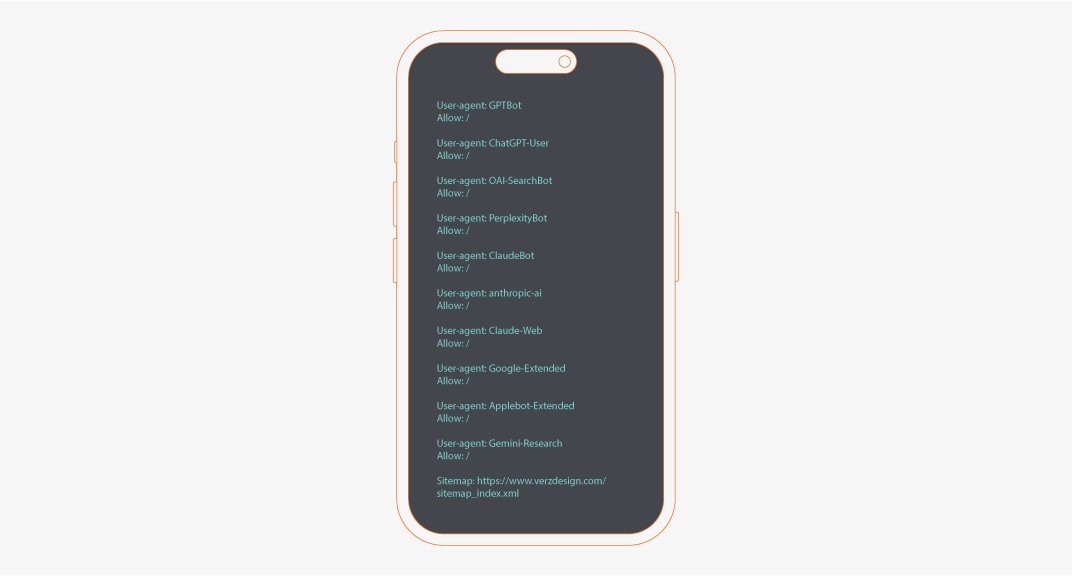
The AI bots you should explicitly allow in your robots.txt file:
GPTBot: ChatGPT’s web crawler. Blocked sites cannot appear in ChatGPT responses or SearchGPT results.
OAI-SearchBot: OpenAI’s search-specific crawler for cited responses in ChatGPT.
PerplexityBot: Perplexity’s crawler. Blocking this means no citations in Perplexity answers.
Google-Extended: Google’s crawler specifically for AI Overviews and Gemini training.
ClaudeBot and Claude-SearchBot: Anthropic’s crawlers for Claude AI responses.
Check yoursite.com/robots.txt right now to confirm none of these are in a Disallow rule. You can also review what llms.txt is and whether your website needs it as part of your broader AI-readiness review. If you use Cloudflare or another CDN with bot-protection settings, verify that these crawlers are explicitly on the allow list; they are often blocked by default ‘Bot Fight Mode’ configurations.
Understand the Role of llms.txt
llms.txt is a relatively new voluntary standard a plain-text file placed at yoursite.com/llms.txt that tells AI agents (tools like Cursor, GitHub Copilot, and other AI assistants operating on behalf of users) which pages of your site are most useful for them to access. It helps AI agents navigate your site intentionally rather than crawling randomly.
However, llms.txt does not function the same way for AI search bots (GPTBot, PerplexityBot, Google-Extended). These search crawlers almost universally follow robots.txt and ignore llms.txt. If you implement llms.txt, understand what it actually does: it signals to AI agents doing research tasks, not to search crawlers deciding what to cite. Both are worth configuring correctly; they serve different audiences.
For AI search citation: Configure robots.txt to explicitly allow the crawlers listed above.
For AI agent access: Implement llms.txt to list your most valuable pages and their purposes.
For content protection: Use robots.txt Disallow rules to block training scrapers (Common Crawl, DataProviderBot, and similar) while keeping search crawlers open.
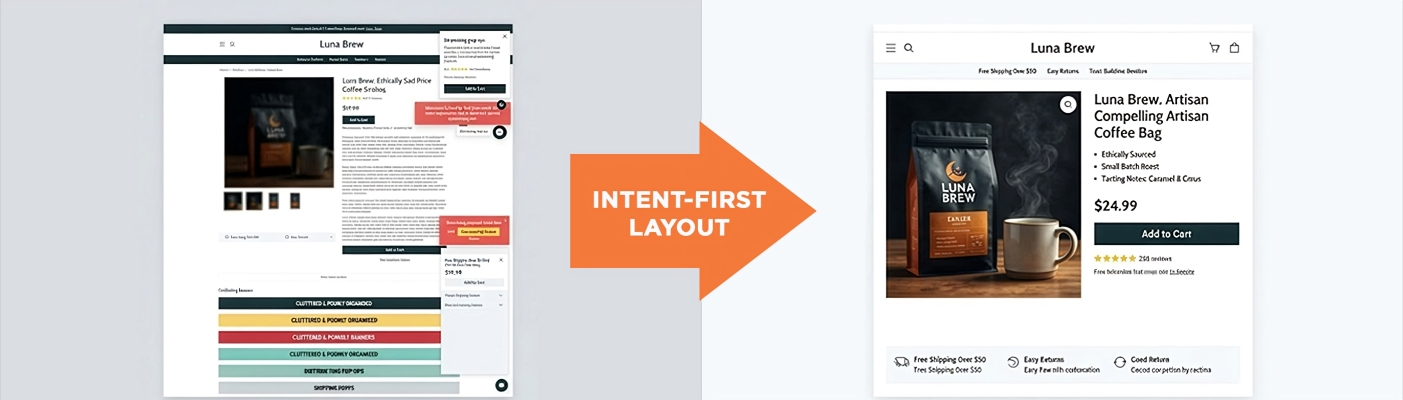
Design for Navigational, Commercial, and Transactional Intent
An AI-ready website isn’t just technically optimised it serves every type of visitor intent in a way that drives action. Visitors arrive at different stages of their decision-making process. Your web design should serve all of them without asking them to work for it.
Intent Type
What the Visitor
Wants
Web Design Elements That Serve This Intent
Navigational
Find a specific page, service, or brand resource
Clear site navigation; breadcrumbs; internal link architecture with question-format anchors; sticky header with CTA; search function; service hub pages that link to all related offerings
Commercial
Investigation
Compare options, evaluate agencies, read reviews
Case studies with measurable results; side-by-side service comparisons; client testimonials with company names and industries; clear pricing indicators; ‘Why us’ pages with specific differentiators
Transactional
Contact, book, enquire, download, get a quote
Persistent CTAs; free audit offers; frictionless contact forms; WhatsApp/phone visibility; chatbot or live chat; downloadable lead magnets (AI-readiness checklists); exit-intent offers
Informational
(GEO priority)
Learn what GEO is, get answers to specific questions
FAQ sections with schema; structured content with direct answers under headings; statistics with sources; step-by-step guides with HowTo schema
Design Elements That Serve High-CTR Intent Specifically
When AI summaries appear in search results, users click traditional links only 8% of the time. The websites that earn those clicks offer something the AI summary cannot replicate: interactive tools, downloadable resources, visual media, or a clear ‘next step’ that’s easier to complete on your site than to find elsewhere.
Interactive Tools and Calculators
Build cost estimators, project timeline generators, or design audit tools directly into your site layout. An AI summary can tell a visitor roughly what web design costs; it cannot give them a personalised quote. Your interactive calculator can. This is the clearest example of a web design element that drives clicks specifically because AI cannot replace it.
Gated High-Value Assets Offer downloadable templates, AI-readiness checklists, or comprehensive industry guides that require a direct visit to access. The PDF checklist from this article about ‘preparing your site for AI search’ is something a visitor must come to your site to download an AI summary will not reproduce the full PDF.
Video and Rich Media
Host custom video walkthroughs, client testimonial videos, and process demonstration reels. AI search engines cite facts. Users click through to experience media. A 90-second video of a Singapore client’s web design transformation drives more consultation enquiries than the same information in text.
Clear Design for Zero-Click Visibility If your business appears in an AI-generated summary, ensure the summary includes your specific name, phone number, and a memorable differentiator. This means your homepage and About page should contain clear, structured entity information: ‘[Company name] is a [specific service type] in [location] that helps [specific audience] achieve [specific outcome].’ When an AI engine summarises your brand, you want that summary to include your name and prompt someone to search specifically for you.
The Foundation Hasn’t Changed: What’s Built on It Has
Preparing your web design for generative search does not mean rebuilding everything from scratch. The fundamentals that have always produced good websites: clear structure, fast loading, genuine expertise, and content that actually answers real questions are precisely what AI systems reward.
What has changed is the precision with which you need to implement them. Schema markup used to be a nice-to-have. Now it directly determines whether your content is extractable by AI systems. Third-party brand signals used to be good for brand awareness. Now they are among the strongest predictors of AI citation probability. Question-format content used to serve user intent. Now it also serves LLM bot indexing preferences.
There are no shortcuts in GEO as the data consistently shows, no trick, prompt, or content hack makes your brand appear in AI answers reliably. Brands that receive consistent AI citations are the ones that have built genuine authority, structured their content clearly, and made sure AI crawlers can access and trust what they find. That work is exactly what well-designed websites have always required.
The generative search era rewards the same things good web design has always rewarded: clarity, speed, expertise, and trust. The difference is that AI engines can now check all four in seconds and they will.Ready to build a website that is designed for both people and generative search? Contact Verz Design to get started.
Frequently Asked Questions
What is Generative Engine Optimisation (GEO) and how is it different from SEO?
Traditional SEO optimises your website to appear on page one of Google's search results. GEO optimises your content to be cited inside AI-generated answers from tools like ChatGPT, Perplexity, and Google AI Overviews where the user reads a summary and may never click through to any website. The two practices overlap: 99% of AI Overview citations come from content already in Google's organic top 10. GEO builds on SEO rather than replacing it, but rewards different content decisions particularly structured data, direct answers under headings, and authentic third-party brand signals.
Does my website need to be redesigned to be AI-ready?
Not necessarily. Many websites can be made significantly more AI-ready through targeted changes: adding schema markup, rewriting key pages with direct answers under headings, configuring robots.txt to allow AI crawlers, updating image alt text, and adding FAQ sections. A full redesign is only needed if your site has fundamental structural problems, poor semantic HTML, slow mobile performance, or a design that buries key information. For most established business websites, a focused AI-readiness audit and implementation is more cost-effective than a full rebuild.
How do I know if AI search tools can currently find my website?
Check your robots.txt file (yoursite.com/robots.txt) to confirm that GPTBot, OAI-SearchBot, PerplexityBot, Google-Extended, and ClaudeBot are not in any Disallow rules. Then search for your brand name in ChatGPT, Perplexity, and Google AI Overviews and check whether you appear. Use Google Search Console to monitor AI Overview appearances for your key queries. You can also check your server access logs for bot traffic from these specific user agents; their presence (or absence) tells you directly whether they are crawling your site.
What is the most important technical change to make a website AI-ready?
Schema markup. Websites with deep structured data are crawled 17% more deeply by LLM bots, with content extracted 12% more reliably, and revisited 13% more often. FAQPage schema on your key pages is the single highest-impact technical change for AI Overview visibility. After that: semantic HTML structure, fast mobile loading (LCP under 2.5 seconds), and question-format content directly answering the queries your audience asks about AI tools.
How does site speed affect AI search citation probability?
AI crawlers are time-constrained; a slow page that takes five seconds to load may time out before the crawler extracts its content. Google's quality signals also incorporate Core Web Vitals performance, and since 99% of AI citations come from the organic top 10, poor page speed that reduces rankings indirectly reduces AI citation probability. Target LCP under 2.5 seconds on mobile as the primary speed benchmark. Clean code, compressed images, minimal JavaScript blocking, and a CDN are the standard fixes.
What is llms.txt and should my website have one?
llms.txt is a voluntary text file placed at yoursite.com/llms.txt that tells AI agents tools like Cursor, GitHub Copilot, and similar AI assistants which pages of your site are most useful for research tasks. It works similarly to robots.txt but for AI agents rather than search crawlers. You should know that AI search crawlers (GPTBot, PerplexityBot, Google-Extended) do not use llms.txt they follow robots.txt instead. Implementing llms.txt is low-effort and worth doing for agentic AI use cases, but it does not directly affect your AI search citation rate.
How long does it take to start appearing in AI-generated search answers?
It varies significantly. If your content already ranks well in Google's top 10, adding schema markup, FAQ sections, and direct-answer formatting can see you appear in AI Overviews within a few weeks. Building AI visibility for entirely new content or for a brand with no established search presence typically takes 3–6+ months. You need the underlying SEO foundation first. Third-party brand mentions in industry publications and review platforms can accelerate the process, since AI systems weight external validation heavily.
Does AI-generated content hurt GEO performance?
Low-quality, unedited AI content consistently underperforms in both traditional SEO and GEO. A Semrush study of 42,000 blog posts found that purely AI-generated content holds the number-one SERP position only 9% of the time. AI-assisted content where a human writer substantially edits, adds expert insights, and verifies facts performs within 4% of fully human-written content in ranking benchmarks. For GEO specifically, adding original statistics, expert quotes, and proprietary insights (things an AI could not generate itself) significantly improves citation probability.
How important are customer reviews for AI search visibility?
Very important and often underestimated. AI systems use external third-party signals to evaluate whether a brand should be recommended. A few negative reviews on Google Business Profile, Trustpilot, or Clutch can cause your business to drop out of AI recommendation results for relevant queries entirely. A concentrated effort to build authentic, positive reviews on trusted platforms (not fake reviews AI systems can assess authenticity patterns) has a disproportionately large effect on AI recommendation probability compared to publishing additional content on your own site.
About the Author:
Bea Dyra Boquiron
Content writing has been a rewarding journey for Dyra, opening up numerous opportunities for her to explore her creativity, sharpen her skills, and connect with people from all walks of life. She loves being able to turn thoughts and ideas into something meaningful, finding fulfillment in seeing how her words...
Contributors:
Vivek Tank
Senior SEO Specialist
Need a strong team specialised in SEO?
Speak to Verz today if you are looking to create a website with a lasting impression to achieve online success.


 Share
Share