When a potential customer visits your website at 11pm on a Sunday, what happens? If your answer is ‘they fill out a form and get a reply by Wednesday,’ you’re losing business that doesn’t need to be lost.
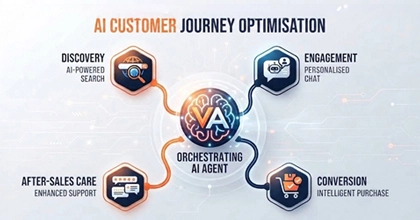
AI agents change that equation. Unlike basic chatbots that follow rigid scripts, AI agents can understand what a customer is actually asking, connect with your CRM or booking system, and take the right action in real time whether that’s answering a technical question, qualifying a lead, or booking a consultation directly into your calendar.
The adoption shift is already well underway. According to Salesforce’s 2026 State of Marketing report, 91% of customer service and support leaders now face direct executive pressure to deploy AI capabilities. Deloitte predicts that 25% of large businesses will have deployed AI agents by the end of 2025, rising to 50% by 2027. For marketing and customer experience teams, this is not a future consideration, it is an active strategic decision happening now.
This guide explains what AI agents actually are, how they reshape the customer journey, and how Singapore businesses can incorporate them into a broader digital marketing strategy that creates real results without adding unnecessary complexity.
What Is an AI Agent?
An AI agent is a software system that can perceive its environment, reason about what it observes, and take action to achieve a goal without needing a human to direct every step.
Unlike a traditional software tool that executes a fixed set of instructions, an AI agent can interpret natural language, retain context from previous interactions, connect to external systems (CRMs, calendars, databases, payment platforms), and decide what action to take based on what it understands about the current situation.
In a digital marketing context, this means an AI agent on your website can do things a form or a standard chatbot cannot: hold a genuine conversation, understand what stage of the buying process a visitor is at, gather information about their specific needs, qualify them against your lead criteria, and connect them with the right resource or person all in a single session.
Customer service conversations handled by AI agents grew at a compound monthly rate of 2,199% in the first half of 2025. (Source: Salesforce Agentic Enterprise Index)
From Chatbots to Autonomous AI Agents: What Has Changed?
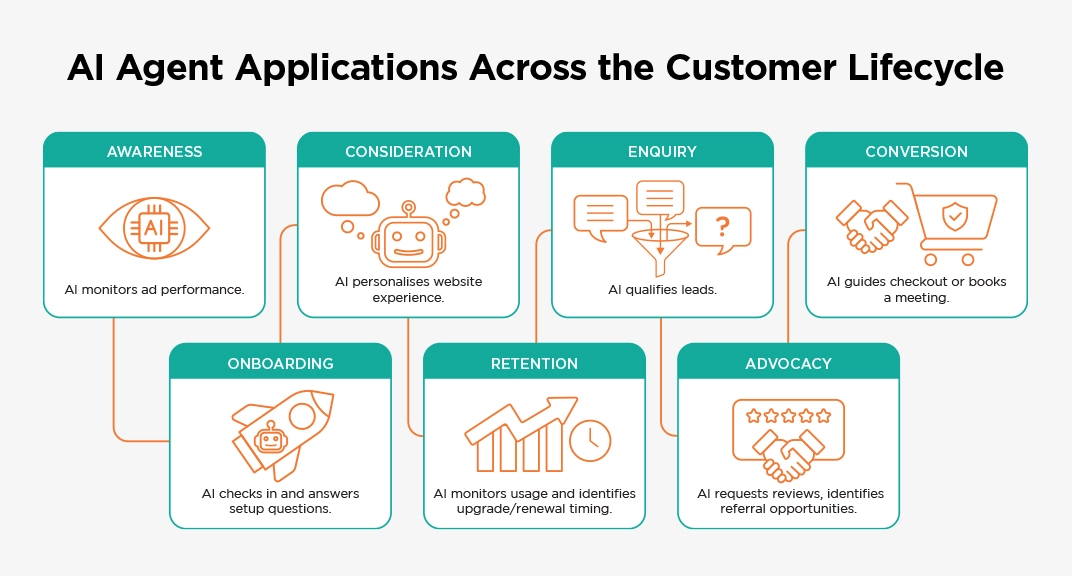
AI in marketing once meant generating headline variations, analysing campaign data, or setting up simple chatbot scripts. Those tools still have their place, but businesses can now deploy AI agents that handle more complex tasks across the entire customer journey, tasks that used to require a human to be available and present.
AI in marketing once meant generating headline variations, analysing campaign data, or setting up simple chatbot scripts. Those tools still have their place, but businesses can now deploy AI agents that handle more complex tasks across the entire customer journey, tasks that used to require a human to be available and present.
AI in marketing once meant generating headline variations, analysing campaign data, or setting up simple chatbot scripts. Those tools still have their place, but businesses can now deploy AI agents that handle more complex tasks across the entire customer journey, tasks that used to require a human to be available and present.
The difference is not simply that one technology is more advanced. It is about what the technology can do for the customer at the moment they need it.
Dimension
Traditional Chatbots
AI Agents
Understanding
Follow predefined scripts
Interpret natural-language requests
Decision-making
Rely on decision trees
Assess situations, weigh options, choose best action
Question handling
Manage predictable, scripted queries
Handle complex, multi-step customer interactions
Escalation
Escalate when reaching script limits
Resolve when possible or escalate with full context
Channel operation
Work within a single channel
Connect with multiple channels and external systems
Context retention
Reset per session no memory
Maintain context across sessions and channels
Learning
Static rules only change by update
Improve from interactions and feedback over time
Integration
Limited system connections
Connect to CRMs, booking systems, inventory, and more
Instead of making someone find the right page, fill in a form, and wait two days for a response, an AI agent can help them move forward during the interaction itself. That shift from passively waiting for a customer to navigate your systems, to actively helping them reach the right outcome is what makes AI agents genuinely different from the automation tools that came before.
The AI Agent Market: Why 2026 Is the Turning Point
The scale of adoption in 2026 makes this a strategic priority rather than an exploratory option. These figures from verified 2025 and 2026 primary sources show where the market is and where it is heading.
The adoption gap is the opportunity: 75% of marketers use AI in some form, but only 13% have deployed self-directed AI agents. The businesses that close this gap in 2026 will have a meaningful head start in customer experience quality and operational efficiency. (Source: Salesforce State of Marketing 2026)
How AI Agents Personalise the Buyer Journey?
Static landing pages give every visitor roughly the same experience. That approach made sense when businesses had limited real-time information about the people visiting their site. In 2026, the information available at the point of a website visit is significantly richer and AI agents can use it.
Static landing pages give every visitor roughly the same experience. That approach made sense when businesses had limited real-time information about the people visiting their site. In 2026, the information available at the point of a website visit is significantly richer and AI agents can use it.
An AI agent can analyse signals such as browsing behaviour, referral source, previous interactions, and session context to understand what a visitor may be looking for. This builds on the same principle behind a customer journey map, where businesses identify customer needs, behaviours and touchpoints across different stages of the buying journey. Rather than forcing every visitor through the same linear journey, it can then adapt the experience to the individual.
What does this look like in practice?
A visitor arriving from a LinkedIn post about eCommerce automation has a very different context from someone who found your site by searching ‘Shopify developers Singapore.’ An AI agent that recognises these signals can adjust the conversation accordingly, presenting relevant case studies, asking the right qualifying questions, and proposing the most appropriate next step for each visitor.
Recommend relevant products or services based on stated intent and browsing behaviour
Adjust messaging based on what the visitor appears to need, not what everyone else needs
Answer specific questions about products, pricing, or process without requiring the visitor to navigate away
Guide visitors towards the most relevant content, tools, or pages
Propose the next step a consultation, a download, a demo based on where the visitor is in their decision
91% of consumers are more likely to purchase from brands that recognise and respond to their preferences. (Source: Accenture)
Creating a More Connected Customer Experience
Getting a customer to the door is only part of the job. What happens after they arrive and after they convert shapes how they feel about the brand long-term. The problem most businesses face is that customers do not think in terms of departments or channels. They simply expect the company to know who they are and what they have already communicated.
When a customer has to repeat the same question to three different team members across three different channels, the friction is cumulative. McKinsey research found that 83% of marketers report customers expect two-way conversations, while 69% struggle to respond promptly due to fragmented data and disconnected systems. AI agents can help bridge that gap when implemented with the right integrations.
Zero-Friction Lead Qualification
A traditional lead journey involves multiple steps: submission, wait, initial call, qualification questions, wait again, then a sales conversation. The delay creates space for the prospect to lose momentum or find a competitor who responded faster.
AI agents can compress that process without removing the human element at the appropriate stage:
Engage website visitors in a natural conversation when they show intent signals
Answer common technical or product questions immediately, in the session
Gather information about the customer’s situation and requirements
Qualify the enquiry against your defined criteria in real time
Book a meeting directly into your sales team’s calendar
Provide useful next steps or resources while the enquiry is being processed
The goal is not to remove salespeople from the process. It is to make sure their time goes towards conversations that genuinely benefit from human expertise and that those conversations start from a stronger position because the context has already been captured.
Omnichannel Memory and Continuity
A well-integrated AI agent maintains conversation context across channels. When a customer moves from your website chat to WhatsApp to email, the system can use the context from previous interactions to provide a more continuous experience reducing the number of times a customer has to explain who they are and what they need.
For the customer, that means less repetition and a sense that the brand actually remembers them. For the business, it means a clearer, more complete picture of each customer’s journey, preferences, and previous concerns data that makes every future interaction more relevant.
Using AI Agents Beyond Customer Service
Customer-facing conversations are the most visible application of AI agents in marketing, but they are not the only ones. Businesses can also use AI agents to support marketing teams with campaign management, performance monitoring, post-purchase engagement, and emerging agentic commerce experiences that benefit from continuous attention rather than periodic human check-ins.
Real-Time Campaign Orchestration
Marketing campaigns change faster than any human team can monitor every metric every second. An ad that performs strongly in the morning may lose momentum after lunch. A particular audience segment may respond significantly better to one message than to another.
AI agents can monitor campaign performance continuously and respond based on predefined rules and objectives. Depending on the level of access granted:
Track campaign conversion performance across channels in real time
Identify underperforming ad variations before significant budget is wasted
Flag unusual changes in performance for human review
Recommend or action budget adjustments towards stronger-performing channels
Adjust audience targeting based on defined performance criteria
Human oversight still matters here. Marketers should determine what the agent can change independently, what it should flag, and when it should request approval. The value comes from combining constant monitoring with human judgement on the decisions that carry higher risk not from handing over campaign strategy entirely.
Predictive Post-Purchase Engagement
The customer journey does not end at conversion. A customer who has just made a purchase may need help with setup, have questions about how to use the product, or be approaching the point when they need a refill, renewal, or upgrade. AI agents can monitor relevant signals usage patterns, order history, time since purchase and identify moments when a proactive message would be genuinely useful rather than just promotional.
The key distinction is timing and relevance. A follow-up that arrives at the right moment, addressing a need the customer actually has, builds loyalty. A generic promotional message sent on a fixed schedule does the opposite.
Why Human Oversight Still Matters?
The rise of AI agents does not mean handing your entire customer experience over to automated systems. Some conversations require judgement, empathy, and the kind of contextual understanding that comes from genuine human expertise. A customer dealing with a sensitive complaint, a complex negotiation, or a highly specific technical question does not want to feel like they are arguing with a system that cannot adapt beyond its training.
The strongest implementations keep humans involved where they add the most value, and let the agent handle what it genuinely does better: availability, consistency, speed, and the ability to gather and structure information before a human needs to act on it.
What makes a good human handoff?
A well-designed AI agent should know when it has reached the limits of what it can handle well. When a conversation involves a complex negotiation, a sensitive complaint, or a request that requires specialist knowledge, the agent routes the customer to the appropriate team member. More importantly, it provides the relevant context before making that handoff:
The customer’s original question and the conversation that followed
Information the customer has already provided
What the agent has already done or offered
The reason for escalation
Any relevant history from previous interactions
That context saves the customer from starting over and gives the employee enough information to engage from an informed position. The best handoff is one the customer barely notices the conversation continues rather than resets.
Setting Clear Guardrails for Your AI Agent
Autonomous systems need clearly defined boundaries. Without them, an agent could provide inaccurate information, make recommendations that don’t reflect your actual offer, or communicate in a way that doesn’t match your brand voice. Before deploying any AI agent, define:
What information the agent can access and use?
What actions can it take independently versus what requires human approval?
How should it handle sensitive or personal customer information?
What can and cannot say on behalf of the brand?
When and how should it escalate a conversation?
How should it respond when it does not know the answer?
These guardrails should be reviewed and updated as the system evolves and as your understanding of how customers interact with it grows. An AI agent is not a one-time deployment; it requires ongoing attention to remain accurate, appropriate, and genuinely useful.
AI Agents in the Singapore Market: What the Opportunity Looks Like
Singapore businesses are operating in a competitive digital environment where customer expectations are rising faster than most teams can scale to meet them. The combination of a tech-savvy consumer base, a high digital adoption rate, and a relatively small talent pool for customer-facing roles makes AI agents particularly relevant for Singapore marketing and customer experience teams.
Where Singapore businesses are already seeing results?
Lead qualification for professional services: Law firms, financial advisers, and consultancies are using AI agents to qualify website enquiries and route them to the right specialist reducing the time between first contact and a meaningful conversation.
After-hours engagement for retail and eCommerce: Singapore consumers shop across time zones. An AI agent that handles product questions, size guidance, and checkout support at 2am converts visitors that a static FAQ page would lose.
WhatsApp-first customer service: WhatsApp is the dominant messaging platform in Singapore. AI agents that operate natively in WhatsApp remembering customer history and providing personalised support align with how Singapore consumers prefer to communicate.
Multilingual support: Singapore’s multicultural market often requires support across English, Mandarin, Malay, and Tamil. AI agents can provide consistent, accurate responses across languages without requiring separate teams for each.
Designing AI Agent Experiences for Navigational, Commercial, and Transactional Intent
An AI agent that treats every visitor the same way is not much better than a form. The genuine value comes from recognising what a visitor is actually trying to accomplish and designing the agent’s responses around that intent.
Intent
Visitor Goal
AI Agent Design That Serves This Intent
Navigational
Find the right service, page, or resource
AI agent as a navigation guide: “What are you looking for?” with personalised routing based on visitor profile and intent signals. Links to specific service pages, case studies, or comparison tools.
Commercial
Investigation
Compare options, evaluate agencies, read case studies
AI agents present relevant case studies by industry, service comparisons, ROI examples. Answers ‘How does your approach differ from competitors?’ with concrete client results rather than generic claims.
Transactional
Book a consultation, get a quote, request a proposal
AI agent captures requirements in conversation, qualifies the lead, and books a calendar slot directly removing the static form and 48-hour wait. Offers instant next steps: call, chat, or meeting booking.
Informational
Learn what AI agents are and how they work
An AI agent answers questions, explains concepts, and guides towards a self-assessment. Delivers educational content contextually right content at the right moment of the learning journey.
The Commercial Intent Opportunity: Where Most Businesses Leave Value on the Table
Visitors with commercial intent comparing options, reading case studies, evaluating agencies are your highest-value website visitors. They have already decided they need a service like yours. What they have not decided yet is who to choose.
A standard website presents them with the same homepage as every other visitor. An AI agent can recognise the evaluation-stage signals and present relevant proof: a case study matching their industry, a comparison of your approach versus common alternatives, specific client results in their service category. It can then offer a direct next step: a demo, a scoping call, a proposal while they’re actively engaged rather than asking them to come back.
This is the highest-ROI application of AI agents for most B2B and professional services businesses in Singapore, because it captures intent at the exact moment it’s most valuable.
How to Start Implementing AI Agents for Your Singapore Business?
The common mistake businesses make with AI agent implementation is trying to do too much at once. A comprehensive AI agent strategy that covers every touchpoint, integrates with every system, and handles every use case simultaneously will take longer to deploy, cost more than expected, and deliver results later than necessary.
A more practical approach starts with one high-value, clearly scoped use case and builds from there.
A 6-Step Implementation Framework
Identify one clear starting point: Choose the highest-friction moment in your current customer journey the place where customers wait longest, ask the most repetitive questions, or drop off most frequently. Lead qualification and after-hours enquiry handling are strong starting points for most Singapore businesses.
Define what the agent needs to know and do: Before selecting any technology, specify: what information the agent should have access to, what it should be able to do independently, what it should escalate, and what it should never do. Guardrails are easier to set before deployment than to add after.
Select the right integration layer: An AI agent that works in isolation from your CRM, calendar, or eCommerce platform has limited practical value. Identify the two or three system integrations that would make the agent genuinely useful and prioritise those connections.
Build a feedback loop from day one: An AI agent’s first deployed version is rarely its best. Define how you will monitor what the agent is doing, how customers are responding, and where it is falling short. Plan to review and update the agent’s knowledge and guardrails on a defined schedule.
Verify AI crawler access: If your website has AI-readable content about your services, confirm that major AI search crawlers (GPTBot, OAI-SearchBot, PerplexityBot, Google-Extended, and ClaudeBot) are not blocked in your robots.txt or CDN security settings. This is one part of preparing your website for AI-powered search engines, alongside content structure and technical accessibility. An AI agent on your site cannot help you if AI search systems cannot find and index your content.
Expand based on what you learn: Once the initial use case is working reliably, use the data and learnings from that deployment to inform the next phase—whether that’s a new channel, a new use case, or a deeper integration with an existing system.
Building an effective AI agent strategy is not a one-week project. The businesses achieving the best results with AI agents in 2026 planned their implementations over 3–6 months, tested continuously, and treated the initial deployment as the beginning of an ongoing programme rather than a finished product.
Ready to Build an AI-Powered Customer Journey for Your Business?
The shift towards AI agents in marketing is not primarily about automation. It is about removing the moments that make customers stop, wait, or feel like they have to work to be helped. A customer who can get an accurate answer to their question at 11pm on a Sunday, book a meeting in the same conversation, and receive a genuinely personalised follow-up two days later is not experiencing automation; they’re experiencing a business that functions well.
That experience used to require a large team with exceptional processes. AI agents make it achievable for businesses of any size, provided the implementation is designed around genuine customer needs rather than around the technology itself.
The 13% of marketers who have already deployed self-directed AI agents are building a meaningful lead in customer experience quality and operational efficiency. The other 87% of the market your Singapore business is competing in have not yet made this transition. The window to build that advantage is open now. Ready to explore what AI agents could do for your business? Contact our team to discuss your requirements and identify the right starting point.
Frequently Asked Questions
What is an AI agent and how is it different from a chatbot?
A chatbot follows predefined scripts and decision trees. It works well for predictable questions but quickly reaches its limits when conversations go outside the programmed flow. An AI agent interprets natural language, retains context from previous interactions, connects to external systems like your CRM or booking calendar, and decides what action to take based on the current situation. The difference is that an AI agent can handle genuinely complex, multi-step customer interactions, not just route customers through a menu.
How do AI agents personalise the customer experience?
AI agents analyse real-time signals browsing behaviour, referral source, previous interactions, and stated preferences to understand what a visitor is most likely looking for. Based on this understanding, the agent adjusts its responses: presenting relevant case studies for visitors comparing agencies, answering technical questions for visitors deep in evaluation, or proposing the most appropriate next step for visitors ready to enquire. The result is a different conversation for different visitors at different stages rather than one generic experience for everyone.
What business tasks can AI agents handle in digital marketing?
The most common applications are lead qualification (engaging website visitors, gathering requirements, and booking meetings automatically), omnichannel customer support (maintaining context across WhatsApp, website chat, and email), real-time campaign monitoring (tracking performance and flagging issues for human review), and post-purchase engagement (timing relevant follow-up based on customer usage patterns). More advanced deployments also use AI agents for audience segmentation, campaign orchestration, and personalised content delivery at scale.
What is the ROI of implementing AI agents in marketing?
Businesses generating $5.44 for every $1 spent on marketing automation is the benchmark from current industry data (SQ Magazine, 2026). Companies that integrate AI agents specifically see an average 23% increase in lead conversion rates (Vellum.ai, 2026). AI-driven personalisation delivers 10–15% revenue uplifts and 15–20% cost reductions per McKinsey. However, ROI depends significantly on implementation quality what use case is chosen, how well the agent is integrated with existing systems, and how consistently it's monitored and improved.
When should an AI agent escalate to a human?
An AI agent should escalate when: a customer is dissatisfied and requires empathetic human handling; the query involves sensitive personal or financial information that requires human judgement; the request is highly specific and falls outside the agent's configured knowledge base; a negotiation or commitment requires authority that the agent is not set up to provide; or when the agent's own confidence threshold for a response falls below the level you've defined as acceptable. The agent should always provide the escalating human with the full conversation context before the handoff.
How long does it take to deploy an AI agent for a Singapore business?
A focused, single use-case deployment such as lead qualification and meeting booking on a service business website typically takes 4–8 weeks from scoping to live deployment. This includes integration with your CRM and calendar, defining the agent's knowledge base and guardrails, testing across scenarios, and a monitored launch phase. More comprehensive deployments spanning multiple channels and use cases typically take 3–6 months. The businesses achieving the best results treat deployment as the beginning of an ongoing programme rather than a one-time project.
Do AI agents work with Singapore-specific messaging platforms like WhatsApp?
Yes. WhatsApp is the dominant messaging platform in Singapore and across Southeast Asia, and AI agents can be configured to operate natively within WhatsApp Business API maintaining conversation history, recognising returning customers, and providing personalised support in the way Singapore consumers prefer to communicate. Integration with WhatsApp is one of the most commercially valuable AI agent deployments for Singapore retail, professional services, and hospitality businesses specifically.
What data and systems does an AI agent need to be effective?
The most impactful AI agent deployments are integrated with at least two or three core business systems. For a marketing and sales use case, that typically means: your CRM (so the agent knows who it's talking to and can log the conversation), your calendar or booking system (so it can schedule meetings directly), and your product or service knowledge base (so it can answer questions accurately). Without these integrations, an AI agent becomes a sophisticated but isolated chat window rather than a genuine part of your customer experience infrastructure.
What guardrails should I set for an AI agent representing my brand?
At minimum, define: what information the agent can access and cite; what actions it can take without human approval; how it should handle requests outside its knowledge base (acknowledge limitations rather than guess); what tone and language it should use; how it should handle sensitive customer information; and what constitutes an automatic escalation to a human. Review these guardrails regularly as the agent's role evolves and as you gather data on how customers actually interact with it.
About the Author:
Bea Dyra Boquiron
Content writing has been a rewarding journey for Dyra, opening up numerous opportunities for her to explore her creativity, sharpen her skills, and connect with people from all walks of life. She loves being able to turn thoughts and ideas into something meaningful, finding fulfillment in seeing how her words...
Contributors:
Vivek Tank
Senior SEO Specialist
Need a strong team specialised in SEO?
Speak to Verz today if you are looking to create a website with a lasting impression to achieve online success.

 Share
Share