



AI search is the broader shift toward people finding and evaluating brands through AI assistants like ChatGPT, Perplexity, Gemini, and Google AI Overviews, rather than through a traditional list of results. Making a brand visible in this environment spans four related disciplines:
- SEO (ranking on traditional results pages)
- GEO (being recommended inside an AI-generated answer)
- AEO (being directly cited as an answer’s source)
- AIO (being legible to any AI system, search-based or not)
All four share a common technical foundation: clear structure, genuine authority, well-organised content, and consistent entity data, but each targets a different outcome and is measured differently. For a broader look at how AI search is changing SEO, see our guide to the evolving search landscape in 2026.
Why Has AI Search Changed How People Find Brands?
For two decades, “search” meant typing a query into Google and scanning a results page. That is no longer the whole picture for Singapore consumers or for the businesses trying to reach them.
A growing share of queries are now answered, at least in part, by AI systems that read across many sources and synthesise a direct answer rather than listing pages for people to click through. This shows up in several distinct places:
- Google AI Overviews generate a synthesised answer directly above the traditional organic results, often answering the question before a person scrolls any further.
- Conversational AI assistants (ChatGPT, Perplexity, Gemini, Microsoft Copilot) are used directly as research and recommendation tools, often as a first stop rather than a fallback from search.
- AI-driven shopping and comparison tools increasingly rely on structured product and brand data to generate recommendations, independent of either traditional search or conversational AI.
What connects all three is the underlying mechanism: these systems do not rank pages the way traditional search does. They read, synthesise, and either cite a source directly or fold information into an answer without a formal citation. That distinction, cited versus simply absorbed, separates the disciplines explained in the next section. The practical consequence for a Singapore business: being easy to find in traditional search no longer guarantees being part of the answer when a buyer asks an AI system the same question.
The Data: How Far This Has Progressed
The shift toward AI-mediated discovery is not a projection; it is measurable today in Singapore and globally.
AI Search in 2026: The Numbers Singapore Businesses Need to Know
68% of Google searches end without any click to any website
48% of tracked queries now trigger a Google AI Overview
83% zero-click when an AI Overview appears on the results page
Up to 40% higher visibility in generative engine responses from specific content techniques
90% of brands have zero mentions in any AI-generated answer
65% collapse in organic CTR on queries where AI Overviews appear
14.2% conversion from AI-referred traffic vs 2.8% from regular Google
The relationship between AI visibility, zero-click behaviour and business outcomes is explored further in our guide to AI and zero-click search. Two numbers stand out for Singapore businesses considering where to invest.
- First: 90% of brands have zero AI mentions; most of Singapore’s competitive landscape has not yet built AI visibility.
- Second: AI-referred traffic converts at 14.2% versus regular Google traffic’s 2.8%, roughly five times higher. Visitors arriving via an AI recommendation have already been pre-qualified by the AI system’s evaluation, making them meaningfully closer to a decision.
Taken together, the data point to one conclusion: AI-mediated discovery is large, growing, and currently won by a small minority of brands that have invested in the right signals. The window for Singapore businesses to establish AI visibility before their competitors is measurable and finite.
The Four Disciplines of AI Search Visibility
AI search visibility is not a single practice. It spans four related disciplines, each targeting a different outcome. Understanding which discipline addresses which gap is the first step in building the right strategy.
SEO (Search Engine Optimisation)
The original discipline, and still the foundation everything else builds on. SEO improves a site’s ranking position on traditional results pages through keyword targeting, technical performance, content quality, and backlink authority. The entity clarity, content quality, and authority signals that support strong SEO are largely the same signals the other three disciplines depend on, which is why none of them replaces it. A brand starting from zero AI visibility almost always needs to address SEO fundamentals before it can build the other disciplines effectively.
GEO (Generative Engine Optimisation)
GEO earns a brand mention, recommendation, or inclusion in a generative AI’s synthesised answer, whether or not that mention includes a formal citation. Researchers at Princeton, Georgia Tech, the Allen Institute for AI, and IIT Delhi formally named GEO in a 2023 academic paper, and controlled testing found that specific content techniques could boost a source’s visibility in generative-engine responses by up to 40%. GEO is broader than AEO; being part of the answer, rather than necessarily being the cited source, is the win condition. For a deeper explanation of how generative engine optimisation works and how it fits into AI search, see our GEO guide.
AEO (Answer Engine Optimisation)
AEO narrows the target: earning a direct citation the specific line an AI answer links back to as its source. Understanding how AI systems decide what content to cite helps explain why relevance, structure, clarity, and trust signals matter when trying to earn those citations. Where GEO is about being part of the answer, AEO is about being the answer’s named source. For a deeper look at the principles behind AEO for AI search, including answer-focused content and structured data, see our dedicated guide.
It is the most measurable of the three AI-native disciplines: a citation is either present or it isn’t, and it is the most demanding, requiring specific content structure and schema markup. Pages cited inside AI Overviews earn 35% more organic CTR and 91% more paid CTR than non-cited competitors on the same query.
AIO (AI Optimisation)
AIO is the broadest discipline, making a brand’s content and entity data legible to any AI system, including AI shopping assistants, voice assistants, and AI agents, not just conversational search. If AEO and GEO focus on winning inside a specific AI-generated answer, AIO focuses on ensuring a brand’s information is correct and consistent everywhere an AI system might encounter it. AIO is primarily a technical discipline: Organisation schema, consistent NAP data across all directories, Product schema for eCommerce, and confirmed AI crawler access in robots.txt.
How the Four Disciplines Relate?
These are not four competing strategies. They are four outcomes built from largely the same underlying technical work. The comparison below shows where each discipline focuses and why a brand rarely needs to choose between them.
| Factor | SEO | GEO | AEO | AIO |
|---|---|---|---|---|
| Goal | Rank on the traditional results page | Be mentioned or recommended in an AI-generated answer | Be the directly cited source of an AI answer | Be legible to any AI system on any surface |
| Surface | Google, Bing, traditional SERP | ChatGPT, Perplexity, Gemini, Google AI Overviews | Same platforms citation-specific | Search AI, shopping AI, voice assistants, AI agents |
| Scope | Widest reach, longest-established discipline | Medium: one generated response | Narrowest: one specific citation | Broadest: every AI touchpoint |
| Win condition | Page 1, positions 1-3 | Named in a generated answer | Your page URL is the cited source | Brand data accurate everywhere AI reads it |
| Core signals | Keyword targeting, backlinks, technical performance, E-E-A-T | Entity clarity, external mentions, answer-first content | FAQPage schema, specific verifiable claims, E-E-A-T | Organisation schema, consistent NAP, product data, crawler access |
| Singapore example | “web design agency Singapore” page 1 ranking | ChatGPT recommends Verz Design for eCommerce builds | Perplexity cites Verz Design blog as source for a GEO stat | Siri and AI Shopping describe Verz Design's services correctly |
The key insight: the content and technical work that earns a strong SEO ranking- clear structure, genuine authority, well-organised information, and consistent entity data is largely the same work that earns AI mentions, citations, and legibility. Verz Design runs all four through a single framework: the 5 Pillars of Generative Visibility.
How to Calculate Your Website's Conversion Rate?
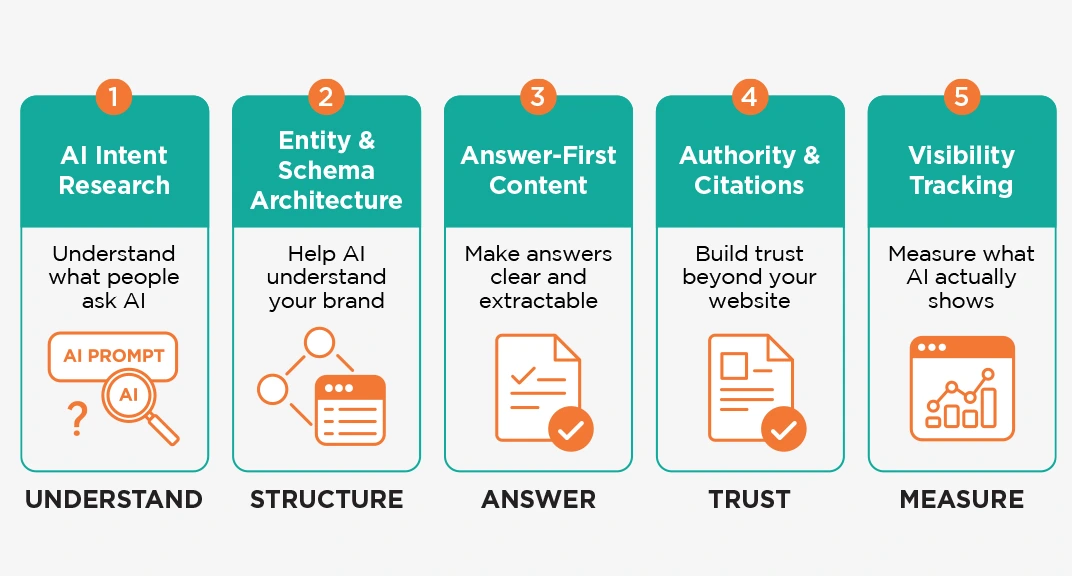
Most agencies treat SEO, GEO, AEO, and AIO as separate products. That is an inefficient approach to a problem where all four disciplines share much of the same foundation.
Verz Design runs all four through a single philosophy: the 5 Pillars of Generative Visibility. The pillars form a compounding sequence. Understanding which questions matter (Pillar 1: AI Intent Research) shapes what gets built for AI identification (Pillar 2: Entity and Schema Architecture). That foundation is what makes content extractable (Pillar 3: Answer-First Content Engineering). Extractable content earns more weight when backed by real third-party trust (Pillar 4: Authority and Citation Sourcing). And none of it means anything without honest monthly measurement of what actually moved (Pillar 5: Visibility Tracking).
The result: work done once through this framework serves SEO ranking, GEO recommendation, AEO citation, and AIO legibility simultaneously. For the full step-by-step implementation of each pillar, see the AI Search Optimisation Complete Guide.
Which Discipline Matters Most by Industry?
AI search affects discovery broadly, but which discipline to build first tends to differ by business category.
| Industry (Singapore) | Lead Discipline and Why |
|---|---|
| eCommerce and Retail | AIO first AI shopping assistants depend on Product, Offer, and AggregateRating schema. Without structured product data, a Singapore eCommerce brand is invisible to AI commerce tools regardless of GEO or AEO content strength. |
| B2B and Professional Services | AEO and GEO buyers ask AI to name or compare providers. FAQPage schema, comparison content, and external editorial mentions are the primary levers. |
| F&B and Hospitality | GEO and LocalBusiness AIO discovery queries are recommendation-driven (“best restaurant in Tanjong Pagar”) and rely on local entity signals (GBP, location schema, review signals). |
| Finance, Legal and Healthcare | AEO with E-E-A-T focus: YMYL categories require named author credentials, regulatory compliance signals, and specific verifiable claims to earn AI citation. |
| SaaS and Technology | AEO for comparison; GEO for discovery buyers compare named tools in ChatGPT. Honest comparison content and feature tables outperform marketing-speak in citation tests. |
| Fashion and Apparel | GEO for recommendation queries, AIO for product attribute search, a mix of brand recommendation (GEO) and structured product data for AI fashion search (AIO). |
| Education and Training | GEO for programme discovery; Course schema for AIO prospective students asking AI for programme recommendations. Course schema and FAQPage content for common questions drive both. |
Not Sure Where Your Singapore Business Stands in AI Search?
AI search isn’t a trend Singapore businesses can afford to watch from a distance. With 68% of Google searches ending without a click, 48% of queries triggering AI Overviews, and 90% of brands invisible in AI-generated answers, the gap between brands that have built AI visibility and those that haven’t is growing with every month.
The practical good news: the technical work required is learnable and buildable. The signals AI systems use clear content structure, consistent entity data, genuine external mentions, and schema markup are not mysterious. They are the same signals that make a website genuinely good: accurate, authoritative, well-organised, and easy for any system, human or AI, to understand.
This page is the starting point. The resource map above links to every deeper guide in Verz Design’s AI search cluster. The right next step depends on where you are: new to the topic, ready to build a strategy, or trying to make the business case internally. Each resource map section points to the right starting point for each situation.
If your business needs help turning these principles into an actionable AI search strategy, an AI SEO agency in Singapore can assess your current visibility and identify areas for improvement. If you’re ready to take the next step, get in touch with Verz Design to discuss your business’s current search presence and what to prioritise next.

Get more value from your existing website traffic
Contact Verz Design about a CRO strategy tailored to your business goals.
Get a free CRO consultation
Frequently Asked Questions
AI search is the shift toward people finding and evaluating brands through AI assistants (ChatGPT, Perplexity, Gemini, Google AI Overviews) rather than a traditional list of ranked links. In AI search, an AI system reads across many sources and synthesises a direct answer rather than simply listing pages for a user to click through. This changes how brands think about visibility: being on page 1 of Google no longer guarantees your brand will be part of the answer when a buyer asks the same question to an AI system.
Not entirely, but it is changing what a strong traditional ranking actually guarantees. Google AI Overviews and conversational AI assistants increasingly answer questions directly above or instead of organic results, meaning 68% of Google searches in 2026 now end without a click to any website (SparkToro/Datos 2026). For Singapore businesses, this means visibility must extend beyond the traditional results page into the AI-generated answers that appear before and alongside organic results.
SEO targets ranking position on traditional results pages. GEO targets being mentioned or recommended inside an AI-generated answer. AEO targets being the specific cited source the page an AI links back to as evidence. AIO targets being legible to any AI system, including shopping assistants, voice search, and AI agents beyond conversational search. The four share most of their underlying technical signals and are best built through a single framework rather than four separate programmes.
Most Singapore brands eventually benefit from all four, since they share most of the underlying technical work: clear content structure, consistent entity data, genuine authority signals, and schema markup. The question is sequencing, not choosing between them. Which discipline to prioritise first depends on your current gaps, which an AI visibility audit reveals directly. A brand absent from AI answers entirely needs to work on GEO first. A brand mentioned but never cited needs AEO work. A brand with incorrect AI-generated information needs AIO entity fixes.
AIO, typically. AI shopping assistants and comparison tools depend entirely on structured product data. Without Product, Offer, and AggregateRating schema, a Singapore eCommerce brand is invisible to AI commerce surfaces, no matter how good its GEO and AEO content is. After AIO, GEO matters for category and brand-discovery queries, and AEO matters for specific product comparison and recommendation queries.
Technical steps (schema markup, entity consistency, robots.txt) produce measurable improvement in AI crawl accuracy within 1-4 weeks. Content improvements, answer-first architecture, FAQ sections, comparison tables typically show increased AI mention frequency within 3-6 months. Authority signals compound over 6-12 months. Monthly tracking is essential because AI platforms continuously re-evaluate content. Verz Design reports movement monthly through share-of-voice tracking rather than promising a fixed timeline.
No. AEO and GEO signals reward clear, well-structured, specific content rather than years of accumulated domain authority, which a smaller, more agile Singapore brand can often produce faster than a large competitor with a less-structured site. 90% of brands currently have zero AI mentions (AI SEO Tracker), including many large brands that have not yet built AI-optimised content. A Singapore SME that moves first with the right content structure and schema markup can establish AI visibility ahead of larger competitors.
The 5 Pillars of Generative Visibility are Verz Design’s framework for building SEO, GEO, AEO, and AIO simultaneously through a single programme. The five pillars are: (1) AI Intent and Prompt Research, mapping the specific questions your buyers ask AI systems; (2) Entity and Schema Architecture, structured data and consistent entity signals; (3) Answer-First Content Engineering, content built for AI extraction and human readability together; (4) Authority and Citation Sourcing, third-party mentions and review signals; (5) Visibility Tracking, monthly share-of-voice measurement across all disciplines on the same query portfolio. Full detail is in the AI Search Optimisation Complete Guide.
Run an AI visibility audit: test 30-40 prompts across ChatGPT, Perplexity, Google AI Overviews, and Gemini that represent your buyers’ actual questions. Also check: robots.txt for blocked AI crawlers (GPTBot, PerplexityBot, OAI-SearchBot, Google-Extended, ClaudeBot), schema markup using Google’s Rich Results Test, and entity consistency across your website, Google Business Profile, and top industry directories.
Share this article: