Singapore’s Social Media Landscape in 2026
Before discussing what AI can do for your social media marketing, it helps to understand Singapore’s social media landscape in 2026. The numbers explain why getting social media right matters so much for Singapore businesses and why AI tools are particularly relevant.
| Metric / Indicator |
2026 Key Benchmark & Data |
| Active Social Media Users |
5.33 million (90.6% of Singapore’s total population)
|
| Average Platforms per User |
6.5 platforms used monthly per person
|
| Daily Time Spent |
2 hours 20 minutes per day on average
|
| TikTok Engagement Rate |
4.2% average (highest of all Singapore platforms)
|
| AI Social Media Tool Adoption |
89.7% of marketers use AI daily or several times weekly
|
| Social Media Ad Spend 2026 |
SGD 680 million projected
Channel distribution: Meta 42% • TikTok 22% • LinkedIn 14% • YouTube 13%
|
These numbers point to three things that directly shape how AI tools should be used for Singapore social media. First, almost every Singaporean is on social media and uses multiple platforms, meaning a single-platform strategy is insufficient, and managing across platforms is genuinely time-consuming. Second, engagement on TikTok is four times higher than Facebook for Singapore audiences, which changes where AI content investment pays off most. Third, AI adoption amongst social media marketers is near-universal in 2026, meaning competitors who aren’t using AI tools are behind, not cautious.
What Can AI Actually Do for Social Media Marketing?
Before jumping into specific tools and tactics, it is worth being precise about what AI actually does in a social media context and what it does not do. AI in social media marketing refers to software that uses machine learning, large language models, and computer vision to automate, assist, or improve specific tasks. It is not a single tool. It is a category of capabilities that shows up differently depending on the task.
| AI Can Do This Well |
AI Cannot (Yet) Do This |
| Generate caption drafts and ideas quickly |
Understand your specific Singapore audience’s cultural nuances and local context without guidance |
| Create image variations and social media graphics at scale |
Produce content with genuine brand personality that requires human voice and direction |
| Suggest optimal posting times based on past performance data |
Make strategic decisions about which platforms to prioritise for your business |
| Write ad copy variations for A/B testing |
Judge whether content is culturally appropriate for Singapore’s diverse audience |
| Summarise analytics reports and flag underperforming content |
Build relationships with your community that require real human engagement |
| Transcribe and caption video content automatically |
Create content that feels genuinely personal and specific to your brand story |
| Identify trending topics and hashtags in real time |
Replace the editorial judgment that decides what a brand should and should not say |
Important Singapore context: 50% of Gen Z globally have unfollowed, muted, or blocked accounts they think are AI-generated (Sprout Social Q1 2026 Pulse Survey). In Singapore, where TikTok’s Gen Z audience is the largest and most engaged, over-automation is a real commercial risk. The most effective 2026 approach is AI-assisted content with clear human editorial direction, not fully automated content pipelines.
7 Practical Ways Singapore Businesses Can Use AI for Social Media
Here are the seven AI applications in social media marketing that deliver the highest return for Singapore businesses, ordered by impact based on available ROI data.
1. AI for Content Ideation and Caption Writing
The highest-ROI AI application in social media marketing is content drafting. McKinsey’s Global AI Survey (2026) puts the median ROI at 3.2x per dollar spent on AI writing tools. For Singapore businesses, the typical use case is using ChatGPT, Claude, or Meta AI to generate caption ideas, content calendar outlines, and hashtag lists based on a product, service, or seasonal event.
The practical workflow: give the AI tool your brand brief (what you sell, who you serve, your tone of voice), the platform, and the content context (“we are running a Chinese New Year promotion for a Singapore F&B brand”). The AI generates five to ten caption options. Your marketing team selects the strongest, edits for brand voice and cultural accuracy, and publishes. This human editing stage is still important because effective social media copywriting depends on adapting the message to the audience and platform.
Singapore-specific note: AI caption tools trained on global data sometimes miss local references, Singlish nuances, and Singapore-specific seasonal triggers (Great Singapore Sale, National Day, Hari Raya, etc.). Always brief the AI tool with Singapore context explicitly, and have a local team member review before publishing.
2. AI Image and Video Creation
75% of marketers now use AI for video and image creation (Typeface 2026). For Singapore businesses, the main use cases are social media graphics and product images using Canva AI or Adobe Firefly; AI video scripts and auto-captioning on TikTok using Symphony AI; and Reels/Shorts thumbnail variations using AI image tools.
The important distinction for Singapore brands: AI-generated images work well for backgrounds, mockups, and generic lifestyle imagery. They work poorly for content meant to show real Singapore places, real people, or specific product photography. Canva AI’s background removal and image editing features are safe at scale. Midjourney or DALL-E for primary product images requires careful review. AI tends to generate images that look polished but slightly wrong in ways that undermine trust.
3. AI-Powered Scheduling and Posting Optimisation
Tools like Hootsuite (OwlyWriter AI), Buffer AI, and Sprout Social use machine learning to recommend the best posting times for your specific audience based on when your followers are online and when your past posts have performed well. For a Singapore business managing Instagram, TikTok, Facebook, and LinkedIn simultaneously, this removes the manual guess-and-check approach to scheduling.
The ROI here is primarily time-based: Salesforce’s State of Marketing (2026) reports that AI saves social media teams an average of 8.3 hours per week. For a Singapore SME paying a marketing executive SGD 4,000-5,000 per month, 8.3 hours per week represents a very significant reclaimed capacity.
4. AI for Audience Insights and Analytics
Social media analytics platforms with AI Sprout Social, Hootsuite Insights, and TikTok Creative Centre’s analytics- can now identify patterns in your content performance that would take a human analyst days to spot: which content formats drive the most saves on Instagram, which posting hours generate the highest watch time on TikTok, and which audience segments engage with promotional vs educational content.
For Singapore businesses, the most practically useful AI analytics feature is content performance pattern recognition: the AI tells you that carousel posts from your account perform 3.1x better than single-image posts on Instagram (industry benchmark from Content Marketing Institute 2026), and then applies that to your specific account data. This turns abstract industry benchmarks into account-specific recommendations.
5. AI Chatbots for Social Media Customer Service
WhatsApp Business with AI automation is the highest-value customer service application for Singapore social media. Singapore has 4.85 million WhatsApp users, the largest single platform by user count. AI chatbots (built via the Meta Cloud API or third-party tools like Tidio, Freshdesk, or ManyChat) can automatically handle routine enquiries such as store hours, product availability, booking confirmations, and order status updates.
As businesses move beyond basic chatbots towards more capable AI agents, these systems can also support more personalised customer interactions and connect conversations with other business systems.
Singapore F&B brands using WhatsApp AI chatbots report handling 60-70% of customer enquiries without human involvement, freeing staff time for complex enquiries and service delivery. Meta’s Click-to-WhatsApp ads connect paid social directly into AI-automated conversations, creating a fully automated acquisition-to-enquiry pipeline.
6. AI for Paid Social Advertising
Meta Advantage+ and TikTok Smart+ are the two most impactful AI advertising tools for Singapore businesses in 2026. Meta Advantage+ Shopping Campaigns uses AI to automatically target the most relevant audience for your products, test creative variations, and optimise budget allocation in real time, removing much of the manual audience setup that previously required specialist knowledge. Meta’s own data shows its GEM ranking model added 3.5% to Facebook ad clicks.
For Singapore eCommerce businesses using Shopify, Meta Advantage+ connects directly to your product catalogue, automatically generates ad creative variations, and allocates budget to the best-performing combinations. The practical outcome: Singapore brands running Advantage+ campaigns typically see a 20-30% reduction in cost per purchase compared to manual campaign management, though results vary significantly by product category and margin.
7. AI for Social Listening and Brand Monitoring
AI-powered social listening tools like Brand24, Mention, and Sprout Social’s listening features use natural language processing to monitor mentions of your brand, competitors, and relevant keywords across social platforms in real time. For Singapore businesses, this is particularly valuable during product launches, promotions, and high-profile events when brand sentiment can shift quickly.
The AI layer in these tools goes beyond simple keyword monitoring: it identifies the sentiment of each mention (positive, negative, neutral), flags emerging patterns (‘mentions of our delivery time are up 40% this week’), and detects early signs of potential issues before they become crises. Singapore brands using AI social listening report responding to negative mentions within 30 minutes, compared with 4-6 hours with manual monitoring.
AI Social Media Tools Singapore Businesses Are Using
This table covers the most widely used AI tools for social media marketing in Singapore, from free platform-native features to paid specialist tools.
| Tool |
Category |
What It Does |
Pricing |
Platforms |
| ChatGPT / Claude |
Content creation |
Captions, content calendars, ad copy, hashtag research |
Free + Paid |
All platforms |
| Meta AI |
Platform-native |
Instagram/Facebook captions, image editing, ad creative |
Free (within Meta) |
Instagram, Facebook, WhatsApp |
| TikTok Symphony AI |
Platform-native |
Script generation, AI avatars, video dubbing |
Free + Paid tiers |
TikTok |
| Canva AI (Magic Studio) |
Image creation |
Social media graphics, AI image generation, video editing |
Free + Paid |
All platforms |
| Adobe Firefly |
Image creation |
Commercial-safe AI images and video |
Free + Paid |
All platforms |
| Hootsuite (OwlyWriter AI) |
Scheduling + content |
AI captions, optimal posting times, analytics |
Paid |
All platforms |
| Buffer AI |
Scheduling + content |
Small business social scheduling with AI assist |
Free + Paid |
All platforms |
| Sprout Social AI |
Analytics + scheduling |
Enterprise social management, sentiment analysis |
Paid |
All platforms |
| Brand24 |
Social listening |
AI brand mention monitoring, sentiment scoring |
Paid |
All platforms |
| Predis.ai |
Content creation |
AI social media post generation from text or product links |
Free + Paid |
Instagram, TikTok, LinkedIn |
Singapore budget guidance: For most Singapore SMEs starting with AI social media tools, the practical entry point is: ChatGPT or Claude (free tier sufficient for caption drafting) + Canva AI (free tier for graphics) + one scheduling tool (Buffer free tier for up to 3 channels). Total cost: SGD 0-30 per month. Upgrade to paid tools once you have an established content workflow and can measure the return on the additional investment.
What AI Cannot Replace in Social Media Marketing?
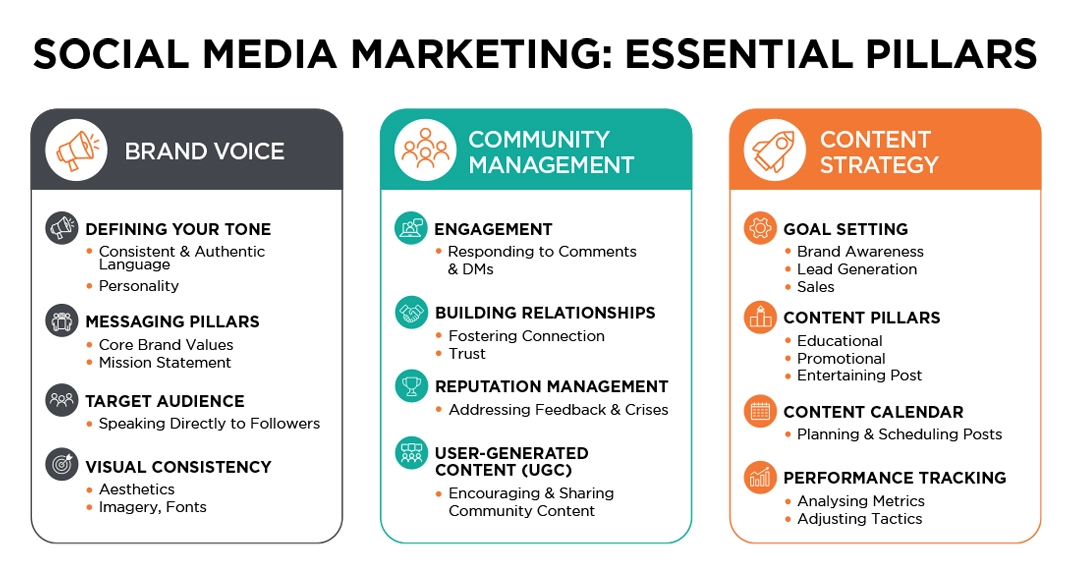
The most important section in this guide. AI tools save time, increase output, and reduce some of the mechanical burden of social media management. They don’t replace what actually makes social media marketing work for Singapore businesses.
Brand Voice and Cultural Accuracy
AI content tools are trained on global datasets. They can produce fluent English captions that are technically correct but culturally generic. A Singapore hawker brand, a Peranakan restaurant, or a heritage retail business has a specific voice, cultural identity, and community context that you can’t brief into an AI tool in a single prompt. Human editorial direction setting the tone, reviewing cultural accuracy, and understanding the specific community the brand serves remains non-negotiable.
Community Management and Relationship Building
AI can draft a response to a comment. It cannot build a genuine relationship with a Singapore customer who has been following your brand for three years. Community management responding thoughtfully to DMs, engaging with follower posts, and managing difficult customer interactions requires human judgment and empathy. Automating community management with AI at scale is the fastest way to damage a brand’s relationship with its most loyal customers.
Content Strategy and Platform Prioritisation
AI can tell you which of your past posts performed best. It cannot tell you whether your brand should be on TikTok at all; that depends on your target audience demographics, content production capacity, brand guidelines, and business goals. Choosing the right social media platforms requires human judgment about your business, your market, and your resource constraints.
Crisis Management
When something goes wrong a product recall, a customer service failure, a viral negative mention AI chatbots and automated responses are exactly what you do not want responding on your behalf. Crisis management requires a human who understands the situation, the stakeholders, and the appropriate tone for a Singapore audience at that moment.
The right mental model: AI in social media marketing is the equivalent of having a very fast assistant who can draft content, format documents, pull data, and suggest ideas on demand. Strategic thinking, cultural judgment, brand voice decisions, and relationship management remain with the human. AI scales execution. Humans provide direction.
AI, Social Media, and Your Singapore Brand’s Search Visibility
One connection many Singapore businesses miss: the relationship between social media AI content and broader AI search visibility.
Social media posts increasingly drive brand entity signals that AI systems use when deciding whether to mention or recommend a brand. When ChatGPT, Perplexity, or Google AI Overviews are asked: “Which [type of business] in Singapore should I use?” The brands they recommend aren’t determined by social media follower counts; they are determined by the consistency of brand entity signals across the web: Google Business Profile, website schema markup, external brand mentions, and the coherence of the brand’s digital presence.
AI-generated social media content that lacks clear brand voice, authentic external engagement, and consistent entity signals can actually work against a brand’s AI search visibility. The Limy.ai GEO research (6.5 million LLM bot events) confirms that authentic external brand mentions carry significantly more weight for AI system citations than volume of self-published content. A Singapore business with 200 genuine social media followers who engage meaningfully and a consistent brand presence is more likely to be cited by AI systems than a business with 10,000 followers receiving automated engagement on generic AI content.
PDPA and AI Social Media Tools: What Singapore Businesses Need to Know
Using AI tools for social media marketing in Singapore involves handling customer data, and Singapore’s Personal Data Protection Act (PDPA) applies to how that data is collected, used, and shared with third-party tools.
Key PDPA Considerations for AI Social Media Tools
- Customer data in AI chatbots: If your WhatsApp Business AI chatbot collects customer names, contact details, or purchase information, that data falls under the PDPA. Ensure your chosen AI chatbot provider has appropriate data processing agreements and collects customer consent before processing data.
- AI tools using your customer list: Tools like Hootsuite, Sprout Social, and Meta’s advertising platform process your customer data to provide targeting and personalisation. Review each tool’s data-processing terms and ensure your privacy policy accurately describes how you use customer data.
- AI-generated content using customer images or testimonials: Using AI tools to modify or repurpose customer-submitted content (photos, reviews) without explicit consent raises PDPA issues. Always obtain clear consent before using customer-generated content in AI-assisted marketing.
- Meta’s AI advertising data usage: Meta’s Advantage+ system uses customer data to optimise ad targeting. Singapore businesses using Meta ads should ensure their website’s data collection (pixel, cookies) is PDPA-compliant, with appropriate consent mechanisms in place.
The ROI of AI in Social Media Marketing: What the Data Says
Before committing to any AI social media tool, understanding which applications deliver the best return on investment helps prioritise your investment.
| AI Application |
Median ROI (McKinsey 2026) |
Other Key Benefit |
Best For |
| Content drafting and captions |
3.2x per dollar spent |
4.2x more content produced per marketer/month (HubSpot 2026) |
All businesses’ highest ROI starting point |
| Personalisation engines |
2.7x per dollar spent |
47% higher engagement vs generic posts (Salesforce 2026) |
Brands with segmented audiences |
| Audience research and segmentation |
2.4x per dollar spent |
Faster trend identification, agile campaign response |
Mid-market and enterprise |
| Ad copy generation |
2.3x per dollar spent |
85% of marketers plan to use AI for ad text creation |
Businesses running paid social |
| Analytics and reporting |
1.9x per dollar spent |
Teams save 8.3 hours/week on content creation (Salesforce 2026) |
All businesses running active campaigns |
| AI video creation |
1.1x per dollar spent |
75% of marketers use AI for video/image creation (Typeface 2026) |
Video-led brands; standalone AI video = lower ROI |
The clear takeaway from this data: start with AI content drafting and caption writing. That is where ROI is highest (3.2x median), brand-quality risk is most manageable (human editing is easy to apply at this stage), and the learning curve is lowest. Build from there as your team becomes more comfortable with AI tools.
Ready to Build a Smarter Social Media Strategy for Your Singapore Business?
AI social media tools are not a shortcut to a better social media presence. They are a production accelerator. Strategy, brand voice, community relationships, and the judgment calls about what to say and when remain entirely human responsibilities.
For Singapore businesses in 2026, the practical question is not whether to use AI tools for social media; 89.7% of social media marketers already do. The question is which tools to use first, how to brief them effectively, how to maintain brand quality through human editorial review, and how to measure whether the tools deliver the return the data suggests is achievable.
Start with content drafting. Write a brand voice document. Use AI to generate ideas and first drafts, not final published posts. Review every piece of AI content through a Singapore cultural lens before publishing. Measure changes in content output volume and engagement rate per post to find the right balance for your brand and audience.
Partner with Verz Design to build a smarter social media strategy that combines AI-powered efficiency with human-led strategy and brand expertise.


 Share
Share