If you have ever searched for something on Google and seen a result with star ratings, a price, expandable FAQs, or a step-by-step guide displayed directly in the search results, that is schema markup at work. The website behind that result added structured data code that told Google exactly what the content meant. Google then used that information to display a richer, more visible listing.
In 2026, schema markup is no longer a specialist technical nicety. It is a foundational requirement for any Singapore website that wants to appear in Google AI Overviews, be cited in ChatGPT or Perplexity answers, or capture the rich result positions that earn 20-40% higher click-through rates than standard blue links. This guide explains everything a Singapore business owner or marketing manager needs to know, from what schema markup is to which types matter most, and how to add it without a developer.
What Is Schema Markup?
Schema markup (also called structured data) is code added to a web page that tells search engines and AI systems what the content on that page means not just what the words say, but what they refer to in the real world. This is also becoming an important part of how websites prepare their content for generative search and AI-powered discovery.
Without schema markup, a search engine reading your page sees text. With schema markup, it understands context. It knows that a number like “289” refers to Google reviews. It knows that a date refers to an event. It knows that a paragraph labelled “question and answer” is exactly that. That context allows Google to display your content as a rich result and allows AI systems like ChatGPT and Perplexity to cite your page as a reliable, structured source.
A Plain-Language Analogy
Think of your website as a book in a library. Without schema markup, the book has no cover, no index, and no chapter titles. A librarian (Google) can read it, but cataloguing it accurately takes effort and guesswork. With schema markup, the book has a structured cover: title, author, genre, subject, publication date. The librarian can immediately classify it correctly, display it in the right section, and recommend it when someone asks for books on that topic. Schema markup is the structured cover your website has been missing.
Where Does Schema Markup Come From?
Schema markup uses a standardised vocabulary from schema.org, a collaborative project launched in 2011 by Google, Bing, Yahoo, and Yandex. Schema.org (currently on version 30.0, updated March 2026) defines over 800 types and 1,400 properties that can be used to describe content. The most common implementation format in 2026 is JSON-LD (JavaScript Object Notation for Linked Data), a compact block of code added to your page’s HTML that is read by search engines and AI systems but not visible to your website visitors.
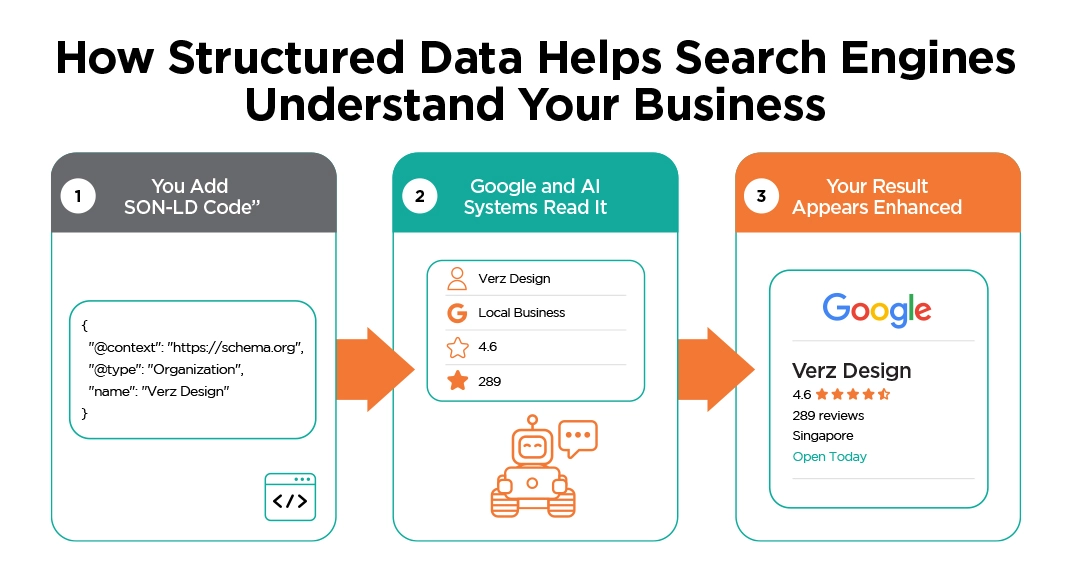
How Schema Markup Works: The Three-Step Process
Schema markup may look like a small piece of code, but it plays a clear role in helping search engines and AI systems understand your content. Here’s how the process works, from adding structured data to how search engines and AI interpret those signals:
Step 1: You Add JSON-LD Code to Your Page
JSON-LD schema markup is a block of code enclosed in a script tag, placed in the head or body section of your HTML. It uses key-value pairs to describe the content on that specific page. For a Singapore restaurant, that might include the business name, address, telephone number, opening hours, cuisine type, and price range. For a blog post, it might include the article headline, author name, publish date, and the publishing organisation.
Step 2: Search Engines and AI Systems Read and Process It
When Google’s crawler visits your page, it reads the JSON-LD alongside the visible content. The structured data gives the crawler unambiguous signals about what each piece of content represents. This is one part of making a website easier for AI systems to interpret, alongside clear page structure, semantic HTML and well-organised content.
When an AI system like ChatGPT or Perplexity indexes your page, structured information can provide additional context about what the content represents. Understanding how AI systems retrieve, evaluate and select information can help put the role of structured data into perspective.
This is the mechanism behind the data from the Limy.ai GEO research (6.5 million LLM bot events): structured data leads to 17% deeper crawl depth, 12% more reliable content extraction, and 13% more search result returns. The structured signals tell the crawler exactly what to extract and how to interpret it.
Step 3: Your Result Appears Enhanced in Search
When Google determines your structured data is correct, complete, and matches the visible page content, your result becomes eligible for a rich result. Rich results can include star ratings, review counts, prices, availability, FAQ dropdowns, breadcrumb navigation, recipe ingredients, event dates, and much more depending on the schema type used. These enhanced listings are more visually prominent, take up more screen space, and earn significantly higher click-through rates than standard blue links.
Schema Markup Impact Data: Why Structured Data Matters in 2026
The 8 Most Important Schema Types for Singapore Websites
Schema.org defines over 800 content types. In practice, eight types account for most rich result eligibility and AI citation value for Singapore business websites. Here is what each one does, when to use it, and what it looks like.
Schema Types
When to use?
Key properties
AI impact
Organisation All websites
Every Singapore website should have an Organisation schema in the site header. This establishes your business entity in Google’s Knowledge Graph, creating the entity signals that AI systems use when deciding whether to cite or recommend your brand.
Establishes your brand as a recognised entity for AI recommendation systems. The sameAs links to LinkedIn, Facebook, and Instagram create the external mention signals that GEO and AEO systems weight when deciding how credible a brand is.
LocalBusiness Singapore businesses with a physical location
The LocalBusiness schema is the single most important schema type for Singapore businesses that serve local customers. It powers your appearance in Google Maps, the local pack, and “near me” queries which are especially high-value for Singapore’s dense, location-conscious search behaviour.
The LocalBusiness schema is a primary citation signal for AI systems answering “which [business type] is near me in Singapore?” queries. Accurate, complete LocalBusiness schema with Singapore PostalCode is one of the strongest local GEO signals available.
Article / BlogPosting Blog posts, guides, news articles
Every blog post and editorial article on your Singapore website should have an Article or BlogPosting schema. This establishes the content type, authorship, and publication date signals that directly affect whether Google and AI systems treat your content as a reliable, current source.
headline, description, datePublished, dateModified, author (Person with name and url), publisher (Organisation with logo), image, url
Article schema with author Person nested inside is one of the strongest E-E-A-T signals available. The dateModified property is particularly important for AI systems: content not updated recently loses citation priority in AI search. This blog should have an Article schema with monthly dateModified updates.
FAQPage Pages with question-and-answer sections
FAQPage schema marks up Q&A content so AI systems can extract individual question-answer pairs reliably. Note: as of 2023, Google no longer displays FAQPage rich results (expandable FAQ dropdowns in SERP) for most commercial websites. However, FAQPage schema remains highly valuable for AI systems: ChatGPT, Perplexity, and Google AI Overviews all use FAQPage-marked content for direct answer extraction.
mainEntity (array of Questions, each with acceptedAnswer containing Answer text)
FAQPage schema is one of the most important GEO and AEO schema types in 2026—even without visual SERP rich results. AI systems use FAQPage markup to identify and extract question-answer pairs reliably. Every FAQ section on your website should have a FAQPage schema.
Product eCommerce product pages
Product schema is the primary structured data type for Singapore eCommerce websites. It marks up product name, price, availability, brand, SKU, and aggregate ratings and when complete, triggers product rich results in Google including star ratings, price, and in-stock status directly in the SERP.
Product schema directly increases purchase-intent click-through rates. Singapore eCommerce stores with complete Product schema (including AggregateRating) see significantly higher CTR from product-specific queries. Also used by Google AI Overviews when answering “best product for X” queries.
BreadcrumbList Every page with a navigation hierarchy
BreadcrumbList schema marks up your site’s navigation path (Home > Category > Page) so Google displays it as breadcrumb navigation in your SERP listing. This replaces the URL in your search result with a readable path, improves click-through rates, and tells AI systems how your site is structured.
itemListElement (array of ListItems, each with position, name, item URL)
BreadcrumbList schema helps AI systems understand your website architecture: which pages are most important and how they relate. It is one of the most widely supported and quickest schema types to implement sitewide, and it is required for some other rich result types to display correctly.
HowTo Step-by-step guides and instructional content
HowTo schema marks up step-by-step instructional content. Note: Google deprecated HowTo rich results for desktop in January 2026. HowTo schema still works on mobile search and more importantly is heavily used by AI systems to extract procedural information for AI-generated answers. Any “how to” content on your Singapore website should still have a HowTo schema for its AI citation value.
name, description, supply, tool, totalTime, step (array of HowToSteps, each with name and text)
HowTo schema is one of the most frequently cited schema types in AI-generated “how to” responses from ChatGPT and Perplexity. Despite Google’s desktop rich result deprecation, keep HowTo schema on instructional content for AI search visibility.
Review / AggregateRating Business listings, products, services with reviews
AggregateRating schema marks up your average rating and review count. When implemented correctly on Product or LocalBusiness pages, it triggers the highly visible star rating display in Google search results, one of the most click-rate-improving features available through structured data.
ratingValue, reviewCount, bestRating (usually 5)
AggregateRating is one of the most commercially valuable schema types: Google case studies show Nestle’s rich results (which include ratings) achieved 82% higher CTR. For Singapore businesses competing on local search, displaying your Google rating in SERP directly increases foot traffic and enquiries.
Schema Markup and AI Search: The 2026 Connection
To understand why schema markup matters for AI search in 2026, you need to understand how AI systems retrieve and process content.
How Do AI Systems Use Schema Markup?
When ChatGPT, Perplexity, Gemini, or Google AI Overviews crawl your website, they look for structured, extractable information they can reliably pull into a synthesised answer without misattributing it or losing context. Schema markup provides exactly that structure.
A page without schema gives AI crawlers a wall of text. A page with correct JSON-LD schema gives AI crawlers labelled, contextual data: this is the name of the business, this is a question and its direct answer, this is the author of this content, this is when it was last updated. That structured context is why pages with schema markup are cited more frequently and more accurately in AI-generated answers.
The Search Engine Land Experiment (September 2025)
A controlled experiment by Search Engine Land (September 2025) tested three nearly identical pages with the same content and comparable domain authority. The only meaningful variable was schema markup. Only the page with well-implemented JSON-LD appeared in a Google AI Overview. It also achieved the highest organic ranking, reaching position 3.
The pages without schema did not appear in AI Overviews. One page without schema was never indexed. This experiment provides the clearest direct evidence available that JSON-LD schema markup is a prerequisite, not a bonus, for AI Overview citation in 2026.
Schema Markup and Singapore’s AI Search Landscape
Singapore has Southeast Asia’s highest AI adoption rate. Singapore consumers increasingly use ChatGPT, Perplexity, and Google AI Overviews to research businesses, compare products, and find service providers before making contact. For a Singapore business, appearing in those AI-generated recommendations is equivalent to appearing at position 1 in traditional Google search, except without paying for ads and without competing against every other result on the page.
The businesses that appear in Singapore’s AI-generated recommendations in 2026 are the ones that have schema markup correctly implemented. The businesses without it are not seen by AI systems regardless of how well-written their content is.
Key insight: Schema markup is the technical bridge between your content and AI systems. Without it, your content exists on the internet but is significantly harder for AI crawlers to reliably interpret, extract, and cite. With it, your content becomes structured, labelled, and AI-ready the prerequisite for appearing in AI Overviews, ChatGPT answers, and Perplexity citations.
How to Add Schema Markup to Your Singapore Website?
Adding schema markup is more accessible than most Singapore business owners expect. Here is the step-by-step process.
Step 1: Decide Which Schema Types You Need
Start with the schema types that match your business type and page types. For most Singapore websites, the priority order is: Organisation (all sites) > LocalBusiness (if you have a physical location) > Article (for every blog post) > FAQPage (for FAQ sections) > BreadcrumbList (sitewide) > Product (for eCommerce) > AggregateRating (for businesses with reviews).
Step 2: Generate Your JSON-LD Code
Three tools make this straightforward without technical knowledge. Merkle’s Schema Markup Generator (technicalseo.com/tools/schema-markup-generator/) lets you fill in a form and generates the JSON-LD code. Google’s Structured Data Markup Helper guides you through highlighting elements on your page and generating the code. For WordPress websites, the Yoast SEO or Rank Math plugins generate most schema types automatically based on page settings.
Step 3: Add the Code to Your Page
Paste the generated JSON-LD code inside a script tag in your page’s HTML head or body section. If you use a CMS like WordPress or Shopify, you can typically add this through your theme’s header settings, a plugin, or directly through the page editor. If you are comparing traditional WordPress with newer AI website builders, our guide to AI-made websites vs WordPress explains the differences in SEO control, customisation and long-term website management. For Shopify, you can add JSON-LD to theme.liquid. For WordPress, use the WP Code plugin or a dedicated schema plugin.
Step 4: Validate Your Implementation
Before publishing, paste your URL or code into Google’s Rich Results Test (search.google.com/test/rich-results). This tool shows which rich results your page qualifies for, flags errors or warnings, and confirms the schema is read correctly. Schema Markup Validator (validator.schema.org) checks for technical JSON-LD errors. Fixing all errors before going live: partial schema implementation produces zero rich result lift.
Step 5: Monitor Performance in Google Search Console
After your schema goes live, check Google Search Console under Enhancements to see which rich result types Google has detected on your site, how many pages are eligible, and whether there are any new errors. The Performance report lets you filter by pages with rich results to measure CTR improvement. Expect rich results to appear within 1-4 weeks of correct implementation.
Tool
Best For
Merkle Schema Markup Generator (technicalseo.com)
Generating JSON-LD for most schema types via form inputs
Google Rich Results Test (search.google.com/test/rich-results)
Validating whether your schema is correct and which rich results it qualifies for
Schema Markup Validator (validator.schema.org)
Technical JSON-LD validation for syntax errors
Google Search Console Enhancements
Monitoring schema performance sitewide, tracking eligible pages and errors
Rank Math (WordPress plugin)
Automating schema generation for WordPress websites across all page types
Yoast SEO (WordPress plugin)
Automating Organisation, Article, and BreadcrumbList schema for WordPress
JSON-LD Playground (json-ld.org/playground)
Testing and debugging JSON-LD syntax before implementation
Schema Markup for Singapore Businesses: Local Considerations
Singapore businesses have specific schema requirements that differ from generic international guidance. These are the most important local considerations.
Address Format for Singapore
In schema markup, use “SG” as the addressCountry value (ISO 3166-1 alpha-2 country code). Singapore postal codes are 6 digits. Block numbers and floor/unit numbers are common in Singapore addresses and should be included in streetAddress. Use both English and the local district name where applicable for maximum local search coverage.
GST and Pricing
For eCommerce and product schema on Singapore websites, note whether prices include or exclude GST. Use the priceSpecification property to indicate whether tax is included. For businesses that state “prices before GST”, add a note in the description property that standard Singapore 9% GST applies.
Singapore Holidays and Seasonal Events
For Event schema covering promotions, sales, and in-store events, include Singapore-specific events like Great Singapore Sale (GSS), National Day, Chinese New Year, Hari Raya, Deepavali, and year-end sales. An event schema with correct startDate, endDate, and location allows these events to appear in Google’s event rich results.
Singapore Business Registration
For Organisation schema on Singapore-registered businesses, you can include legalName (UEN-registered business name) and taxID (Singapore UEN/GST registration number) in the schema. These entity signals help Google’s Knowledge Graph associate your schema with the correct registered business entity in Singapore.
Google Business Profile Consistency
Schema markup works best when the information it contains matches exactly what is in your Google Business Profile (GBP). Inconsistency between your schema (name, address, phone number) and your GBP creates conflicting signals. Before implementing LocalBusiness schema, verify that your GBP information is current and accurate, then mirror it exactly in your JSON-LD.
Common Schema Markup Mistakes Singapore Websites Make
Implementing schema without validating it first: Schema with errors produces zero rich results. Use Google’s Rich Results Test before publishing any schema markup, on every page. A missing required property (like AggregateRating on Product schema) means no star ratings display, regardless of how correct the rest of the schema is.
Using the wrong format: Microdata instead of JSON-LD: Google recommends JSON-LD as the only implementation format in 2026. Microdata (embedded directly in HTML tags) and RDFa are error-prone, harder to maintain, and do not separate cleanly from page content. Any schema implementation in Singapore should use JSON-LD exclusively.
Adding schema that does not match the visible page content: Google penalises schema that describes content not visible on the page. Adding 5-star ratings to a page where no reviews are displayed, or adding FAQPage schema to questions without visible answers on the page, is treated as spam and can result in manual action. Schema must always reflect what is actually on the page.
Leaving stale schema uncorrected: Outdated price, opening hours, or event dates in schema create user frustration and erode Google’s trust in your structured data. Set a quarterly calendar reminder to review and update all schema on key pages. This is especially important for Product schema (prices change) and Event schema (dates expire).
Not checking AI crawler access after schema implementation: 27% of companies block at least one major AI crawler through robots.txt or CDN security settings. GPTBot, OAI-SearchBot, PerplexityBot, Google-Extended, and ClaudeBot must be allowed to access your pages for AI systems to use your schema. Check yoursite.com/robots.txt; if any of these crawlers are blocked, those AI platforms can’t see your schema.
Using deprecated schema types: Google deprecated seven structured data types in January 2026. Using deprecated schema types does not improve rich result eligibility and adds maintenance overhead. Focus on the active types that deliver real results: Organisation, LocalBusiness, Article, FAQPage, Product, BreadcrumbList, HowTo, and AggregateRating.
Applying site-wide schema that is not page-specific: Organisation schema belongs sitewide (in the header). Article schema belongs on every individual article page with that article’s specific properties. Applying the same generic Article schema to every page, regardless of content type, reduces its accuracy and its value.
Who Needs Schema Markup? Singapore Business Types and Priority
Business Type
Most Important Schema Types
Local service business (clinic, law firm, contractor)
Does Your Singapore Website Have Proper Schema Markup?
Schema markup sits at the intersection of three things that define search visibility in 2026: traditional SEO (rich results, higher CTR), AEO (structured content for featured snippets and PAA boxes), and GEO (AI-readable entity and content signals for ChatGPT, Perplexity, and Google AI Mode citations).
For Singapore websites, the case for schema markup has never been stronger. A controlled experiment confirms that correctly implemented JSON-LD is a prerequisite for appearing in Google AI Overview. Industry data shows 20-40% CTR uplift for pages with rich results. Google’s own case studies document 82% CTR improvement for Nestle’s schema-enhanced listings. Limy.ai GEO research also shows 17% deeper LLM crawl depth and 12% more reliable content extraction for structured data pages.
The good news: schema markup is one of the most accessible technical SEO improvements available. For WordPress and Shopify websites, plugins handle most of it automatically. For custom websites, a one-time implementation of the eight priority schema types covers most of the benefit. Key requirements include using JSON-LD, ensuring the schema matches visible page content, validating before publishing, and reviewing quarterly.
Need help getting your Singapore website’s schema markup right? Contact Verz Design to get started.
Frequently Asked Questions
What is schema markup in plain language?
Schema markup is code added to your website that tells Google and AI systems what your content means, not just the words, but the context. It tells a search engine that a certain number is a star rating, that a paragraph is a question and answer, that a date is an event, or that a price refers to a specific product. This context lets Google display your content as a rich result (with stars, prices, FAQs, or breadcrumbs) and lets AI systems like ChatGPT and Perplexity cite your page accurately in their answers.
Does schema markup improve my Google rankings?
Schema markup is not a direct ranking factor; Google has stated this officially. It does not directly move your page from position 5 to position 1. However, it significantly improves click-through rate by triggering rich results, and higher CTR can indirectly contribute to improved rankings over time. More importantly, in 2026, schema markup is a prerequisite for Google AI Overview citation, and a controlled Search Engine Land experiment (September 2025) found that the page with JSON-LD schema was the only one that appeared in a Google AI Overview.
What is the difference between schema markup and meta tags?
Meta tags (like meta title and meta description) are HTML tags that tell search engines basic information about your page: its title and a short summary. Schema markup (JSON-LD) is structured data that describes your page's content in detail: the type of content, who wrote it, when it was published, what questions it answers, and how it relates to other entities. Meta tags are required for basic search visibility. Schema markup is required for rich result eligibility and AI search citation.
Which schema markup format should I use: JSON-LD, Microdata, or RDFa?
JSON-LD is the only format Google recommends in 2026. Microdata and RDFa are older formats that embed structured data directly into HTML elements, making them harder to maintain and more error-prone. JSON-LD is added as a separate script block that you can add, remove, and update without touching your page's visible content. Any Singapore website implementing schema markup in 2026 should use JSON-LD exclusively.
How do I check if my schema markup is working correctly?
Use Google's Rich Results Test (search.google.com/test/rich-results). Paste your URL, and the tool will show which rich results your page is eligible for, any errors or warnings, and a preview of how Google reads your page's structured data. Also check Google Search Console under Enhancements; this section shows which rich result types Google has detected on your site and whether there are any errors across your pages.
What schema markup does my Singapore eCommerce store need?
At minimum: Organisation schema (sitewide, in the header), Product schema (on every product page with name, price, availability, and AggregateRating if you have reviews), BreadcrumbList schema (sitewide), and FAQPage schema on any FAQ sections. If you have customer reviews, add AggregateRating to your Product schema to display star ratings in Google. If you have blog content, add Article schema to each post. If you run promotions or events, add an Event schema.
Will schema markup help my Singapore website appear in Google AI Overviews?
Yes, it is one of the most important factors for AI Overview eligibility. A controlled experiment by Search Engine Land in September 2025 tested three identical pages; only the page with correctly implemented JSON-LD schema appeared in a Google AI Overview. Schema markup also helps ChatGPT, Perplexity, Gemini, and Copilot extract and cite your content. For a Singapore business that wants to appear in AI-generated recommendations for its service category, schema markup is a non-negotiable technical prerequisite.
Do I need a developer to add schema markup to my Singapore website?
Not necessarily. For WordPress websites, plugins like Rank Math or Yoast SEO generate most schema types automatically. For Shopify, a developer can add JSON-LD schema to your theme's header files, or you can use a dedicated schema app. For custom websites, you typically need a developer. If you are not comfortable with code, Verz Design offers schema markup audit and implementation as part of its Singapore SEO services, ensuring the markup is complete, validated, and free of errors before going live.
How often should I update my schema markup?
Organisation schema is a good starting point if your site has no schema at all. It establishes your brand entity, logo, contact information, and social profiles across the web- the foundation that every other schema type builds on. After Organisation schema, your next priority depends on your site type: LocalBusiness for businesses with physical Singapore locations, Product + AggregateRating for eCommerce, Article for blogs and content sites, and FAQPage for any page with Q&A content.
About the Author:
Vivek Tank
Senior SEO Specialist with a strong background in digital marketing and content strategy. With expertise in keyword research, on-page SEO, and backlink building, Vivek creates results-driven strategies tailored to each brand’s goals.
Need a strong team specialised in SEO?
Speak to Verz today if you are looking to create a website with a lasting impression to achieve online success.


 Share
Share