If you have spoken to more than two digital marketing agencies in Singapore in 2025 or 2026, you have almost certainly heard all three of these acronyms: SEO, AEO, and GEO. The problem is that very few agencies explain clearly what each one is, how they are different, and most importantly, which one your business should actually be investing in right now.
This guide answers those questions in plain language. By the end, you will understand exactly what each discipline does, which surface it targets, how results are measured, where they overlap, and how to decide where your budget should go first. This reflects the broader shift in SEO from search to answers, where traditional rankings increasingly sit alongside AI-generated answers, AEO and GEO.
SEO, AEO and GEO: The Plain-Language Summary
Before we compare them in detail, here is what each one means in one sentence:
|
SEO
(Search Engine Optimisation)
|
AEO
(Answer Engine Optimisation)
|
GEO
(Generative Engine Optimisation)
|
| Get your website into Google’s 10 blue links for target keywords. |
Get your content cited as the direct answer in featured snippets, PAA boxes, voice search, and AI Overviews. |
Get your brand recommended by ChatGPT, Perplexity, Gemini, Copilot, and Google AI Mode for relevant queries. |
If those definitions already make sense to you, you can skip to the comparison table below. If you want a deeper explanation of each before comparing them, read the next three sections first.
What Is SEO? (Search Engine Optimisation)
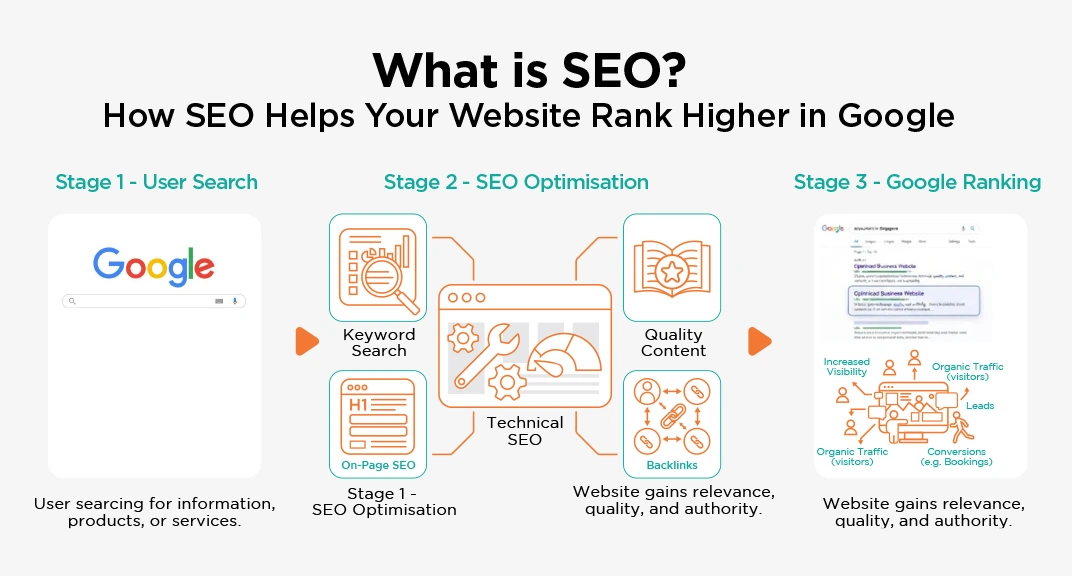
SEO is the oldest and most established of the three disciplines. At its core, SEO is the practice of making your website and content more visible in Google’s traditional organic search results, the ten blue links that appear when you search for something on Google. For businesses looking for professional support, SEO services typically cover technical optimisation, content, keyword research, and authority building.
When someone searches ‘accountant in Singapore’ or ‘best CRM software for SMEs’, the websites that appear on page one of Google have been optimised for those specific keywords. That optimisation is SEO.
What Does SEO Actually Involve?
- Keyword research: Identifying the terms your target customers search for, and the difficulty of ranking for each one.
- On-page SEO: Writing and structuring page content to include those keywords naturally in headings, body copy, meta titles, and meta descriptions.
- Technical SEO: Ensuring your website loads fast, is mobile-friendly, is crawlable by Google, and has no technical errors blocking indexation.
- Link building: Earning links from credible, relevant external websites signals to Google that your content is authoritative.
- Content creation: Publishing original, helpful content that answers what your target audience is searching for.
SEO in one sentence: Get your website to appear in Google’s top 10 results for the queries your potential customers are already searching. Everything else in search marketing builds on this foundation.
How Is SEO Measured?
- Keyword ranking position (where your page appears in Google results for each target query)
- Organic traffic volume (how many users visit your site from Google search)
- Click-through rate from search results (what percentage of users who see your page in results actually click it)
- Organic conversion rate (what percentage of organic visitors take your target action)
How Long Does SEO Take?
Meaningful ranking improvements for competitive keywords typically take 3–6 months. Highly competitive markets (financial services, healthcare, law, technology) can take 9–12 months. This isn’t unique to SEO; it reflects Google’s algorithm, which values consistent, sustained authority over rapid changes.
What Is AEO? (Answer Engine Optimisation)
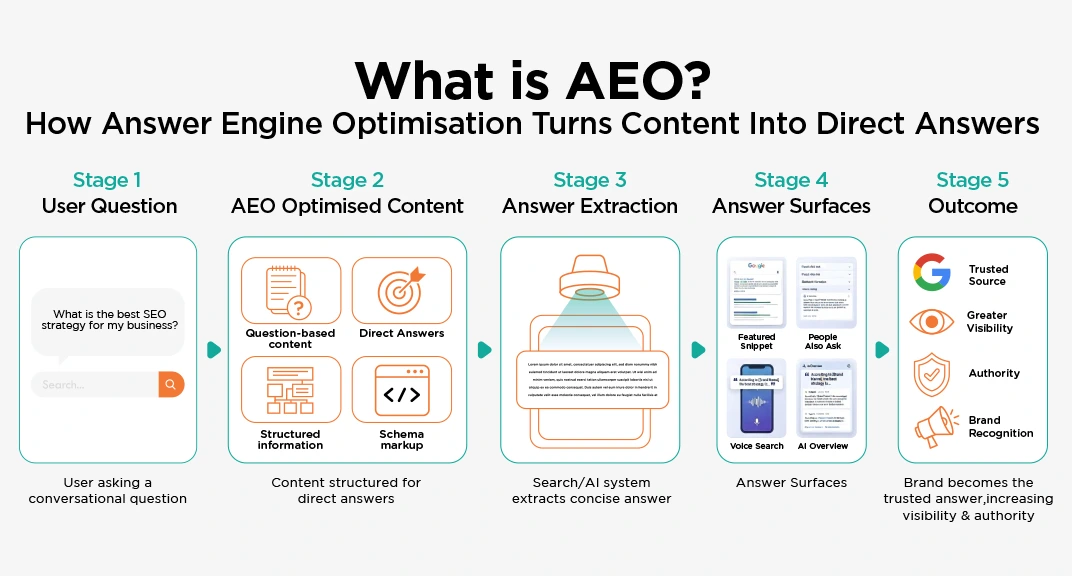
AEO is a more focused discipline than SEO, targeting a specific outcome: getting your content cited as the direct answer to a user’s question, rather than appearing as a blue link the user has to click.
AEO has become significantly more important in 2025–2026 as three major changes have reshaped search: Google’s AI Overviews now appear above all traditional results for the majority of informational queries; voice search through AI assistants is handling more complex questions; and 60% of all Google searches end without a click (WSI World, 2025), meaning the user gets their answer directly on the search results page.
For a business, being the source cited in those direct answers is the equivalent of the top position in traditional SEO but more prominent, more trusted, and more visible.
What Answer Surfaces Does AEO Target?
- Featured Snippets (Google): The highlighted box at the top of search results that shows a direct answer to a question above all organic results and paid ads.
- People Also Ask (PAA) boxes: The expandable Q&A sections in search results that show related questions with direct answers. Each PAA entry is a separate citation opportunity.
- Voice search (Google Assistant, Siri, Alexa): 60% of voice search results are delivered directly from Featured Snippets. Holding the snippet for a query means holding the voice search answer.
- Google AI Overviews: AI-generated summaries that appear at the top of search results for many informational queries, citing specific sources within the AI-generated answer. Understanding how AI systems decide which content to cite is therefore an important part of modern AEO.
What Does AEO Actually Involve?
- Schema markup: Adding FAQPage, HowTo, Speakable, Article, and VideoObject markup per page so AI systems can reliably extract structured information.
- Question-format content: Writing H2 and H3 headings as full questions, with direct, concise answers in the first 2–3 sentences beneath each heading.
- AI crawler access: Verifying that GPTBot, OAI-SearchBot, PerplexityBot, Google-Extended, and ClaudeBot are allowed in robots.txt; blocked crawlers cannot cite your content.
- PAA targeting: Identifying People Also Ask questions for your category and creating content that directly answers each one.
- Content freshness: Pages not updated at least quarterly lose AI citation at 3× the normal rate (Search Engine Land, 2025)
AEO has become significantly more important in 2025–2026 as three major changes have reshaped search: Google’s AI Overviews now appear above traditional results for many informational queries; voice search through AI assistants is handling more complex questions; and zero-click searches mean users can get answers directly on the search results page without visiting a website.
What Is GEO? (Generative Engine Optimisation)
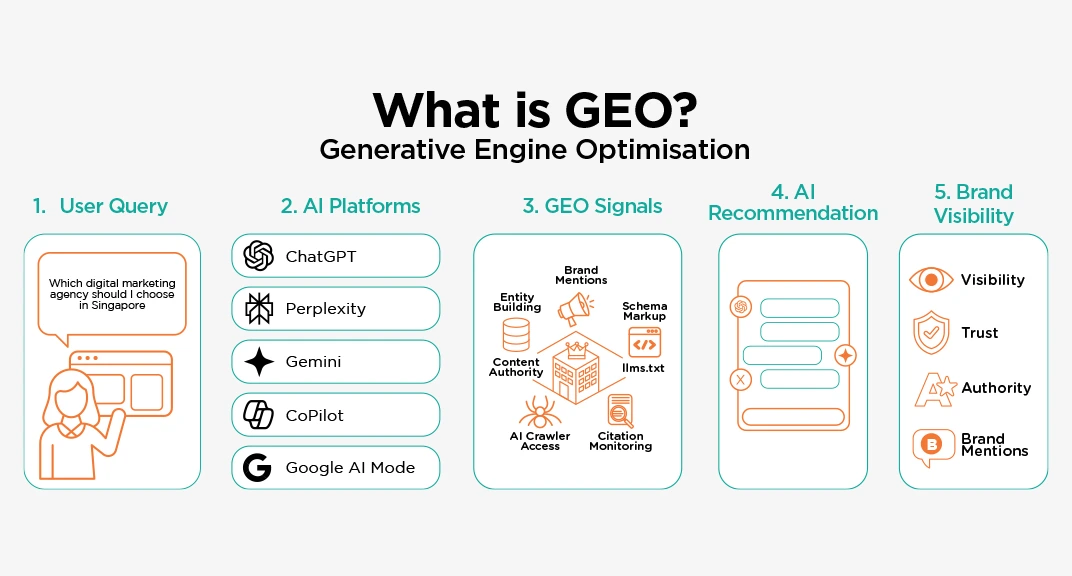
Generative Engine Optimisation (GEO) is the newest of the three disciplines and focuses on improving how brands are understood, surfaced, cited, and recommended across generative AI platforms. It emerged as a formal practice in 2024–2025 in response to a fundamental shift in how people research and make decisions: a growing proportion of users are now asking generative AI systems like ChatGPT, Perplexity, Gemini, Copilot, and Google AI Mode for recommendations, comparisons, and advice, rather than typing keywords into Google.
When someone asks ChatGPT ‘which digital marketing agency should I use in Singapore?’ or asks Perplexity ‘what is the best CRM for a 20-person company?’, they receive a synthesised recommendation, not a page of links. The brands that appear in those recommendations have been optimised for generative engine visibility. The brands that don’t appear are invisible to that user, at that moment.
GEO is broader than AEO. While AEO focuses on being the direct answer to specific questions within Google’s ecosystem, GEO focuses on making a brand recommendable across all generative AI platforms for open-ended, recommendation-style queries.
What Does GEO Actually Involve?
- Entity building: Establishing your brand as a clearly recognised entity through consistent Google Business Profile, Wikipedia/Wikidata signals, industry directory listings, and public factual information.
- External brand mentions: Building authentic third-party brand mentions in credible Singapore publications, industry directories, review platforms, and online communities. AI systems weight external validation more heavily than self-published content.
- Schema markup (Organisation/LocalBusiness): Ensuring AI systems can reliably identify your brand, location, services, and key facts.
- Content authority: Building comprehensive, expert content that establishes topical authority in your category the content that AI systems draw on when recommending your brand.
- AI crawler access: Same as AEO, verifying that all major AI crawlers (GPTBot, OAI-SearchBot, PerplexityBot, Google-Extended, ClaudeBot) can access your website. 27% of companies accidentally block at least one.
- llms.txt: An optional file that helps AI agents understand your site’s content and navigation, distinct from robots.txt, which is for search bots.
- Multi-platform citation monitoring: Tracking how frequently your brand is cited in ChatGPT, Perplexity, Gemini, Copilot, and Google AI Mode responses for target query categories.
GEO in one sentence: Build the brand signals, content authority, and entity clarity that cause ChatGPT, Perplexity, Gemini, Copilot, and Google AI Mode to include your brand in their recommendations when users ask about your category.
GEO vs AEO vs SEO: The Full Side-by-Side Comparison
This table covers every meaningful dimension where SEO, AEO, and GEO differ, from goals and metrics to content format, schema types, traffic type, timeline, and when to prioritise each.
| Criteria |
SEO |
AEO |
GEO |
| Primary goal |
Rank in Google’s 10 blue links for target keywords |
Be the direct answer in featured snippets, PAA, voice search, and Google AI Overviews |
Be recommended by ChatGPT, Perplexity, Gemini, Copilot, and Google AI Mode |
| Success metric |
Keyword ranking position and organic click-through rate |
Featured snippet rate, PAA appearances, and AI Overview citation rate |
AI citation frequency and brand recommendation rate across 5 platforms |
| Visibility channel |
Google Search (blue link results) |
Google Featured Snippets, PAA boxes, Google AI Overviews, voice assistants |
ChatGPT, Perplexity, Google AI Mode, Google Gemini, Microsoft Copilot |
| Content format |
Keyword-targeted articles and landing pages, structured around primary and secondary keywords |
Question-and-answer format: H2/H3 headings as questions, direct answers in the first 2-3 sentences |
Comprehensive, entity-rich content that establishes brand authority and external credibility |
| Schema types |
Basic meta tags and sitemap |
FAQPage, HowTo, Speakable, Article, VideoObject per page |
Organisation, LocalBusiness, FAQPage + external entity signals (Google Business Profile, directories) |
| Key signals |
Backlinks, Core Web Vitals, page authority, on-page keyword signals |
Direct-answer content structure, schema markup depth, Speakable schema for voice |
External brand mentions, entity clarity, knowledge graph signals, robots.txt AI crawler access |
| Traffic type |
Click-based organic traffic |
Zero-click visibility + high-intent click capture from trusted answer positions |
High-intent AI-referred traffic (converts at significantly higher rate than standard organic) |
| Results timeline |
3-6 months for meaningful ranking improvement |
2-6 weeks for featured snippet capture; 3-6 months for AI Overview consistency |
3-6 months for consistent AI citation; 6-12 months for measurable recommendation frequency |
| Does it require other disciplines? |
Independent foundation always start here |
Requires strong SEO base (99% of AI citations come from organic top 10) |
Requires SEO + AEO as foundation. GEO without AEO is significantly less effective |
| Can you do it in-house? |
Partially, basic on-page SEO can be done in-house; technical SEO and link building need experts |
Partially content restructuring in-house; schema markup and AI crawler audits need specialists |
Rarely without help: entity building, multi-platform citation monitoring, and AI crawl audits are specialist skills |
| When to prioritise |
First always. SEO is the foundation every other discipline depends on |
Second, once core pages rank in the top 10, start AEO implementation on those pages |
Third, once AEO is in place, GEO amplifies brand recommendation across generative AI platforms |
Where Do GEO, AEO and SEO Overlap?
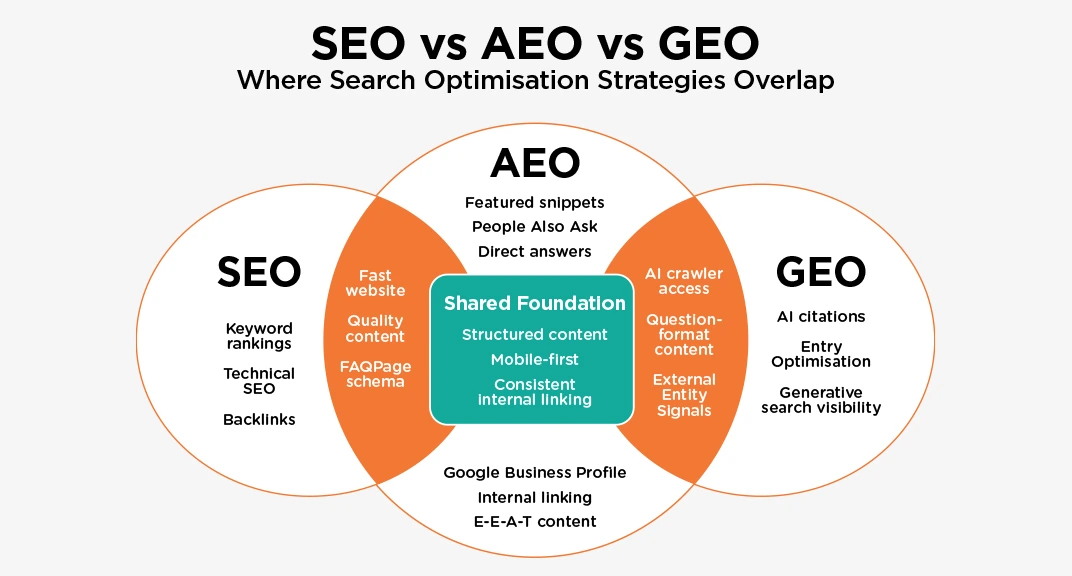
The three disciplines are not separate; they share significant common ground. Understanding the overlap prevents duplicated effort and helps prioritise work that moves all three forward at once.
The table below shows which specific techniques benefit one, two, or all three disciplines so you can identify where a single piece of work delivers maximum cross-discipline value.
| Technique / Signal |
Helps SEO? |
Helps AEO? |
Helps GEO? |
| Quality, structured content |
YES |
YES |
YES |
| Fast-loading, mobile-friendly website |
YES |
YES |
YES |
| Consistent, relevant internal linking |
YES |
YES |
YES |
| FAQPage schema markup |
Shared |
YES |
YES |
| HowTo and Speakable schema |
Shared |
YES |
Shared |
| Google Business Profile completeness |
YES |
Shared |
YES |
| Strong backlink profile |
YES |
NO |
Shared |
| External brand mentions (PR, directories) |
Shared |
NO |
YES |
| robots.txt AI crawler access |
NO |
YES |
YES |
| llms.txt for AI agents |
NO |
Shared |
YES |
| Core Web Vitals (LCP, INP, CLS) |
YES |
Shared |
NO |
| Question-format headings and copy |
Shared |
YES |
YES |
Key insight: Quality structured content, fast mobile-friendly website performance, and consistent internal linking benefit all three disciplines equally. If you do those well, you are building the foundation for SEO, AEO, and GEO simultaneously.
Which Should You Focus on First: SEO, AEO or GEO?
The sequencing of SEO, AEO, and GEO is not a matter of opinion; it is determined by the technical dependencies between them. Here is the logical priority sequence for Singapore businesses in 2026:
| Priority |
Strategy |
Focus |
Approx Budget (SGD) |
Timeline |
| 1st |
SEO |
Keyword research, on-page optimisation, technical audit, backlinks |
from $750/mo |
3–6 months |
| 2nd |
AEO |
FAQPage/HowTo/Speakable schema, content restructuring, featured snippet targeting, AI crawler audit |
from $800/mo |
2–6 weeks for first results |
| 3rd |
GEO |
Entity building, external brand mentions, multi-platform citation monitoring, robots.txt AI access |
from $800/mo |
3–6 months |
Why SEO Must Come First?
SEO is the prerequisite for both AEO and GEO. 99% of Google AI Overview citations come from content that is already in the organic top 10 (Incremys analysis, 2026). Pages that do not rank well in Google have very limited chances of being cited in AI Overviews, no matter how well their schema markup is implemented. Before investing in AEO or GEO, your core pages need to rank.
Why AEO Comes Second?
Once a page is in the top 10 organically, AEO implementation restructuring headings as questions, adding FAQPage schema, verifying AI crawler access converts that SEO authority into direct answer citations. AEO is the layer that makes top-ranking content extractable as an answer, not just as a blue link.
Why is GEO Built on Both?
GEO’s effectiveness depends on the brand already having SEO-level authority (content in the top 10) and AEO-level structure (clearly formatted, schema-marked content that AI systems can extract reliably). Without that foundation, GEO’s entity-building and external brand-mention work has a much lower ceiling. With it, GEO amplifies brand recommendation across all generative AI platforms.
Exception: If your business is brand-new and has no SEO foundation yet, you can and should implement AEO and GEO-ready technical setup (schema markup, robots.txt, Google Business Profile) from day one as part of your initial web build. AI-ready website architecture can also be considered during the initial build rather than retrofitted later.
How Are Results Measured Differently for Each Discipline?
One of the most common questions when evaluating SEO, AEO, and GEO agencies is what reporting to expect and how to tell if the investment is actually working. Each discipline has its own distinct set of metrics.
| Metric Category |
SEO Metrics |
AEO Metrics |
GEO Metrics |
| Primary success measure |
Keyword ranking position (1–100) |
Featured snippet rate (% of target keywords in position 0) |
AI citation frequency (% of target queries where brand appears in AI answer) |
| Traffic measure |
Organic sessions and page views |
Zero-click impressions + CTR from snippet positions |
AI-referred sessions (tracked in GA4 as ai.google.com, chatgpt.com referrals) |
| Visibility measure |
Share of voice in SERP |
PAA box ownership rate |
Share of AI-generated recommendation (vs named competitors) |
| Content measure |
Crawl coverage, indexation rate |
AI Overview citation rate |
Multi-platform brand mention rate (ChatGPT, Perplexity, Gemini, Copilot) |
| Platform |
Google Search Console, Rank Tracking tools |
Google Search Console (rich results), PAA monitoring tools, AI Overview trackers |
Manual AI platform testing, AI citation monitoring tools, GA4 referral tracking |
| How to report to leadership |
Position changes for priority keywords, organic traffic growth |
Featured snippet captures (before/after), AI Overview citation appearances |
Share of AI recommendation for category queries (vs competitors) |
Important: Be cautious of any agency that reports GEO results using only organic keyword rankings, or AEO results using only page speed scores. Each discipline has specific metrics. If those metrics are not in the monthly report, the work may not be discipline-appropriate.
The 2026 Search Landscape: Why All Three Disciplines Matter Now
The urgency around AEO and GEO in 2026 is not marketing language. It reflects specific, measurable changes in how people discover businesses, research purchases, and make decisions.
| The 2026 AI Search Landscape: Why SEO, AEO, and GEO All Matter |
| Metric / Trend |
Data & Verified Finding |
| Google searches without a click (2025) |
60% of Google searches end without any click
|
| Google AI Overviews monthly users |
2 billion monthly users
|
| Voice results from Featured Snippets |
60% of voice search answers sourced from featured snippets
|
| ChatGPT weekly active users (2026) |
900M+ weekly active users
|
| Traditional search volume forecast |
25% decline in traditional search volume
|
| AI-referred session growth |
527% year-over-year growth in AI-referred website sessions
|
What these numbers mean in plain terms: the traditional ‘rank high, get clicks’ model of SEO is still important, but it is no longer sufficient on its own. A growing share of users receive their answer before clicking, ask AI assistants for recommendations rather than typing into Google, or use voice search for category queries. AEO and GEO capture businesses that appear in those non-click, non-ranking answer surfaces.
Do You Need All Three? How to Decide
Not every business needs GEO on day one. But every business needs SEO. Here is a practical decision framework:
| Your Situation |
What You Need |
| Starting from scratch with no web presence |
SEO only builds the foundation: on-page optimisation, technical setup, content creation. Add AEO-ready schema and GEO-ready robots.txt from day one as part of the initial build. |
| Site is live, ranking on page 2–5 for core keywords |
SEO is the priority. Implement technical AEO prerequisites (schema, robots.txt) while improving organic rankings. |
| Site is ranking on page 1 for some core keywords |
Start AEO: restructure those top-ranking pages to capture featured snippets. Begin GEO preparation: Google Business Profile, entity signals, external mentions. |
| Strong SEO, some featured snippet appearances |
Full AEO programme: systematic schema implementation, PAA targeting, voice search. Begin GEO monitoring across ChatGPT, Perplexity, Gemini. |
| Established brand, good SEO, AEO in place |
Full GEO programme: multi-platform citation monitoring, entity building, external brand mention acquisition, AI recommendation tracking. |
| Competitive sector (finance, healthcare, legal, tech) |
All three simultaneously; the competitive cost of absence from any of the three surfaces is too high. Start with SEO/AEO and add GEO within the first 6 months. |
5 Common Misconceptions About GEO, AEO and SEO
Misconception 1: GEO replaces SEO
GEO does not replace SEO; it builds on it. Because 99% of AI citations come from content already in Google’s organic top 10, businesses that stop investing in SEO to focus exclusively on GEO will see their AI citation rates decline as their organic rankings fall. GEO amplifies SEO; it doesn’t replace it.
Misconception 2: AEO is just adding FAQ sections to a page
FAQPage schema is one AEO technique. A genuine AEO programme includes restructuring entire pages so every H2 and H3 heading is a question with a direct answer in the first sentence beneath it, implementing Speakable schema for voice search, verifying AI crawler access in robots.txt, systematically targeting PAAs, and tracking featured snippet and AI Overview citation rates monthly.
Misconception 3: GEO results can be achieved in weeks
Meaningful GEO results and consistent brand recommendation in AI-generated answers for your category queries typically take 3–6 months of sustained effort. Entity building, external brand mention acquisition, and AI system ‘learning’ of your brand’s authority all take time. Any agency promising AI recommendation results in two to three weeks should be questioned about what specific metric they are measuring.
Misconception 4: Only large companies need GEO
Singapore SMEs in competitive service categories healthcare, legal, financial, education, and professional services face immediate competitive pressure from AI search. When a potential client asks ChatGPT ‘which [service] in Singapore should I use?’, the business cited is the one that wins the enquiry, regardless of company size. SMEs in high-intent query categories should treat GEO as an urgent priority.
Misconception 5: If you have good content, GEO takes care of itself
Good content is a prerequisite for GEO, not a guarantee. AI systems also weigh entity clarity (are you a recognisable brand entity?), external brand signals (do credible third parties mention you?), technical accessibility (can AI crawlers read your site?), and content freshness (has your content been updated recently?). Content quality is necessary but not sufficient without the technical and entity-level work that GEO requires.
Not Sure Where Your Business Stands on SEO, AEO and GEO?
If you have read this far, you now understand what makes each of these three disciplines distinct, how they are measured, where they overlap, and in what order to invest in them. The short version:
- SEO: Always first. Always ongoing. The foundation that every other search discipline depends on.
- AEO: Start when your core pages are in the top 10. Restructure content for direct-answer citation and add schema markup per page.
- GEO: Build once AEO is in place. Entity signals, external brand mentions, and multi-platform AI citation monitoring.
- All three together: The strongest possible search marketing position for a Singapore business in 2026 and the standard that the most competitive businesses in every sector are now moving toward.
Verz Design offers a free AI visibility audit for Singapore businesses. We measure your current performance across all three disciplines and tell you exactly which to prioritise first.
Work with us to strengthen your search visibility across SEO, AEO and GEO.
Need a strong team specialised in SEO?
Speak to Verz today if you are looking to create a website with a
lasting impression to achieve online success.


 Share
Share