In today’s digital landscape, many businesses focus heavily on marketing. They invest in ads, social media campaigns, and promotions expecting immediate results. However, one common mistake we often see is marketing without a strong branding foundation.
Branding is your identity. It defines how your business is perceived by your audience, including your logo, colours, tone, positioning, and overall experience. Marketing, on the other hand, is how you communicate that identity through campaigns, advertisements, and digital channels. In simple terms, branding shapes perception, while marketing delivers the message.
1. Branding Builds the Foundation While Marketing Drives Traffic
Many businesses jump straight into performance marketing without first defining their brand, often with the expectation of immediate returns. While this may generate short-term traffic, it frequently results in inconsistent messaging, lower conversion rates, and weak customer retention. Without a clear brand direction, marketing efforts lack cohesion and fail to build lasting impact.
A strong brand provides the foundation that marketing relies on. It defines your positioning, tone, visual identity, and overall customer experience, ensuring that every campaign communicates a consistent and recognisable message. This alignment reduces friction across the user journey, from first impression to conversion and beyond. A well-defined customer journey map also helps businesses understand how users interact with the brand at every stage, creating a more consistent and effective marketing experience.
From a practical standpoint
- Branding ensures consistency across ads, landing pages, and user experience
- It improves conversion rates by building trust and clarity
- It strengthens customer recall, making future marketing more effective
- It supports long-term retention instead of one-time engagement
In essence, marketing drives traffic and brings users into the funnel, but branding is what gives direction, meaning, and long-term value to those efforts.
2. Branding Builds Trust While Marketing Drives Visibility
Marketing can attract attention and bring users to your website, but branding builds trust and influences decision-making. Without trust, users may click but not convert. Without a clear brand, customers may not remember you. This is why branding plays a critical role in improving both conversion rates and customer loyalty.
From a more technical perspective, branding directly impacts key performance metrics across the funnel. A strong and consistent brand identity improves click-through rates (CTR) by making campaigns more recognisable and credible. Once users land on the site, branding influences user experience (UX) through visual consistency, tone of voice, and content clarity, factors that reduce bounce rates and increase time on site.
More importantly, branding strengthens conversion rate optimisation (CRO). Elements such as trust signals, brand consistency, and perceived authority reduce friction in decision-making, leading to higher conversion efficiency. Over time, this also contributes to stronger customer lifetime value (CLV), as users are more likely to return and engage with a brand they recognise and trust.
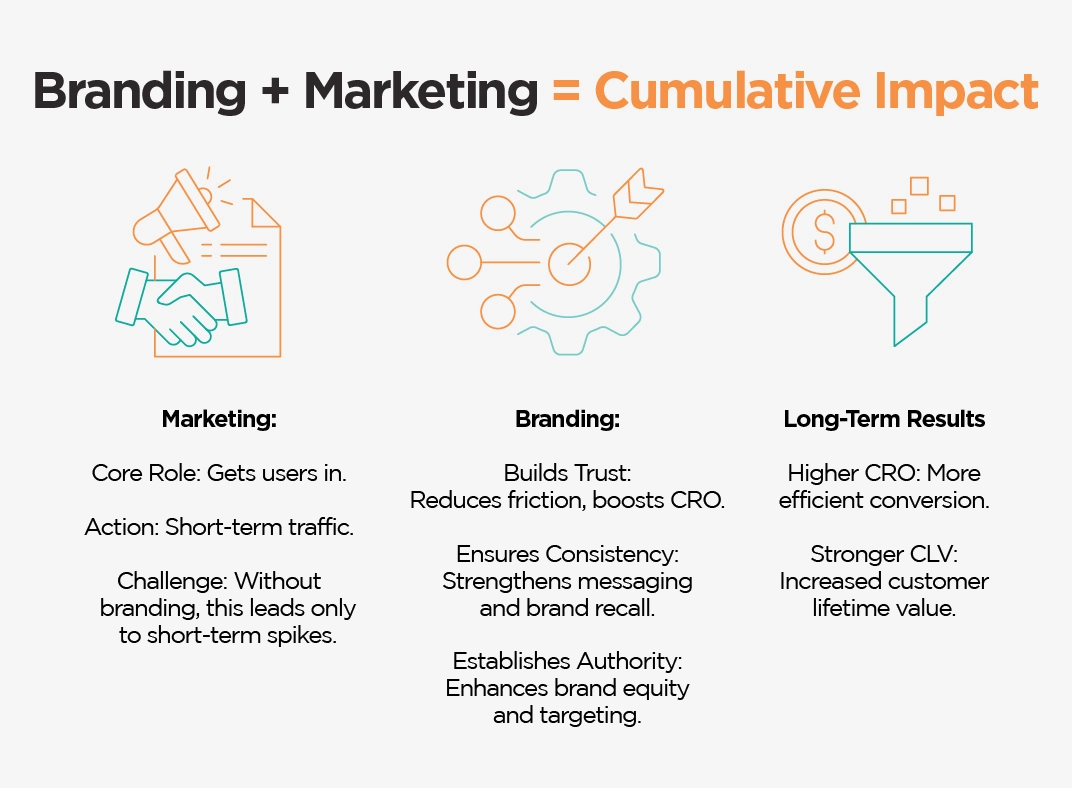
From a strategic standpoint, marketing without branding often results in short-term traffic spikes but weak retention and low brand recall. In contrast, when branding and marketing are aligned, every campaign reinforces the same message, creating cumulative impact. This leads to more efficient media spend, improved audience targeting, and stronger long-term brand equity.
In simple terms, marketing gets users in the door, but branding is what makes them stay, trust, and come back.
3. Short-Term Marketing vs Long-Term Brand Building
Short-term marketing focuses on immediate results. It is performance-driven and typically includes paid ads, promotions, and tactical campaigns designed to generate quick traffic, leads, or sales. These efforts are measurable and effective for driving short bursts of growth, but they often rely heavily on budget and may not create a lasting impact once the campaign stops.
Long-term brand building, on the other hand, is about creating sustained value over time. It focuses on shaping perception, building emotional connection, and establishing a consistent identity in the minds of consumers. This includes brand positioning, storytelling, visual identity, and customer experience. While the results are less immediate, strong branding compounds over time and reduces dependency on constant advertising spend.
From a technical standpoint, short-term marketing typically optimises for metrics such as cost per acquisition (CPA), return on ad spend (ROAS), and conversion rates. Long-term brand building influences metrics like brand recall, direct traffic, organic search growth, and customer lifetime value (CLV). Businesses that focus only on short-term gains may see declining efficiency over time, as acquisition costs increase without a strong brand to support retention.
The most effective strategy is not choosing one over the other, but integrating both. Short-term marketing drives immediate results, while long-term brand building ensures sustainability. When aligned, performance campaigns become more efficient, and every marketing effort contributes to building a stronger, more recognisable brand over time.
4. Branding Improves Marketing Performance
A well-defined brand makes marketing significantly more effective. It ensures consistency across all touchpoints, from advertisements to landing pages, which builds familiarity and trust with the audience. This consistency improves campaign performance by increasing recognition and reducing cognitive friction during the user journey.
From a technical perspective, strong branding enhances key performance metrics. It improves ad relevance and quality scores, which can lower cost per click (CPC) and increase click-through rates. On the conversion side, a clear and credible brand identity strengthens user confidence, leading to higher conversion rates and more efficient funnel performance. Branding also plays a critical role in customer recall and retention. When users clearly understand who you are and what you stand for, they are more likely to return directly rather than through paid channels. This increases direct traffic, improves organic search performance, and reduces reliance on continuous ad spend.
In addition, strong branding reduces the need for heavy discounting and promotions. Instead of competing purely on price, businesses can compete on perceived value, positioning, and experience. This leads to healthier margins and more sustainable growth.
Ultimately, when branding is clear and well executed, marketing becomes more efficient, scalable, and cost-effective, with each campaign contributing not just to immediate results but also to long-term brand equity.
5. Branding Retains Customers While Marketing Acquires Them
A common misconception is that strong marketing alone is enough to drive growth. In reality, marketing is only one part of the equation. While it is effective in bringing users into the funnel, it does not guarantee retention or long-term loyalty. Without a strong brand, marketing efforts can feel fragmented, and customers may engage once but not return.
Branding provides the consistency and trust that customers need to stay. It shapes how users perceive your business across every touchpoint, from ads to website experience to post-purchase interactions. When branding is clear and cohesive, it creates familiarity, reduces uncertainty, and strengthens customer confidence over time.
This is where the balance becomes critical
- Marketing drives acquisition and initial engagement
- Branding builds trust and long-term loyalty
- Marketing creates visibility, but branding creates memorability
- Branding improves retention, repeat purchases, and customer lifetime value
Marketing brings customers in, but branding is what keeps them coming back and choosing you again.
6. What Businesses Should Focus On First
Many businesses feel pressured to start with marketing, especially when the goal is quick results. However, jumping straight into campaigns without a clear foundation often leads to inconsistent messaging, low conversion rates, and wasted budget. The more sustainable approach is to first establish a strong brand, then scale marketing on top of it.
At the early stage, businesses should focus on defining their core identity. This includes understanding their target audience, clarifying their value proposition, and establishing a consistent visual and verbal direction. Without this clarity, even the best marketing strategies will struggle to perform effectively.
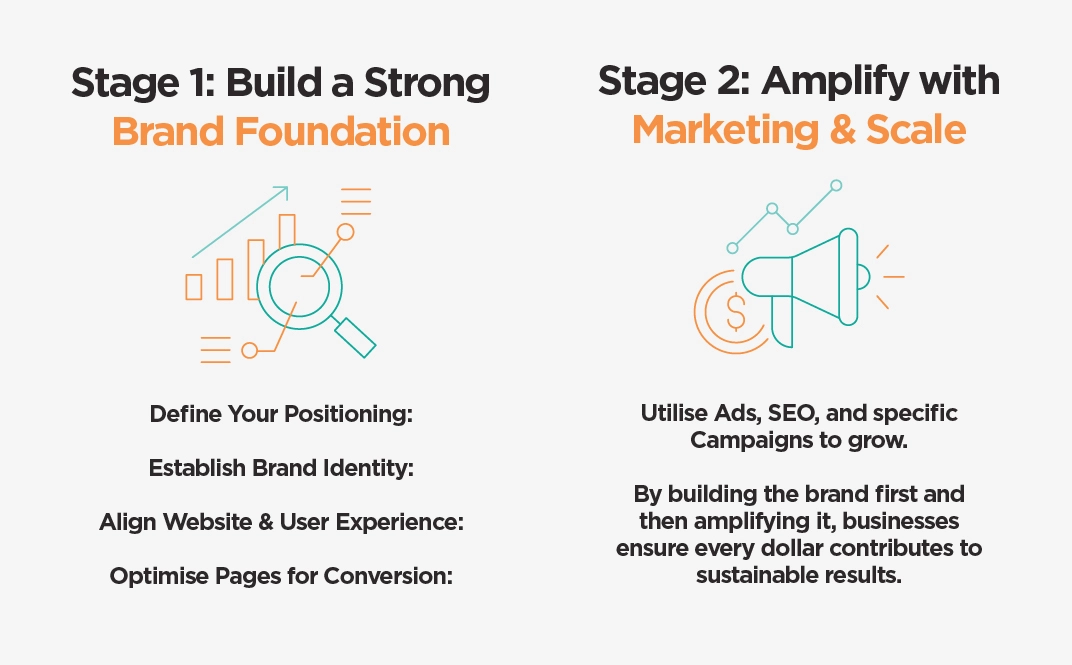
Once the foundation is in place, marketing becomes significantly more efficient and impactful
- Define your positioning and target audience clearly
- Establish a consistent brand identity, including visuals, tone, and messaging
- Align your website and user experience with your brand direction
- Ensure your key pages are optimised for conversion before driving traffic
- Then scale marketing through ads, SEO, and campaigns
In simple terms, build the brand first, then amplify it with marketing. This ensures that every dollar spent on marketing contributes not just to short-term results, but also to long-term growth.
7. Conclusion and Common Misconception Clarity
Branding and marketing are both essential for business growth, but they serve different purposes. Branding defines who you are, while marketing communicates it.
A common misconception is that branding is simply a part of marketing. In reality, branding is the foundation that supports all marketing activities.
At Verz Design, we believe that a strong brand is key to long-term success. When branding is done right, marketing becomes more impactful, more consistent, and more cost-efficient, and selecting the right images and videos for your website plays an important role in this. We provide a wide range of professional stock assets from multiple platforms. This allows us to curate high-quality visuals that align with your brand identity, while also ensuring proper licensing and avoiding copyright concerns. A wider selection of professional assets surely helps maintain consistency across your website and marketing materials.
Another often overlooked area is the post-submission experience, such as the Thank You page after a user submits a form. Instead of a generic confirmation, a customised Thank You page can reinforce your brand message, guide users on what to expect next, and create a more complete and professional user journey.
These small but intentional details help build trust, strengthen brand perception, and create a more cohesive experience for your users.
In a competitive digital landscape like Singapore, businesses are constantly investing in paid marketing to stay visible. However, without a strong brand foundation, marketing costs continue to rise while returns remain inconsistent. By focusing on branding first, businesses can improve marketing efficiency, reduce customer acquisition costs, and build long-term brand equity that supports sustainable growth. Contact us today to schedule a consultation and work with us confidently!
Need a strong team specialised in SEO?
Speak to Verz today if you are looking to create a website with a
lasting impression to achieve online success.


 Share
Share