



Full-funnel marketing means planning every stage of the customer journey as one connected system from the first time someone sees your brand, through to the sale, and beyond that to repeat business.
A practical way to plan it is AIDAR: Attention, Interest, Desire, Action and Retention. Real buying journeys rarely follow a straight line. A Singapore business owner might read a guide recommended by Google AI Overviews, see a retargeting ad three days later, and then book a call after asking ChatGPT for agency recommendations. The goal is not to control the sequence, but to be present and measurable at every stage.
This guide explains what AIDAR means, how to map it to the channels and tools that work for Singapore businesses in 2026, and how to connect it to a CRM so the whole system works as one. Whether you run a service business, a B2B company, or an eCommerce store, you will find a stage-by-stage framework you can put into practice.
Key takeaway: For Singapore businesses in 2026, the highest-return starting points are: fixing what happens at the bottom of the funnel before scaling ad spend at the top, adding a CRM (HubSpot for services, Klaviyo for ecommerce), and showing up in AI-generated search results at the Attention stage. These three changes address the most common gaps in Singapore digital marketing strategies.
What Is Full-Funnel Marketing?
Full-funnel marketing is the practice of running activity across all stages of the customer journey at the same time, rather than concentrating all budget and effort at the point of sale.
Most digital marketing budgets in Singapore are heavily weighted towards the bottom of the funnel: Google Search ads, retargeting campaigns and SEO for high-intent keywords. These channels produce measurable short-term returns, which is why they attract the most spending. The problem is that demand has to be created before it can be captured.
McKinsey described this as the “performance marketing trap” brands that over-invest in lower-funnel activity can sustain returns for a while by harvesting existing demand, but they gradually lose market share as awareness fades (McKinsey, “Why every business needs a full-funnel strategy”, 2021, in the authors’ experience).
| Layer | What happens here |
|---|---|
| Upper funnel | Being discovered through SEO, social content, AI-generated answers and brand-building activity |
| Middle funnel | Being considered through blog content, email nurture, webinars and comparison pages |
| Lower funnel | Converting through paid search ads, landing pages, checkout flows and WhatsApp |
| Post-purchase | Retaining customers through email, loyalty programmes, reviews and referral incentives |
Customer journeys are not linear. AI-generated answers from Google AI Overviews, ChatGPT and Perplexity can now take a buyer from Attention to Desire in a single conversation. Someone asks “which marketing agency in Singapore is best for ecommerce”, reads a summary answer that names three agencies, and contacts one directly without visiting a traditional search result at all. A consistent message and a CRM that tracks all these touchpoints is what makes a full-funnel strategy work.
The AIDA Model, and Why We Add R
AIDA (Attention, Interest, Desire, Action) is one of the most widely used marketing frameworks, first attributed to advertising practitioner E. St. Elmo Lewis in the late 19th century. It remains useful because it maps the psychological sequence most buyers move through before deciding.
| Stage | What the buyer thinks | What the marketer must do |
|---|---|---|
| Attention | "I have seen this brand before" | Create content and ads that are relevant to your audience's problems, not just your product. SEO, social media, and AI search visibility all contribute at this stage. |
| Interest | "This looks worth reading" | Produce specific, helpful content that answers real questions. Generic brand messaging does not earn a second look. |
| Desire | "This might solve my problem" | Show proof: case studies, customer reviews, comparison pages, transparent pricing guides. Social proof matters more in Singapore than in many other markets. |
| Action | "I am ready to buy" | Make it easy: fast pages, short forms, local payment options (PayNow, GrabPay), clear next steps, and a WhatsApp option for buyers who want to ask a question first. |
Why add R (Retention)?
Many marketing frameworks stop at Action. AIDAR adds Retention as an explicit fifth stage because repeat customers and referrals cost significantly less to generate than new ones.
Research from Bain & Company (Reichheld) found that a 5% improvement in customer retention can increase profits by 25 to 95%, depending on the business model. This figure varies across industries; treat it as a directional indicator rather than a precise rule, but the principle is consistent: keeping a customer costs less than acquiring one.
For Singapore businesses, the Retention stage typically involves: onboarding sequences for new service clients, post-purchase email flows for ecommerce customers, loyalty programmes, review requests, and win-back campaigns for customers who have gone quiet.
Funnel Models Compared
Several funnel frameworks exist, and different teams use different names for the same idea. Here is a brief comparison:
| Framework | Stages | Best for |
|---|---|---|
| AIDA / AIDAR | Attention, Interest, Desire, Action, Retention | Service, B2B and ecommerce businesses wanting a clear stage-by-stage marketing plan |
| TOFU / MOFU / BOFU | Top of funnel, Middle of funnel, Bottom of funnel | Content teams planning editorial calendars and blog strategies |
| See-Think-Do-Care | See, Think, Do, Care | Brand planning and media channel allocation across a large audience |
| AARRR (Pirate Metrics) | Acquisition, Activation, Retention, Referral, Revenue | SaaS products and app-based businesses focused on product-led growth |
| Flywheel | Attract, Engage, Delight (cyclical) | HubSpot-driven B2B businesses where referral and word of mouth drive growth |
This guide uses AIDAR because it names Retention as an explicit stage rather than an afterthought. For most Singapore SMEs, Retention is the most under-resourced part of the funnel and often the highest-return investment.
The AIDAR Full-Funnel Map
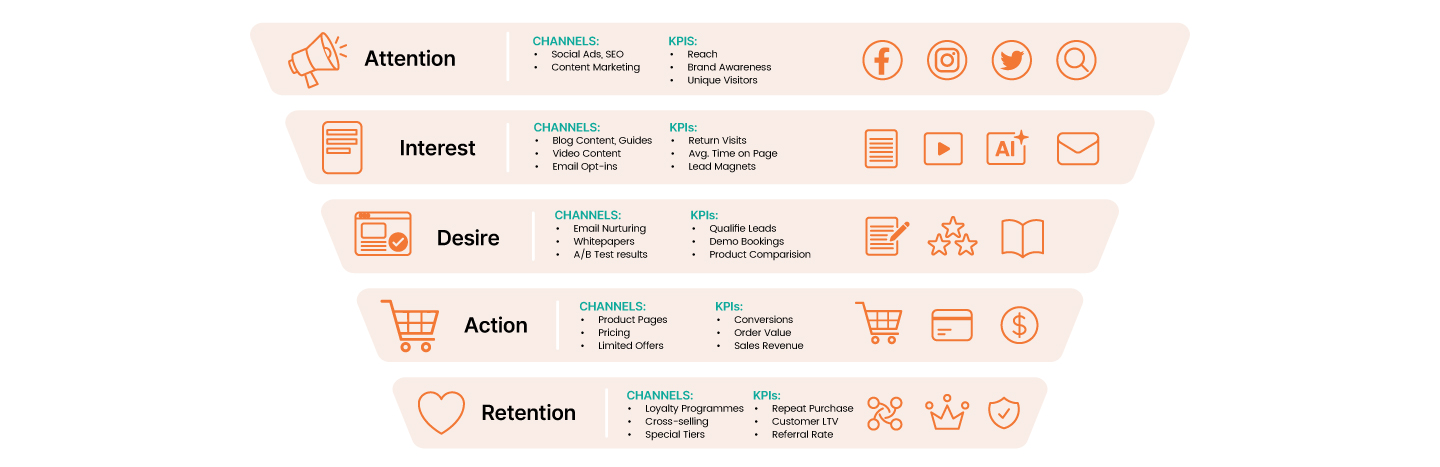
Each stage has a goal, a set of channels, the type of content that works there, and one primary KPI to track:
| Stage | Goal | Channels | Content | Primary KPI |
|---|---|---|---|---|
| Attention | Be found and remembered | SEO, GEO / AI search, social media, Meta and YouTube reach campaigns | Guides, short-form videos, social posts, podcast appearances | Reach, impressions, AI share of voice |
| Interest | Earn a second look | Blog content, email sign-up forms, retargeting ads, LinkedIn outreach | How-to articles, checklists, webinars, lead magnets, comparison guides | Engaged sessions, return visits, email sign-up rate |
| Desire | Win the comparison | Case studies, review platforms, service or product pages, comparison pages | Case studies with real results, "X vs Y" articles, transparent pricing guides | Service/product page visits, add-to-cart rate, consultation requests started |
| Action | Make buying easy | Google Search ads, landing pages, checkout flow, WhatsApp Business | Offer pages, short enquiry forms, clear CTAs, payment option variety | Leads, conversion rate, CPL, CPA, ROAS |
| Retention | Turn buyers into repeat buyers and referrers | Email, SMS, loyalty programme, client reporting, review requests | Onboarding emails, results reports, post-purchase flows, win-back sequences | Repeat purchase rate, renewal rate, customer lifetime value, referrals |
The CRM That Connects the Funnel: HubSpot for Services, Klaviyo for Ecommerce
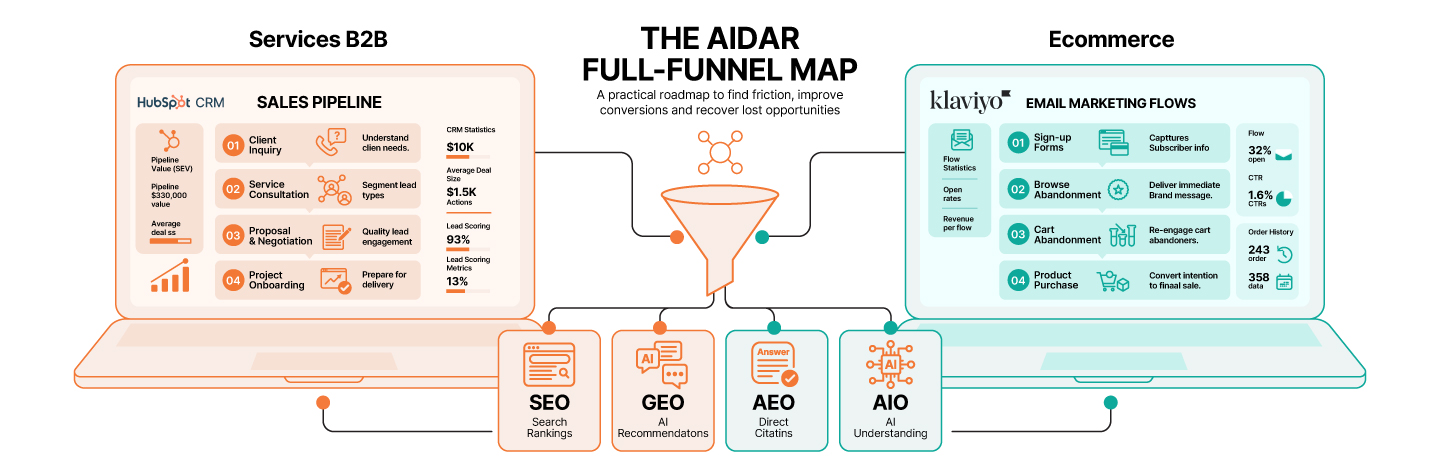
Ads and content bring people in. The CRM is what remembers them, nurtures them, and tells your ad platforms who actually became a customer so bidding can favour real buyers rather than everyone who clicked.
Two platforms are most commonly used by Singapore businesses: HubSpot for service and B2B businesses, and Klaviyo for ecommerce.
| Stage | Services / B2B: HubSpot | Ecommerce: Klaviyo |
|---|---|---|
| Attention | Tracking code and forms record each visitor's first traffic source, building a first-touch attribution picture across SEO, paid and social | Sign-up forms and pop-ups capture subscribers at the moment of interest. Profiles sync automatically from Shopify or WooCommerce |
| Interest | Lifecycle stage: subscriber moves to lead. Nurture sequences send guides and case studies based on which pages they visited and which content they engaged with | Welcome flow introduces the brand, product range and value proposition to new subscribers over 3-5 emails |
| Desire | Lead scoring (available on paid tiers) flags who is ready to talk to sales. Sales can see which pages a lead visited and which emails they opened | Browse-abandonment flow re-engages visitors who viewed products but did not add to cart. Back-in-stock alerts capture returning demand |
| Action | Lead to MQL to SQL to deal with the pipeline. Closed-won deals are sent back to Google Ads and Meta audiences so bidding favours the profile that actually converts | Abandoned-cart and checkout-abandonment flows recover revenue. Purchase data feeds Meta and Google audiences for lookalike targeting |
| Retention | Client onboarding sequence, quarterly reporting, NPS surveys, renewal reminders, referral asks | Post-purchase flow, cross-sell recommendations, replenishment reminders, win-back sequence at 30 and 60 days, VIP tier for highest-value customers |
Check current tier features and pricing on HubSpot’s and Klaviyo’s websites before making a decision; features differ between plan tiers and pricing changes regularly.
Two Singapore customer journeys
Services (B2B): A Singapore SME owner asks ChatGPT how to generate more leads online. A Verz Design guide is cited in the answer. They read the article, which they found through an organic search a few days later. A retargeting ad keeps Verz visible while they compare options. They book a consultation through a short form on the website. HubSpot captures the lead, assigns a lifecycle stage, and starts a case study nurture sequence. A deal is created in the pipeline. After the project is signed, an onboarding sequence sets expectations, and the account manager gets a reminder to run a 90-day review call.
eCommerce: A shopper sees a Reel from an online clothing store and browses three products. They leave without buying. Klaviyo sends a browse-abandonment email two hours later with the products they viewed. They return and add one to cart but still do not check out. A cart abandonment email with free delivery arrives the next morning. They complete the purchase. A post-purchase flow requests a Google review at day 7. At day 60, a win-back sequence re-engages them with new arrivals.
How AI Search Is Changing the Full Funnel?
In 2024 and 2025, the Attention stage changed significantly for Singapore businesses. AI-generated answers from Google AI Overviews, ChatGPT, Perplexity, and similar platforms can now take a buyer from Attention to Desire in a single conversation. Someone asks “which is the best digital marketing agency in Singapore for ecommerce”, reads a summary answer naming two or three agencies, and contacts one without visiting a traditional search result.
This creates two practical priorities for Singapore businesses:
1. Be the brand AI recommends
AI tools cite specific pages, not just domains. Content that is well-structured, factually accurate, cited by other sources, and written to directly answer specific questions is more likely to be used as a source in AI-generated answers. This discipline is called Generative Engine Optimisation, and it overlaps significantly with traditional SEO, but the emphasis shifts from keyword density to factual accuracy, source credibility, and answer structure. Our AI search optimisation guide and our AEO vs GEO vs AIO explainer cover the full approach.
2. Consider the new Attention-stage paid option
ChatGPT Ads launched in Singapore in 2025, giving businesses a paid route to visibility inside AI-generated answers at the Attention stage. Our guide to ChatGPT Ads for Singapore businesses covers how the format works and when it makes sense for your budget.
Schema markup makes AI extraction easier
FAQPage and HowTo schema markup help AI systems understand and extract your content correctly. A page with FAQPage schema is more likely to have its question-and-answer content cited verbatim in AI-generated answers. Our schema markup guide covers implementation for Singapore websites step by step.
Reduce Friction Between Funnel Stages
Each stage transition is where buyers are lost. A few consistent sources of friction affect Singapore websites disproportionately:
| Friction point | Where it hits hardest | How to address it |
|---|---|---|
| Slow page load | Action stage checkout and landing pages | Target LCP under 2.5 seconds on mobile. Compress images, remove render-blocking scripts, improve server response time. See our conversion rate optimisation guide for a full checklist. |
| Long forms | Interest-to-Action transition | Test whether name, email, company and a one-line brief are sufficient for a service enquiry. For ecommerce, reduce checkout fields to the minimum required for delivery and payment. |
| Slow response to enquiries | Action-to-Desire transition (services) | Set up an automated acknowledgement email in HubSpot immediately after form submission. Define a same-day response target for all inbound leads. A lead that waits 48 hours is usually already in conversation with a competitor. |
| Message mismatch | All stage transitions | If the ad says "free consultation" and the landing page says "contact us for a quote", the mismatch creates doubt. The message should be consistent from ad to landing page to thank-you email. |
| No clear next step | All stages | Every page should answer "what should I do next?". A blog post ends with a relevant CTA or internal link. A service page ends with a contact form. A product page ends with an add-to-cart button. Visitors who are not guided leave. |
How to Measure a Full-Funnel Strategy?
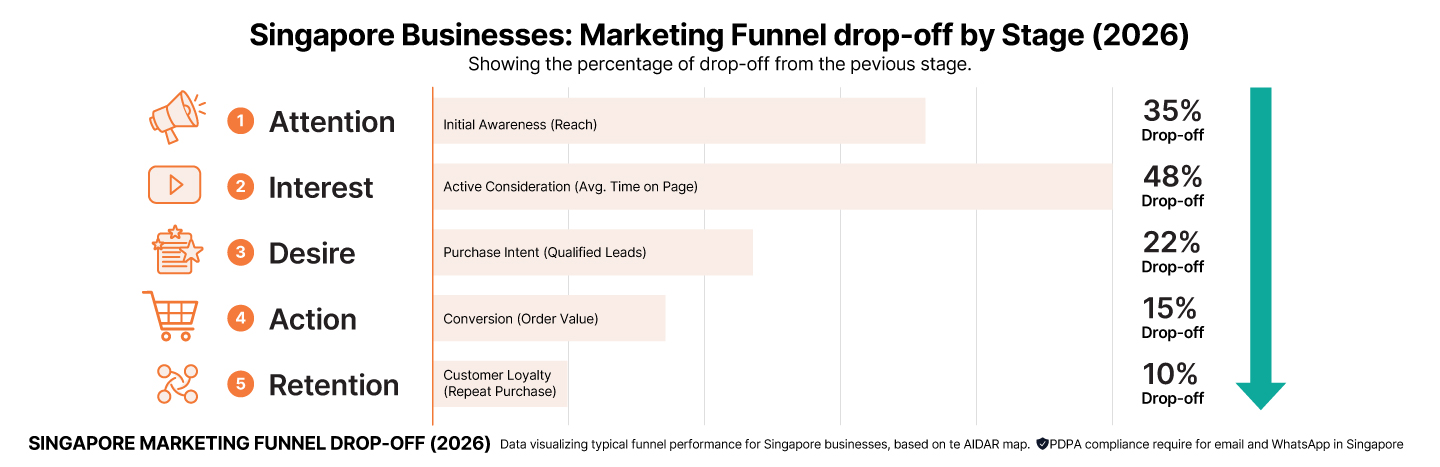
Track one primary KPI per funnel stage and connect them to business outcomes:
| Stage | Primary KPI | Why it matters |
|---|---|---|
| Attention | Reach, impressions, AI share of voice | Tells you whether your brand is visible to the right audience at the awareness stage in search results, social feeds and AI-generated answers |
| Interest | Engaged sessions, return visit rate, email sign-up rate | Engaged sessions in GA4 (over 10 seconds, two page views, or a conversion event) indicate genuine interest, not accidental clicks |
| Desire | Service/product page visits, add-to-cart rate, consultation requests started | These micro-conversions show buyers moving from interest to intent without completing the final action yet |
| Action | Leads, conversion rate, CPL, CPA, ROAS | The primary revenue metrics but read alongside upper-funnel data to understand the full picture. Last-click attribution alone misleads. |
| Retention | Repeat purchase rate, renewal rate, CLTV, referrals | Customer Lifetime Value (CLTV) vs Customer Acquisition Cost (CAC) is the most important ratio for long-term business health. If CLTV does not significantly exceed CAC, the Retention stage is where the problem usually sits. |
Close the loop with your CRM
Most Singapore businesses know their cost per lead. Fewer know which channels produce customers, not leads that never convert. When HubSpot or Klaviyo is connected to your Google Ads and Meta campaigns, closed-won revenue flows back to the ad platforms, letting bidding algorithms favour the type of person who actually buys, not just the type who fills in a form.
Test and learn
Change one variable at a time. Wait for sufficient data: at least two weeks for ads, at least 500 sessions for A/B tests on landing pages. Measure the impact, record what you found, then move to the next test. Changing CTA copy, page layout, email subject lines, and ad creative at the same time makes it impossible to know what worked.
Is Full-Funnel Marketing Right for Your Business?
Full-funnel marketing delivers the strongest results for businesses where the time between first exposure and purchase is longer than a week. If your customers typically research several options before deciding, running activity only at the Action stage means you are invisible during most of the decision process.
Strong fit
- B2B professional services: consulting, IT services, legal, accounting, HR
- Education: courses, training providers, tuition centres
- Healthcare and aesthetics: clinics, specialists, wellness brands
- Property and real estate: new launches, commercial leasing, interior design
- Higher-ticket ecommerce: furniture, electronics, premium fashion, appliances
- Subscription and recurring services: SaaS, managed services, maintenance contracts
Starting with a limited budget?
Start at the bottom. Use search ads to capture demand that already exists, a CRM to nurture and retain, and email to keep buyers coming back. Add Attention-stage investment (blog content, social, GEO) once the lower funnel converts reliably. The foundation of a working funnel is a bottom that converts, not a top that reaches a large audience.
Common Full-Funnel Mistakes
- All budgets at the Action stage: Search ads and retargeting work well for capturing existing demand. They do not create it. If you only run bottom-funnel activity, you are relying entirely on the awareness your competitors have already built in the market. Eventually, fewer qualified buyers enter your campaigns.
- Judging every channel on last-click conversions: Social content and blog posts rarely drive direct conversions; they build awareness and consideration. Attributing zero value to channels that didn't produce the last click undervalues them and eventually leads you to cut the wrong things. Use GA4 attribution reports to understand the full path.
- No retention plan after the sale: The most expensive customer to acquire is the one who buys once and never returns. Email flows, check-in calls, review requests and loyalty incentives cost far less than paid acquisition and produce significantly better margins. The AIDAR framework makes Retention a stage to plan for, not an afterthought.
- The same message at every stage: A buyer who is discovering your brand for the first time needs a different message from someone who has read three of your blog posts and is ready to book. Generic "contact us today" messaging at the top of the funnel will not earn attention. Specific, helpful content will.
- A CRM that is not connected to the ad platforms: If your Google Ads and Meta campaigns are optimising to form fills but your CRM shows that many of those form fills never become paying clients, you are paying for junk leads. Connecting your CRM's "closed won" data back to the ad platforms lets bidding algorithms favour the profile that actually converts.
Build Your Full Funnel in 5 Steps
The shift toward AI-mediated discovery is not a projection; it is measurable today in Singapore and globally.
- Set goals and KPIs: Before choosing channels or tools, define what success looks like at each stage. What is your current conversion rate? What is your average deal size or order value? What is your customer lifetime value? These numbers determine where improvement will have the biggest financial impact.
- Map the customer journey: List the touchpoints a typical customer has with your business before buying, and trace their path through the funnel. Identify where most people drop off and where your highest-converting traffic comes from. GA4 funnel exploration reports and session recordings are useful starting points.
- Choose channels per stage: Match channels to stages based on where your audience spends time and your available budget. SEO and content for Attention and Interest; SEM and retargeting for Action; email and SMS for Retention. Do not try to be everywhere at once to cover the stages where your current gaps are largest.
- Connect the CRM: Set up HubSpot if you are a service or B2B business, or connect Klaviyo if you run an eCommerce store. Link your CRM to Google Ads and Meta so performance data flows in both directions from ad click to closed revenue.
- Measure, test and optimise: Review your one primary KPI per stage monthly. Identify the weakest link the stage with the biggest drop-off and run one focused improvement at a time. Document what you tested, what changed and what the result was. Share findings with the team so learning is not lost when people move on.
Full-Funnel Marketing Statistics
A 5% improvement in customer retention can increase profits by 25–95%.
15–20% higher marketing ROI reported by the authors based on their experience with full-funnel marketing programmes.
AI Overviews appeared in approximately 60% of Google searches for informational queries in Singapore.
84% of Singapore’s internet users actively use WhatsApp.
70.22% of online shopping carts are abandoned before checkout.
How Verz Design Helps Singapore Businesses Build a Full Funnel?
A full-funnel strategy works best when every marketing activity supports the next stage of the customer journey. Verz Design helps Singapore service businesses and ecommerce brands build this connected approach through a combination of digital marketing, search visibility, and website solutions.
At the Attention and Interest stages, SEO and GEO help businesses improve their visibility in traditional search results and AI-powered platforms, making it easier for potential customers to discover their brand when researching products or services. Through SEO services and Generative Engine Optimisation, businesses can build a stronger search presence with relevant content and structured information.
As potential customers move into the Interest and Consideration stages, digital marketing strategy helps connect different channels through a clear channel mix, budget allocation and KPI framework across all five AIDAR stages. Digital marketing services support this planning, while Klaviyo email marketing helps nurture subscribers, recover abandoned carts, and encourage repeat purchases through automated email flows.
At the Action stage, Google Ads and Meta Ads help businesses reach people with strong purchase intent and reconnect with users who have already shown interest. SEM services support this paid acquisition and retargeting activity. However, attracting visitors is only part of the process. A well-designed website must also make it easy for them to take the next step. Through website design and development, businesses can create fast, mobile-friendly experiences and smoother checkout journeys that reduce friction and support conversions.
The funnel also continues after a purchase. Klaviyo email marketing supports the Retention stage by keeping customers engaged, encouraging repeat purchases and helping businesses build longer-term customer relationships. By connecting these services, Verz Design helps businesses create a more consistent customer journey, from initial discovery to conversion and retention.
Ready to build a full funnel that actually works?
Not sure whether your current marketing channels are working together effectively? Contact Verz Design to discuss your business goals and current marketing challenges. Our team can help review your channel mix, identify funnel drop-off points, assess your CRM setup and evaluate your AI search visibility.

Get more value from your existing website traffic
Contact Verz Design about a CRO strategy tailored to your business goals.
Get a free CRO consultation
Frequently Asked Questions
Full-funnel marketing is the practice of running activity across all stages of the customer journey from awareness through to purchase and repeat buying as one connected system, rather than focusing only on the moment of sale. It typically uses a framework like AIDAR (Attention, Interest, Desire, Action, Retention) to map channels, content, and KPIs to each stage.
AIDA stands for Attention, Interest, Desire, and Action, the four psychological stages a buyer moves through before making a purchase decision. AIDAR adds a fifth stage, Retention, to reflect the fact that keeping existing customers buying is typically more cost-efficient than acquiring new ones. Many marketers use AIDAR as a practitioner extension rather than a formally published model.
Performance marketing focuses on measurable, last-click activity, such as Google Search ads, retargeting, and affiliate marketing, where return on ad spend is direct and trackable. Full-funnel marketing includes upper-funnel activity such as content, social media and GEO that builds awareness and consideration before the sale. Performance marketing captures demand that already exists; full-funnel marketing creates it. Most Singapore businesses need both.
It depends on your business model. HubSpot is the stronger choice for service businesses and B2B companies that sell through enquiries, proposals or consultations; it manages the full lead-to-close pipeline and connects to your ad platforms. Klaviyo is built specifically for ecommerce and integrates directly with Shopify and WooCommerce to power abandoned cart, welcome and win-back flows. Both have free entry-level tiers.
No. The principles apply at any budget. If you are starting with limited spend, prioritise the Action stage (search ads to capture existing demand) and the Retention stage (email to keep buyers returning). Add Attention-stage investment blog content, social media, GEO once the lower funnel converts reliably. A focused small budget on the right stage produces better returns than the same budget spread thin across all five stages.
Bottom-funnel changes (improving landing page conversion rate, adding a cart abandonment email flow) can show measurable results within 30 to 60 days. Mid-funnel improvements (email nurture sequences, retargeting audiences built from engaged website visitors) typically show results in 60 to 90 days. Upper-funnel investments (SEO, content, GEO) usually take 3 to 6 months to compound into measurable traffic and lead growth. The full picture of a connected funnel where upper-funnel activity visibly feeds lower-funnel conversions typically takes 6 to 12 months to build.
AI-generated answers from Google AI Overviews, ChatGPT and Perplexity can now take a buyer from Attention to Desire in a single conversation, bypassing several traditional funnel stages. Businesses that appear in AI-generated answers gain Attention and credibility at the same time. Optimising for AI search (GEO) is now part of the Attention stage for most Singapore businesses, particularly for informational and comparison queries. Our AEO vs GEO vs AIO guide covers the full picture.
Share this article: