AEO, GEO and AIO all describe optimising for AI-driven discovery, but they target different outcomes. AEO (Answer Engine Optimisation) earns your brand a direct citation inside an AI-generated answer where your specific page is the named source. GEO (Generative Engine Optimisation) earns you a mention or recommendation within that answer, whether or not it carries a formal citation. AIO (AI Optimisation) is the broadest of the three: making your content and entity signals legible to any AI system, including ones outside search, so your brand appears accurately wherever AI is summarising, comparing or recommending. Most Singapore businesses need all three, built together through a shared technical foundation.
Why Does This Distinction Actually Matter
The terms AEO, GEO, and AIO get used interchangeably online, and sometimes by agencies that haven’t thought through the difference. That causes real confusion for a Singapore business trying to decide what to invest in.
The confusion has a practical cost. A page can be well-cited (strong AEO) while still being absent from broader AI recommendations (weak GEO), or vice versa. Diagnosing which gap a Singapore business actually has determines whether the fix is a schema and FAQ restructuring problem (AEO), a broader authority and content-coverage problem (GEO), or a technical entity-data consistency problem (AIO). Treating all three as interchangeable means applying the wrong fix and wondering why results are slow.
Getting the terminology right is not academic. It is the foundation for correctly diagnosing where a Singapore brand is underperforming in AI search, and for sequencing the work that closes the gap.
The Numbers Behind AI Search in Singapore (2026)
Before the comparison, a quick look at why AEO, GEO, and AIO matter for Singapore businesses right now, not eventually.
2026 Key Data Points: Why AI Search Visibility Matters Now
GEO technique uplift in AI search visibility
GEO can boost visibility by up to 40% in generative engine responses
The 90% figure from the AI SEO Tracker is worth pausing on. Nine out of ten brands have zero mentions in AI-generated answers, which means your competitors are almost certainly in that group too. For Singapore businesses building AEO, GEO, and AIO signals now, the opportunity isn’t to play catch-up; it is to establish presence before the space gets crowded.
What Is AEO (Answer Engine Optimisation)?
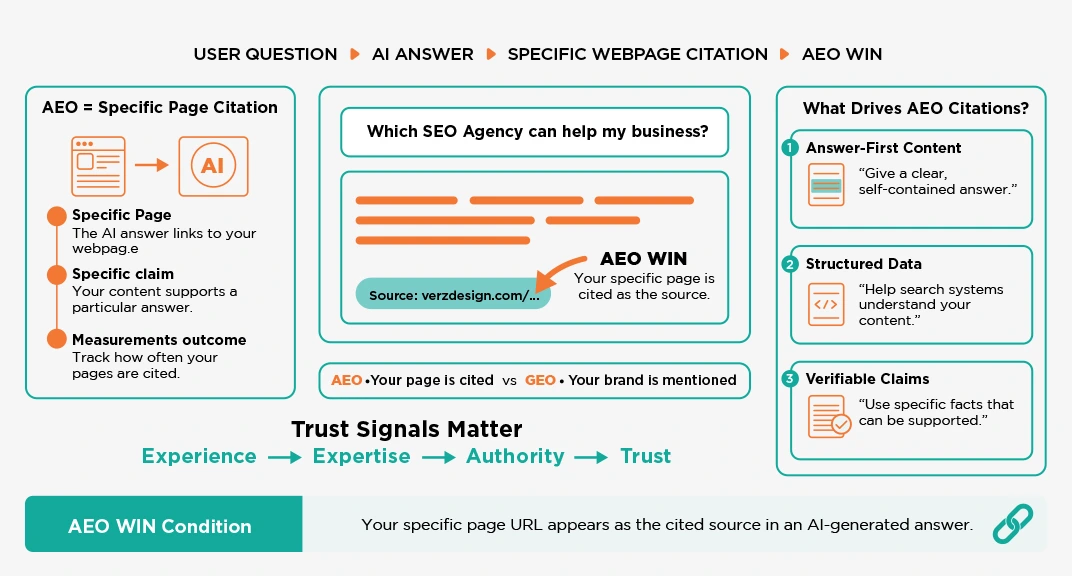
AEO is the narrowest and most measurable of the three disciplines. It targets a specific outcome: your page is the source that an AI answer links back to. For a deeper look at how AEO for AI search works and how to implement it, see our guide to Answer Engine Optimisation.
The distinction from a general mention is important. AEO is not about your brand name appearing in an AI answer that is GEO. AEO is about your specific page being the evidence for a specific claim or the source of a specific answer. That citation is what earns the 35% higher organic CTR and 91% higher paid CTR that Seer Interactive’s November 2025 research documents for AI-cited pages.
What Drives AEO Citations?
Three technical signals drive AEO performance more than any others.
Answer-first content: the paragraph immediately after a heading should open with a self-contained 40-60 word answer that could stand alone as an AI citation block. AI systems extract content in specific passages, not whole pages.
Structured data: FAQPage and HowTo JSON-LD schema label your Q&A content explicitly, making it significantly easier for AI systems to identify and extract.
Verifiable specific claims: “Verz Design has completed 4,000+ projects in Singapore since 2009” is citable; “we have extensive experience” is not. AI systems cite specific, verifiable facts, not general statements. Understanding how AI systems decide which content to cite can help businesses structure claims and supporting content more effectively.
E-E-A-T (Experience, Expertise, Authoritativeness, Trustworthiness) signals also matter heavily for AEO, particularly in Singapore’s YMYL (Your Money, Your Life) categories: finance, healthcare, legal services. Named author credentials, institutional affiliations, and consistent brand signals across third-party sources all contribute.
AEO win condition: Your specific page URL appears as the cited source in an AI-generated answer. Measurable via citation frequency tracking in tools like Peec AI, Conductor, or manual prompt testing in ChatGPT and Perplexity.
What Is GEO (Generative Engine Optimisation)?
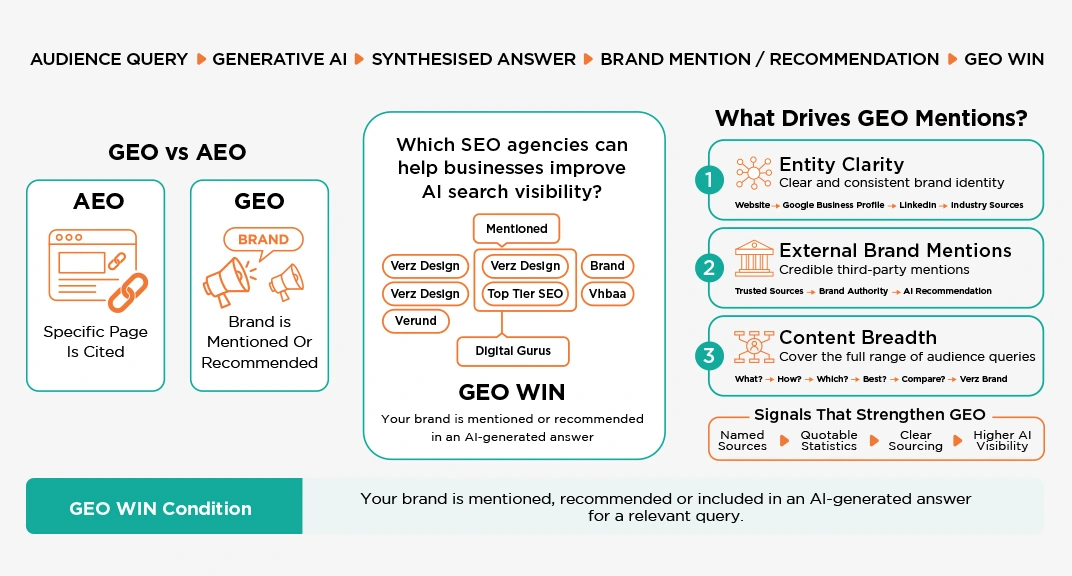
GEO is broader than AEO. It covers being mentioned, recommended, or worked into a generative AI’s synthesised answer whether or not that mention carries a formal citation link. For a deeper look at the underlying optimisation process, see our GEO guide covering generative engine optimisation and AI search.
GEO was formally named in a 2023 academic paper from researchers at Princeton, Georgia Tech, the Allen Institute for AI and IIT Delhi accepted at KDD 2024 which tested specific content techniques in controlled generative-engine environments. The researchers found that techniques including adding named citations, quotable statistics, fluency improvements, and clear sourcing could boost a source’s visibility in generative engine responses by up to 40%.
What Drives GEO Mentions?
GEO visibility is driven by three main signal categories. First, entity clarity: AI systems can only mention a brand they can confidently identify. Consistent brand name, description, and category signals across your website, Google Business Profile, LinkedIn, and industry directories build entity confidence. Second, external brand mentions: the Limy.ai GEO research confirms that authentic third-party mentions carry more weight for AI recommendation decisions than volume of self-published content. One credible mention in a recognised Singapore business publication is worth more for GEO than ten self-authored blog posts. Third, content breadth: GEO requires coverage of the full range of queries your target audience asks AI systems, not just the specific questions you have answered for AEO.
The Aggarwal et al. research also found that explicitly citing sources within your own content, naming data sources, referencing external research, and including quotable statistics improved GEO visibility. Content that itself demonstrates the behaviour of a trustworthy information source earns more generative engine recommendations than content without these signals.
GEO win condition: Your brand name is mentioned, recommended, or worked into an AI-generated answer in response to a relevant query, whether or not a specific page URL is cited alongside it. Measurable via mention frequency tracking in Peec AI, Profound, or manual prompt testing.
What Is AIO (AI Optimisation)?
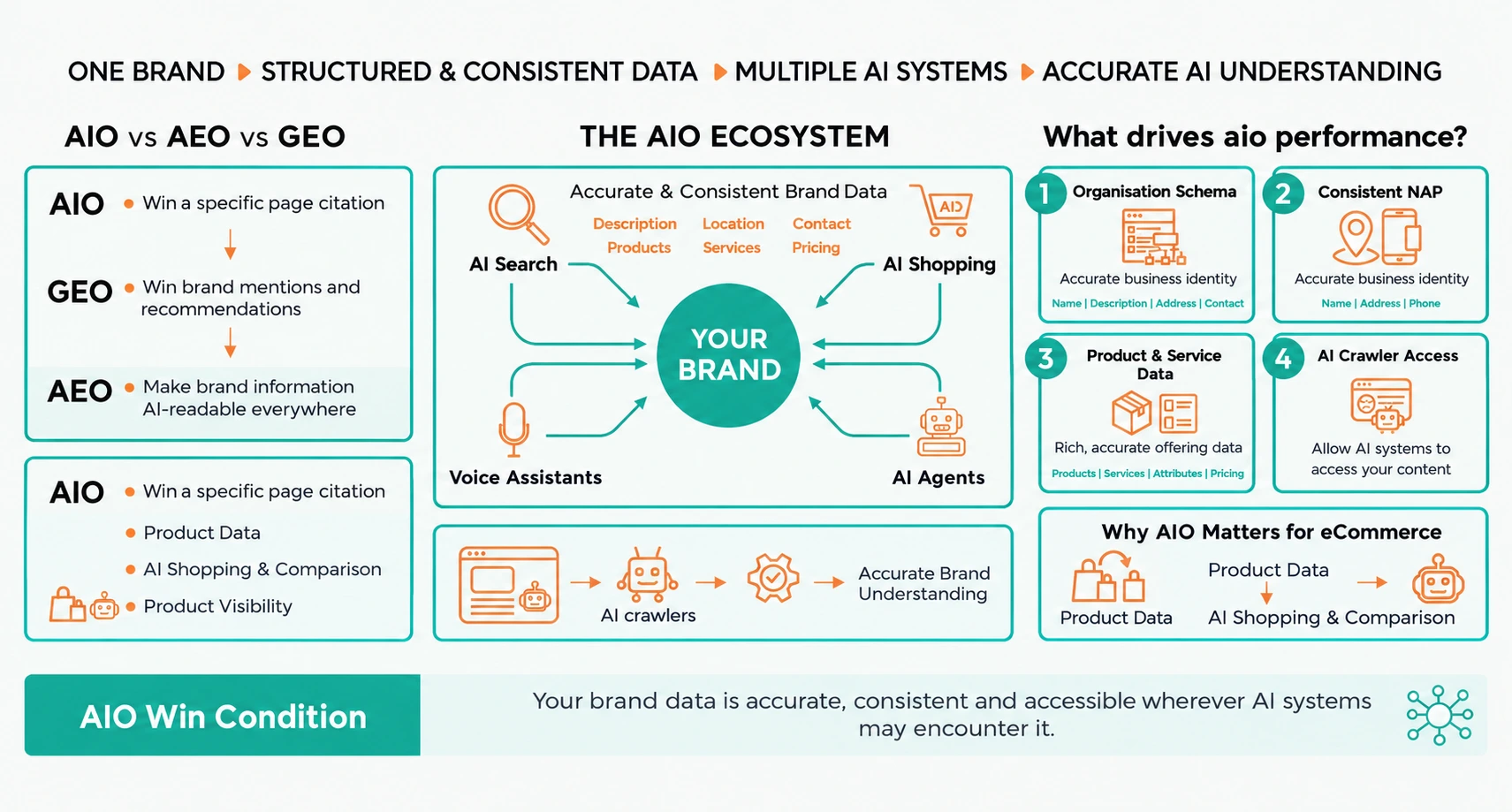
AIO is the broadest of the three disciplines. It is the umbrella practice of making your brand’s content and entity data legible to any AI system, not just conversational AI search platforms, but also AI shopping assistants, voice assistants, and AI agents that summarise, compare, or recommend using your content as input.
If AEO and GEO are about winning inside a specific AI-generated answer on a specific platform, AIO is about making sure your brand’s information is correct and consistent everywhere an AI system might encounter it. A brand with strong GEO but weak AIO might be recommended by ChatGPT for its services while an AI shopping assistant describes it incorrectly because its product schema is outdated. Both gaps harm the same brand, but they require different fixes.
What Drives AIO Performance?
AIO is primarily a technical discipline, not a content discipline. The core requirements: Organisation schema with accurate name, description, address, and contact information sitewide; consistent NAP (Name, Address, Phone) data across every directory and third-party listing an AI system might read; Product and Service schema with rich, accurate attributes for every offering; and AI crawler access confirmed in robots.txt (GPTBot, OAI-SearchBot, PerplexityBot, Google-Extended, and ClaudeBot all allowed). For implementation details and JSON-LD examples, see our guide to schema markup.
For Singapore eCommerce businesses, AIO is often the highest-priority starting point because AI shopping assistants and comparison tools that operate outside conversational AI search depend entirely on structured product data to function. An eCommerce brand with excellent GEO and AEO but no Product schema is invisible to AI commerce surfaces entirely.
AIO win condition: Your brand data name, description, location, contact, services, products, and pricing is accurate and consistent everywhere an AI system might read it, and your content is accessible to all major AI crawlers. Measurable via entity consistency audit and Google Rich Results Test.
AEO vs GEO vs AIO: Side by Side
With each discipline defined, here is the full comparison. The most important column is “Singapore example”. Abstract distinctions are much clearer when grounded in a specific context.
Factor
AEO
GEO
AIO
Goal
Earn a direct citation: your page is the named source of a specific claim or answer
Earn a mention or recommendation: your brand is named in the answer, whether cited or not
Make your brand’s entity data and content legible to any AI system on any surface
Scope
Narrowest: one answer, one citation
Medium: one AI-generated response, recommendation included
Broadest: every AI touchpoint search, shopping, voice, agents
Primary surfaces
ChatGPT, Perplexity, Google AI Overviews, Gemini
Same AI search platforms, plus generative summaries and recommendations
AI shopping tools, voice assistants (Siri, Alexa), AI agents, comparison engines
What a win looks like
Your specific page URL is linked as the source in an AI answer
Your brand name is spoken or written in an AI recommendation, with or without a link
Your brand data (name, description, offering, contact) is correct wherever AI reads it
Core technical signals
FAQPage schema, HowTo schema, answer-first paragraphs with verifiable specific claims, E-E-A-T
Named external mentions, credible third-party citations, authority signals, content breadth
Consistent entity data: Organisation schema, accurate NAP sitewide, correct product data in catalogues
Singapore example
Perplexity cites a Verz Design blog article as the source for a stat on GEO for Singapore eCommerce
ChatGPT recommends Verz Design when a user asks “which Singapore agency handles GEO?”
An AI shopping assistant accurately describes Verz Design’s service offering, contact, and location
Measurement metric
Citation frequency: how often your page URL appears as a cited source
AI mention frequency: how often your brand name appears inside generated answers
Entity consistency score: whether brand data is accurate across all AI-readable sources
Timeline to first results
2-4 months with correct answer-first content and schema
3-6 months for consistent mention frequency
1-3 months: primarily technical schema and entity data can be fixed quickly
How to Diagnose Which Gap Your Singapore Business Has
The most practical application of the AEO / GEO / AIO distinction is diagnosis. Running an AI visibility audit with 30-40 prompts across ChatGPT, Perplexity, Google AI Overviews, and Gemini will reveal which specific pattern applies to your brand.
Symptom You Are Seeing
What the Gap Actually Is
Where to Focus First
Brand is not mentioned at all in AI-generated answers
Broad visibility gap possibly all three disciplines
GEO first: build entity clarity, external mentions, and answer-first content to establish a presence in AI answers before optimising for citations
Brand is mentioned in AI answers but never linked as a source
AEO gap: you have GEO but lack citation signals
AEO: restructure content with answer-first paragraphs, add FAQPage and HowTo schema, use specific verifiable claims that AI systems can extract and cite
Brand is cited in search AI but missing from shopping or comparison tools
AIO gap citation in search AI but no entity legibility on commerce surfaces
AIO: audit entity consistency, implement Product and Offer schema, ensure brand data is accurate in Google Merchant Center, industry directories, and AI-readable catalogues
Competitor mentioned in AI answers but your brand is not, despite similar content
Authority and mention gap GEO signal weakness
GEO: build external brand mentions in credible third-party sources, improve directory presence, increase review signal volume on platforms AI systems read. It is also useful to understand why competitors get mentioned in ChatGPT when assessing this type of visibility gap.
Mentioned in AI answers but information is wrong (wrong location, wrong service)
Entity data inconsistency AIO gap
AIO: audit entity data across GBP, website schema, all directories, and LinkedIn for inconsistencies. Fix Organisation schema data. Ensure NAP is identical across all sources.
Most Singapore brands will find a combination pattern: absent from AI answers entirely (all three disciplines need work) or mentioned but not cited (GEO exists but AEO is weak). A smaller group will find specific entity accuracy issues (AIO gap) where their brand is mentioned or cited, but the information in the AI answer is incorrect.
The audit is the non-negotiable first step before any programme investment. Spending on GEO content when the actual gap is entity consistency (AIO) wastes budget. Spending on AIO schema implementation when the brand is entirely absent from AI answers (all three disciplines needed) creates technically correct data for a brand with no AI presence. Sequence matters: audit first, then build in the right order.
How AEO, GEO and AIO Work Together?
In practice, the three disciplines are not built as separate programmes. Verz Design runs AEO, GEO and AIO through the same 5 Pillars of Generative Visibility framework, because the underlying signals reward overlapping work:
Pillar 1: AI Intent and Prompt Research
Identifies the specific questions and prompts your Singapore buyers ask AI systems the foundation for both AEO content targeting (which specific questions to answer directly) and GEO content breadth (which topic clusters to cover to appear in recommendation-type answers).
Pillar 2: Entity and Schema Architecture
Organisation schema, consistent NAP data, Google Business Profile accuracy, and AI crawler access serve all three disciplines. Schema makes AEO citations more reliable, entity clarity makes GEO recommendations more confident, and both are AIO prerequisites.
Pillar 3: Answer-First Content Engineering
Question-phrased headings and 40-60 word self-contained answer paragraphs earn AEO citations directly, while the broader content architecture comparison tables, statistical claims, FAQ clusters earn GEO recommendation mentions in the same pass.
Pillar 4: Authority and Citation Sourcing
The third-party mentions that AI systems weight for GEO recommendations also contribute to AEO citation credibility. A brand cited in credible Singapore business publications is more likely to be both mentioned (GEO) and cited (AEO) than a brand that exists only on its own website.
Pillar 5: Visibility Tracking
Monthly measurement across AEO citation frequency, GEO mention frequency, and AIO entity consistency score tracked on the same query portfolio against named competitors. Three numbers from one set of prompts and one audit pass, rather than three separate reporting cycles.
The practical implication: content built correctly for AEO (clear structure, schema markup, verifiable specific claims) tends to perform well for GEO and AIO simultaneously, because the underlying signals of all three disciplines reward are the same. The distinction matters for diagnosis and measurement, not for building three separate content pipelines.
Which One Should Singapore Businesses Build First?
The right answer depends on your current AI visibility state, your business category, and what technical infrastructure already exists. Here is the decision framework:
Start with GEO if:
Your brand has little to no presence in AI-generated answers today. GEO is the broadest lever and has the most immediate return on investment for a brand starting from zero AI visibility. Existing SEO content can often be adapted toward GEO fastest: question-phrasing headings, adding FAQ sections, and improving external mention signals are all changes a Singapore business can make to existing pages rather than creating new ones. GEO is also a strong starting point for Singapore B2B and professional services brands, where buyers typically ask AI systems to name or compare providers rather than ask narrow, specific questions.
Prioritise AEO if:
Your brand is already mentioned by AI systems (GEO exists) but not cited directly, or you have a specific, well-defined service or expertise that deserves to be the named answer to a common and commercially significant question. AEO is the right priority for Singapore brands with strong existing content that simply needs restructuring. Answer-first paragraphs, schema markup, and specific verifiable claims are the AEO levers, and they can be applied to existing content without a full content rebuild. Brands in information-heavy categories (finance, healthcare, legal, B2B SaaS) typically see the fastest AEO gains because their content is inherently answer-rich.
Invest in AIO if:
Your category involves AI-driven shopping, comparison, or recommendation tools beyond conversational search marketplaces, AI shopping assistants, or voice search. For Singapore eCommerce businesses on Shopify or similar platforms, AIO is typically the first gap worth closing: without Product schema and consistent entity data, the brand is entirely invisible to AI commerce surfaces regardless of how strong its GEO and AEO content is. AIO is also the right first step for any Singapore brand that discovers its AI-generated mentions or citations contain incorrect information (wrong address, wrong description, wrong service list) that is always an AIO entity data problem, not a GEO or AEO content problem.
Most Singapore brands need all three eventually. The question is sequencing, not choosing. An AI Visibility Audit testing your brand across ChatGPT, Perplexity, Google AI Overviews and Gemini on your specific query portfolio is the only reliable way to know which gap to address first.
Tools for Measuring AEO, GEO and AIO
Each discipline is measured differently. The right tools depend on budget, scale, and how granular the tracking needs to be.
Tool
Discipline
What It Measures
Cost / Access
Google Search Console
SEO / AEO
Click-through rate on AI Overview queries, ranking positions, indexed page count
Free (requires site verification)
Google Rich Results Test
AEO / AIO
Whether schema markup is valid and which rich results a page qualifies for
Free (tool.google.com)
Peec AI
GEO / AEO
Brand mention frequency, citation frequency, share of voice against competitors across AI platforms
Paid Verz Design’s primary GEO tracking tool
Profound
GEO / AEO
AI brand visibility tracking across ChatGPT, Perplexity, Gemini, Claude
Paid enterprise tier
Conductor
AEO / GEO
AI share-of-voice, citation pattern tracking, content performance in AI Overviews
Paid enterprise tier
Manual prompt testing
GEO / AEO
Direct testing of your brand across 30-40 prompts in ChatGPT, Perplexity, Gemini, AI Mode
Free time cost only; incognito session required
Schema Markup Validator (validator.schema.org)
AIO / AEO
Technical JSON-LD validation flags syntax errors before going live
Free
Google Analytics 4 (AI referral filter)
GEO / AEO
Direct sessions from chatgpt.com, perplexity.ai and other AI platforms
Free requires GA4 setup
For most Singapore SMEs starting their AI visibility programme, the practical minimum tracking set is: manual prompt testing (free, 30-40 prompts monthly in incognito) for GEO mention frequency and AEO citation frequency, Google Search Console for traditional SEO and AI Overview impressions, GA4 AI referral session tracking (free), and Google Rich Results Test for schema validation before publishing any structured data changes. Scale up to Peec AI or Profound once there is an established baseline and ongoing programme to measure against.
AEO, GEO and AIO vs Traditional SEO
Understanding how the three disciplines relate to traditional SEO clarifies where each fits in a Singapore brand’s digital marketing strategy.
Factor
Traditional SEO
Primary target
A position on a results page (Google, Bing)
User experience
User sees a list of results and chooses which to click
Click-through dependency
Traffic depends on earning a click from the results page
3-6 months for meaningful ranking movement on competitive queries
Zero-click impact
SEO loses direct traffic value when AI Overviews answer queries above the organic results
Relationship
SEO is the foundation: technical accessibility, domain authority, and content quality underpin all three disciplines
The key strategic point is understanding how AI search is changing SEO, particularly as AI Overviews answer more queries above the organic results. But a brand with strong AEO and GEO signals appears in those AI Overviews. Click loss is the same, but brand visibility is preserved. This is the fundamental reason Singapore businesses need all four disciplines: SEO, GEO, AEO, and AIO rather than SEO alone.
Not Sure Which Gap Your Singapore Brand Has AEO, GEO, or AIO?
The distinction between AEO, GEO, and AIO is not semantic; it is diagnostic. Knowing which of the three gaps your Singapore business has is the difference between investing in the right fix and investing in work that addresses a problem you don’t actually have.
The practical starting point for any Singapore business is an honest audit: test your brand across ChatGPT, Perplexity, Google AI Overviews, and Gemini on 30-40 prompts that represent your buyers’ actual questions. What you find will tell you whether the gap is a content and schema problem (AEO), an authority and entity problem (GEO), a technical data problem (AIO), or a combination of all three, which is the most common result for Singapore brands starting from zero AI visibility.
The good news is that 90% of brands have zero AI mentions, which means the space is still wide open. Singapore brands that build the right signals now across all three disciplines, through a single framework, have a meaningful window to establish AI visibility before most competitors notice the gap. If your business needs help identifying and closing these AI visibility gaps, explore our AI SEO services in Singapore. Contact Verz Design for an AI visibility assessment.
Frequently Asked Questions
Is AEO the same as GEO?
No. AEO (Answer Engine Optimisation) targets a direct citation to the specific line an AI answer links back to as its source. GEO (Generative Engine Optimisation) is broader and covers being mentioned or recommended within a generated answer even without a formal citation link. A brand can have strong GEO (mentioned frequently) with weak AEO (rarely cited as a source), or strong AEO (specific pages cited) with narrow GEO (mentioned on a limited set of queries). The technical work overlaps significantly, but the win condition and the measurement method differ.
What is the difference between AIO and GEO?
GEO earns brand mentions and recommendations inside AI-generated answers on conversational AI platforms. AIO (AI Optimisation) is broader: it covers making brand data legible across all AI surfaces, including AI shopping tools, voice assistants, and AI agents, not just conversational search. GEO is a content and authority discipline. AIO is primarily technical: Organisation schema, consistent entity data across directories, Product schema, and AI crawler access. A brand can have strong GEO (recommended in ChatGPT) with weak AIO (invisible to Google Shopping AI or incorrectly described by Siri).
Do I need to choose between AEO, GEO and AIO?
No. Most brands benefit from running all three simultaneously because the underlying technical work schema markup, entity consistency, answer-first content, and authority signals reinforces all three. The distinction matters most for diagnosing which gap to fix first, not for choosing a single lane to invest in. Verz Design runs all three through a single 5 Pillars framework so the same content and technical build serves all three disciplines.
Which is more important for eCommerce brands in Singapore?
AIO tends to matter most for eCommerce specifically, because AI shopping assistants and comparison tools depend on structured product data. Without Product, Offer, and AggregateRating schema, a Singapore eCommerce brand is invisible to AI commerce surfaces, no matter how strong its GEO and AEO content is. After AIO, GEO matters for category and brand-discovery queries, and AEO matters for specific product comparison and recommendation queries.
Which discipline should a Singapore B2B company prioritise?
GEO first, then AEO. Singapore B2B buyers frequently ask ChatGPT and Perplexity to name or compare service providers: 'which Singapore SEO agency handles GEO?', 'compare digital marketing agencies in Singapore.' These are recommendation-type queries that GEO addresses. Once the brand appears in recommendation-type answers, AEO becomes the refinement: restructuring specific pages to be cited as the source for the specific claims AI systems make about the category.
How long before I see results from AEO, GEO and AIO?
AIO is typically the fastest: entity consistency and schema fixes produce measurable improvement in AI crawl accuracy within 1-4 weeks of correct implementation. GEO mention frequency typically shows movement within 3-6 months as content is re-evaluated and external mention signals accumulate. AEO citation frequency moves at a similar pace to GEO, though specific answer-first restructuring and schema implementation can accelerate initial citations to 2-4 months. Monthly tracking is essential AI platforms re-evaluate content continuously, so progress does not follow a linear timeline.
Can a small Singapore business compete in AEO and GEO against larger competitors?
Yes, and in some categories, smaller brands have a structural advantage. Unlike traditional SEO, which rewards years of accumulated domain authority and backlinks, AEO and GEO signals reward clear, well-structured, specific content that a smaller brand can produce faster than a larger competitor with a less-structured site. 90% of brands currently have zero AI search mentions (AI SEO Tracker); this includes many large Singapore brands that have not yet built AI-optimised content architecture. A Singapore SME that moves first with correct AEO and GEO content can establish AI visibility before its larger competitors.
What is the 5 Pillars of Generative Visibility framework?
The 5 Pillars of Generative Visibility is Verz Design's framework for building AEO, GEO, and AIO simultaneously through a single programme rather than three separate projects. The five pillars are: (1) AI Intent and Prompt Research, mapping the specific queries your buyers ask AI systems; (2) Entity and Schema Architecture, structured data and consistent entity signals; (3) Answer-First Content Engineering, content built for AI extraction and human readability together; (4) Authority and Citation Sourcing, third-party mentions and review signals; (5) Visibility Tracking, monthly share-of-voice measurement across all three disciplines on the same query portfolio.
How do I know if I have an AEO gap, a GEO gap, or an AIO gap?
Run an AI visibility audit: test 30-40 prompts across ChatGPT, Perplexity, Google AI Overviews, and Gemini that represent your buyers' actual questions. If your brand is absent from all answers, all three disciplines need work; start with GEO. If your brand is mentioned but never cited as a source: GEO exists, but AEO is weak. If your brand is mentioned or cited but the information is wrong: AIO entity data issue. If your brand is strong in conversational AI but absent from AI shopping or voice: AIO commerce schema gap. The audit tells you which pattern applies before you spend on content or schema work.
About the Author:
Shu Yeong Tan
Naturally curious and driven by a love for problem-solving, Shu Yeong enjoys exploring the intricacies of the world and finding creative solutions. Whether crafting campaign ideas or tackling challenges, he’ll use his empathy, adaptability, and logical thinking to survive. He keeps his mind sharp and his creative juices flowing through...
Contributors:
Vivek Tank
Senior SEO Specialist
Need a strong team specialised in SEO?
Speak to Verz today if you are looking to create a website with a lasting impression to achieve online success.

 Share
Share