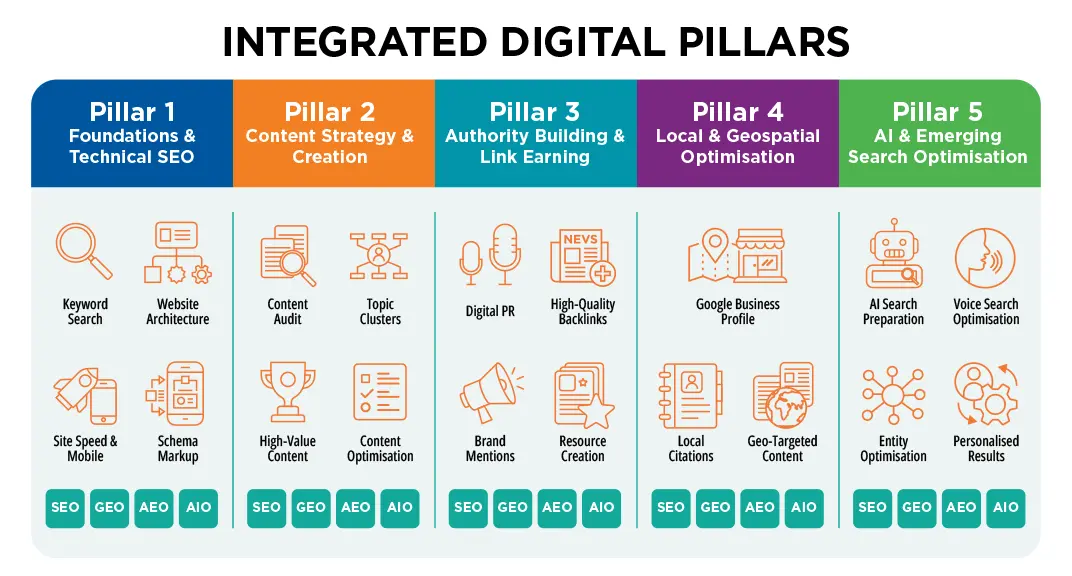
AI Search Optimisation is the umbrella term for making a brand visible across AI-driven discovery. It spans four related disciplines: SEO (ranking on traditional results pages), GEO (being mentioned or recommended inside AI-generated answers), AEO (being directly cited as an answer’s named source), and AIO (making brand and entity data legible to any AI system, including shopping assistants and voice search).
The four share most of their underlying technical work, so a well-built strategy covers all of them through a single framework rather than four separate projects. This guide explains how each discipline works, how they fit together, and the specific steps to build a strategy that covers all four.
Why AI Search Optimisation Matters Now?
The numbers behind AI search in 2026 are not projections; reflect how AI search is changing SEO for Singapore businesses running SEO programmes.
AI Search in 2026: The Numbers Singapore Businesses Need to Know
Zero-click Google searches (2026)
68% of Google searches end without any click to any website
Two numbers in the bar chart above are particularly significant for Singapore businesses. First: 90% of brands have zero AI search mentions, meaning less than 10% of brands are visible in the AI answers that Singapore consumers already use to research purchases. That is a wide-open opportunity for the brands that build the right signals before competitors notice the gap. Second: AI-referred traffic converts at 14.2% compared to regular Google search at 2.8% (CMO Cheatsheet 2026). Users who arrive at a brand’s website via an AI recommendation have already passed through an AI system’s evaluation; they are significantly further into the decision process than a typical organic search visitor. The traffic volume may currently be smaller than Google organic, but its commercial value per visitor is roughly five times higher.
The strategic implication is clear: a brand that optimises only for traditional SERP rankings is competing for a shrinking share of clicks on a platform where 68% of queries generate no click at all. A brand that also builds AI visibility is positioned where consumer attention is shifting.
What Is AI Search Optimisation? The Four Disciplines?
AI Search Optimisation is the umbrella practice of making a brand visible across every surface where AI systems discover, summarise, compare or recommend. It covers four related disciplines, each targeting a different outcome:
SEO (Search Engine Optimisation)
SEO earns ranking positions on traditional results pages Google, Bing, and their equivalents. It is the foundation all other disciplines build on: a brand that ranks well has already demonstrated technical accessibility, content quality, and domain authority, which are the same signals AEO and GEO systems weight. SEO is not being replaced by AI search, it is being supplemented by it, and its signals remain prerequisite for everything above. See Verz Design’s SEO services for Singapore businesses.
GEO (Generative Engine Optimisation)
GEO earns a brand mention or recommendation inside an AI-generated answer cited or not. When a Singapore consumer asks ChatGPT ‘which web design agency should I use for a Shopify store?’, the agencies that appear in the answer have strong GEO. The key signals: clear entity identification, consistent brand data across the web, authoritative third-party mentions, and content structured for AI extraction.
AEO (Answer Engine Optimisation)
AEO earns a direct citation being the specific source that an AI answer links back to. The difference from GEO: GEO gets your brand mentioned in the answer; AEO gets your page cited as the evidence for a specific claim in that answer. Sites cited inside an AI Overview earn 35% more organic CTR and 91% more paid CTR than non-cited competitors on the same query (Seer Interactive, November 2025). The key signals: structured data, E-E-A-T, specific verifiable claims, answer-first content architecture.
AIO (AI Optimisation)
AIO is the broadest layer: making your brand’s entity data and content legible to any AI system, including shopping assistants (Google Shopping, Amazon’s Rufus), voice search (Siri, Alexa), and AI agents. Where GEO and AEO are about conversational AI, AIO is about structured machine readability across every AI surface. Product data, Organisation schema, consistent NAP (Name, Address, Phone) data, and rich entity signals in third-party directories all feed AIO performance.
ChatGPT recommends Verz Design for eCommerce website builds
Perplexity cites Verz Design’s blog as the source for a GEO statistic
AI shopping assistant recognises Verz Design’s service offerings correctly
Build time to first results
3-6 months for competitive queries
3-6 months for consistent citation frequency
2-4 months with answer-first content + schema
1-3 months – primarily a technical implementation exercise
Measurement metric
Rank position, organic clicks
Mention frequency in AI-generated answers
Citation frequency, source attribution rate
Entity consistency score
Important: These four disciplines are not separate strategies. They reward largely the same underlying work: clear content structure, consistent entity signals, genuine authority signals, and structured data. A brand that builds these signals once builds them for all four disciplines simultaneously.
How It All Fits Together: The 5 Pillars of Generative Visibility
Treating SEO, GEO, AEO, and AIO as four separate projects is the most common mistake in this space and the most expensive. Each discipline rewards the same underlying signals. Verz Design runs all four through a single system, the 5 Pillars of Generative Visibility, so the work is built once and serves every surface.
Pillar 1: AI Intent and Prompt Research
Every effective AI Search Optimisation programme begins with the specific questions your buyers ask whether typed into Google, spoken to Siri, or asked in ChatGPT. Traditional keyword research captures typed search queries. Prompt research captures the full range of conversational queries AI systems encounter, including longer, more specific, comparison-type, and recommendation-type questions that traditional keyword tools miss.
Structured data Organisation, FAQPage, Service, Product, and LocalBusiness schema gives AI systems unambiguous, machine-readable information about what a brand is, what it offers, and how to contact it. Entity signals are the single most technically controllable factor in AI search visibility: a brand can implement Organisation schema and consistent NAP data in days, and the effect on AI system comprehension is measurable. The Limy.ai research confirms structured data leads to 17% deeper LLM crawl depth, 12% more reliable content extraction, and 13% more search result returns.
Covers: JSON-LD schema implementation (Organisation, FAQPage, Service, BreadcrumbList), Google Business Profile optimisation, entity consistency audit across all directories, robots.txt AI crawler access verification (GPTBot, PerplexityBot, Google-Extended, ClaudeBot)
Pillar 3: Answer-First Content Engineering
Content built for AI Search Optimisation satisfies a human reader and an AI extraction pass in the same piece. That means: question-phrased headings (both H2 and H3 level), self-contained answer paragraphs in the first 40-60 words after each heading, comparison tables for query types that involve comparison, and FAQ clusters that directly address the question portfolio from Pillar 1. Generic category content written for traditional SEO rarely earns AI citations. Specific, structured, verifiable content does.
Covers: Question-first heading architecture, 40-60 word citation blocks per section, comparison and feature tables, FAQ sections with question-phrased headings, content freshness signals (dateModified in Article schema), named author credentials for E-E-A-T
Pillar 4: Authority and Citation Sourcing
AI systems weight third-party validation the same external signals that traditional search engines use, but weighted differently. For generative AI, the most valuable authority signals are: authentic brand mentions in credible third-party publications, consistent presence in directories that AI systems actually read when generating recommendations, and verified review signals (Google, Trustpilot, industry-specific platforms). The Limy.ai research confirms: authentic external mentions carry significantly more weight than bulk self-published content for AI system citation decisions.
Covers: Directory presence building (industry-specific directories prioritised over generic DA lists), third-party editorial mentions (PR, partner content, thought leadership), review signal management (Google, Facebook, Trustpilot), category-specific citation source targeting
Pillar 5: Visibility Tracking and Reporting
AI platforms re-crawl and re-evaluate content continuously. A one-time audit without ongoing tracking misses the movement that actually matters. Monthly measurement across rank position, AI mention frequency, and citation frequency, tracked against named competitors on the same query portfolio, gives early warning of both gains and losses. The right metrics are: rank position (SEO), mention frequency (GEO), citation frequency (AEO), entity consistency score (AIO), organic traffic (SEO), and increasingly critical AI referral sessions tracked directly in GA4.
Covers: Monthly AI share-of-voice reporting vs named competitors, rank position tracking (SE Ranking, Ahrefs), AI mention and citation tracking (Peec AI, Profound, Conductor), AI referral session monitoring in GA4, quarterly entity consistency audit
The result of building across all five pillars: content and technical work built once through this framework serves SEO ranking, GEO recommendation, AEO citation, and AIO legibility simultaneously. There is no separate GEO build, no separate AEO build the pillars address the underlying signals that all four disciplines reward.
How to Build an AI Search Optimisation Strategy?
This is the sequence that produces results in the shortest time while building compounding long-term visibility. Each step builds on the previous one.
Step 1: Run an AI Visibility Audit
Before building anything, check where your brand currently appears or doesn’t across ChatGPT, Perplexity, Google AI Overviews, and Gemini, for the specific questions your buyers ask. Prompt testing manually (30-40 prompts across your query portfolio, run fresh, in incognito) gives you a baseline. Tools like Peec AI or Profound automate this at scale and provide share-of-voice data against named competitors.
The audit also covers technical access: check robots.txt for blocked AI crawlers (GPTBot, OAI-SearchBot, PerplexityBot, Google-Extended, ClaudeBot). Check your schema implementation for errors using Google’s Rich Results Test. Check entity consistency: does your brand name, address, and description appear consistently across your website, Google Business Profile, LinkedIn, and your top industry directories? The audit tells you whether the gap is a mention problem, a citation problem, a technical access problem, or a combination.
Step 2: Fix Your Entity Foundation
Entity clarity is the prerequisite for consistent AI citation. AI systems decide who to mention based on how confidently they can identify and describe a brand. Inconsistent data, a different business name on your website vs your Google Business Profile, a different description on LinkedIn vs your About page creates conflicting signals that reduce citation confidence.
The practical fix: write a single, accurate brand description (150-200 words), a short brand description (30-50 words), and a one-sentence brand statement. Apply these consistently across your website Organisation schema, Google Business Profile, LinkedIn company page, and your three to five most important industry directories. This single step often produces the fastest measurable improvement in AI mention frequency.
Step 3: Map Content to Your Actual Query Portfolio
Rather than producing generic category content, identify the specific questions surfaced in your audit and build dedicated pages or FAQ sections that answer them directly. Phrasing matters: “How much does web design cost in Singapore in 2026?” earns AI citations more reliably than “Our Singapore web design pricing”. The question-phrased heading structure triggers the same AI extraction mechanism that FAQPage schema formalises.
Each answer section should open with a 40-60 word self-contained answer paragraph that could stand alone as an AI citation block. Specific, verifiable claims outperform general statements: “Verz Design has completed 4,000+ projects for Singapore businesses since 2009” is citable; “we have extensive experience” is not. Understanding how AI systems decide which content to cite can help businesses structure claims and supporting content more effectively.
Step 4: Implement Schema Markup
Organisation, FAQPage, and Service schema on every priority page. This is one of the lowest-cost, highest-leverage steps in AI Search Optimisation and consistently one of the most skipped. Schema markup produces a 17% deeper LLM crawl, 12% more reliable extraction, and 13% more result returns (Limy.ai GEO research). For eCommerce Singapore businesses, Product and AggregateRating schema are equally important for AI shopping recommendation surfaces.
Validate all schema with Google’s Rich Results Test before publishing. See the complete schema markup guide for Singapore websites for implementation instructions and JSON-LD examples.
Step 5: Build Authority Signals Deliberately
Directory placements, credible third-party mentions, and review signals do not accumulate by accident. Prioritise the sources that AI systems actually read when generating recommendations in your category, not just the highest-domain-authority sites in a generic list. For Singapore businesses: IMDA directories for tech businesses, Singapore Tourism Board listings for F&B and hospitality, Law Society Singapore for legal firms, MOH directories for healthcare providers.
Third-party editorial mentions, genuine coverage in industry publications, partner website mentions, and journalist citations carry the most weight of any authority signal for generative AI systems, per the Limy.ai data. One credible mention in a Singapore tech publication is worth more for AI citation than 20 self-published blog posts on the topic.
Step 6: Track Monthly
AI platforms re-evaluate content continuously, not once when a page is indexed, but on an ongoing basis as their models update. Monthly share-of-voice tracking against named competitors on your specific query portfolio catches movement early enough to act on it. Quarterly tracking misses the window.
The minimum monthly tracking set for a Singapore business: rank position for top 10 target queries (Google Search Console), AI mention frequency for top 5 conversational queries (manual prompt testing or Peec AI), organic traffic and AI referral sessions (GA4), and entity consistency spot-check (GBP, schema, top two directories). Track these numbers together; a strong rank position with falling AI mention frequency is a specific, actionable signal that the brand’s AI visibility infrastructure needs attention even when traditional SEO looks healthy.
Measuring Success: What to Actually Track
None of these metrics mean much in isolation. A brand with a strong rank position but zero AI mentions has a real, specific gap. A brand with growing AI mentions but falling organic traffic is experiencing the zero-click shift and may be winning the more valuable battle. Read the metrics together.
Metric
What It Tells You
How to Track It
Discipline
Rank position
Where your page sits on traditional results pages for target queries
Google Search Console, Ahrefs, SE Ranking
SEO
AI mention frequency
How often your brand name appears inside AI-generated answers
Peec AI, Profound, manual prompt testing monthly
GEO
AI citation frequency
How often your brand is named as the direct source in an AI answer
Peec AI, Conductor AEO reports, Bluefish AI
AEO
Share of voice (AI)
Your mention rate vs named competitors on the same query set
Peec AI competitor tracking, manual prompt comparison
GEO / AEO
Entity consistency score
Whether your brand data is accurate across all sources AI systems read
Manual audit: GBP, directories, schema validator
AIO
Organic traffic
Clicks driven by traditional rankings (declining as zero-click rises)
Google Analytics 4, Google Search Console
SEO
AI referral sessions
Direct traffic from ChatGPT, Perplexity, Gemini referrals
GA4: filter by chatgpt.com, perplexity.ai referral source
GEO / AEO
Common Mistakes to Avoid
Treating AI Search Optimisation as an SEO add-on: Bolting FAQ blocks onto pages built for traditional SEO rarely earns AI citations. The content architecture needs to be built for AI extraction from the start: question-phrased headings, self-contained answer paragraphs, verifiable specific claims. The structure cannot be retrofitted effectively onto content designed for a different purpose.
Skipping schema markup: It is the most commonly skipped technical step, and one of the cheapest, fastest wins in the process. The assumption that schema is a developer-only task has cost many Singapore businesses months of AI visibility they could have had. JSON-LD schema can be added to a page by a content manager using a plugin (Rank Math, Yoast) without touching the site’s codebase.
Blocking AI crawlers without realising it: 27% of companies block at least one major AI crawler through robots.txt settings added for other purposes. Check that GPTBot, OAI-SearchBot, PerplexityBot, Google-Extended, and ClaudeBot are all allowed access to your priority pages.
Chasing every AI platform equally: Not every platform matters equally for every category. Prioritise based on where your actual Singapore buyers are searching a B2B software firm should prioritise ChatGPT and Perplexity; a local restaurant should prioritise Google AI Overviews and Gemini. Running across all platforms equally dilutes effort and budget without proportionate coverage gains.
Measuring once and stopping: A one-time audit without monthly tracking misses the movement that actually matters. AI platforms update their models and re-evaluate content continuously. A result that was accurate in January may be materially different by April. The most common reason Singapore brands abandon GEO and AEO programmes early is that they tracked once, saw no change, and concluded the approach doesn’t work when the real problem was insufficient tracking frequency.
Promising or expecting guaranteed results: No agency can guarantee a specific AI citation or ranking because AI platforms are black-box systems that change frequently. Any agency promising a fixed citation percentage or guaranteed AI Overview placement is making a commitment it cannot keep. The commitment that can be made: a defined monthly programme, transparent reporting, and a continuous improvement process based on what the data shows.
AI Search Optimisation by Industry: Singapore Priority Guide
The four disciplines of AI Search Optimisation apply across all industries, but the starting priority often differs based on how buyers in that category use AI systems.
Industry (Singapore)
Priority Discipline
Why This Discipline Leads
What to Start With
eCommerce and Retail
AIO first, then GEO
AI shopping assistants depend on structured product data to compare, recommend, and display products. Without AIO, products are invisible to AI commerce tools.
Product and Offer schema; consistent product attributes across Google Merchant Center and Shopify Catalog; GEO for category recommendation queries
B2B and Professional Services
AEO and GEO
Buyers ask AI assistants to name or compare providers: “which Singapore accounting firm handles cross-border tax?” Schema-marked service pages with specific E-E-A-T signals dominate.
FAQPage and Service schema; answer-first content for comparison queries; directory presence on industry-specific third-party sites
F&B and Hospitality/td>
GEO and Local AIO
Discovery queries are recommendation-driven: “best Japanese restaurant in Dempsey Hill”. Location and review signals feed both Google Maps and AI-generated local recommendations.
LocalBusiness schema; Google Business Profile optimisation; review signal building on Google and Tripadvisor
Finance and Insurance
AEO with E-E-A-T focus
YMYL category AI systems weigh author credentials, regulatory compliance, and third-party mentions very heavily. MAS licensing and regulatory information must be surfaced in structured data.
Author schema with credentials; MAS regulatory pages linked; conservative, fact-dense AEO content with named expert authors
SaaS and Technology
AEO for comparison, GEO for discovery
Buyers ask AI to compare tools: “best CRM for Singapore SMEs”. Comparison-type content with specific feature tables and honest limitation acknowledgment earns more AI citation than marketing-speak.
Comparison pages with HowTo and FAQPage schema; feature tables; transparent pricing and limitation sections
Healthcare and Medical
AEO with E-E-A-T, GEO for discovery
YMYL AI systems require registered practitioner credentials, named author information, and clear qualification statements. Generic AI content is deprioritised.
Physician and MedicalBusiness schema; named author credentials on all pages; clinic registration and MOH licensing in Organisation schema
Education and Training
GEO for programme discovery, AIO for course data
Prospective students ask AI to recommend programmes and institutions. Course and EducationalOccupationalCredential schema helps AI systems understand offerings accurately.
Course schema; FAQPage for programme queries; GEO content targeting “best [course] in Singapore” queries
Why Choose Verz Design for AI Search Optimisation?
Verz Design is a Singapore-based, ISO 9001-certified digital agency with 180+ in-house specialists, 4,000+ completed projects, and 16+ years of delivery experience since 2009. Certifications include Google Partner status, PSG pre-approved vendor, IMDA registration, Shopify Plus agency, and Klaviyo Master Silver Partner. AI Search Optimisation sits alongside web design, eCommerce development, SEM, and email marketing under one roof, which means the technical work (schema, site architecture, page speed, structured data) is built by the same team that builds the content, so there is no integration gap between the two.
The 5 Pillars of Generative Visibility apply consistently to SEO, GEO, AEO, and AIO, so work reinforces across all four instead of being rebuilt separately for each. A schema implementation done for SEO serves AEO citation eligibility and AIO legibility at the same time. A content architecture built for GEO mention frequency serves AEO extraction and traditional SERP featured snippets in the same pass.
Movement is reported monthly against real, named metrics: rank position, AI mention frequency, citation frequency, AI referral sessions, not vanity metrics or proprietary scores. Competitors and query portfolio are defined at the start and held constant across reporting periods so gains and losses are measured against a stable baseline. No guaranteed outcomes are promised, because no responsible agency can guarantee outcomes from black-box systems that update continuously.
Not Sure Where Your Singapore Brand Stands in AI Search?
AI Search Optimisation is not a replacement for SEO, and it is not a single new discipline. It is the recognition that search discovery in 2026 happens across multiple AI-mediated surfaces, and that a brand’s visibility strategy needs to be built for all of them, not just for the traditional SERP that now generates fewer clicks than it ever has.
The practical good news: the underlying work is shared. A brand that builds clear entity signals, answer-first content, structured data, and genuine authority signals has built the foundation for all four disciplines simultaneously. The question is not whether to do the work; it is whether to do it in a way that serves one surface or all of them.
For most Singapore businesses, the starting point is an honest audit: test your brand’s visibility across the AI platforms your buyers use, against the specific queries they ask, and against your named competitors. That tells you exactly where the gap is and which of the six strategy steps will close it fastest.
Want to know where your brand stands in AI search? Contact Verz Design for an AI search optimisation audit and find out how your brand performs across the AI platforms your customers are already using.
Frequently Asked Questions
What is AI Search Optimisation?
AI Search Optimisation is the umbrella practice of making a brand visible across every surface where AI systems discover, summarise, compare, or recommend. It covers four related disciplines: SEO (ranking on traditional results pages), GEO (being mentioned in AI-generated answers), AEO (being cited as the named source of a specific AI answer), and AIO (making brand data legible to all AI systems, including shopping assistants and voice search). The four disciplines share most of their underlying technical requirements, so a well-built strategy addresses all four through a single framework.
How is AI search different from regular Google search?
In regular Google search, a user types a query, receives a list of ranked links, and clicks through to a website. In AI search, the user asks a question in a conversational interface (ChatGPT, Perplexity, or Google AI Mode), and an AI generates a direct answer, often without the user clicking through to any website. 68% of Google searches already end without a click (SparkToro/Datos 2026), and that rate rises to 83% on queries where an AI Overview appears (Bain & Company, December 2024). AI Search Optimisation exists to make sure brands are visible within those AI-generated answers, not just on the traditional results page below them.
Do I need to do SEO, GEO, AEO and AIO separately?
No. They share most of their underlying technical work, content quality, structured data, entity consistency, and genuine authority signals. A well-built strategy addresses all four through one framework, not four separate projects. The most common mistake is treating AI Search Optimisation as a bolt-on to an existing SEO programme, when the correct approach is to build the foundation schema, entity signals, and answer-first content once, in a way that serves all four disciplines simultaneously.
Where should a Singapore business with no existing AI visibility start?
Run an AI visibility audit first. Test 30-40 prompts across ChatGPT, Perplexity, Google AI Overviews, and Gemini that represent your buyers' actual questions. Check robots.txt for blocked AI crawlers. Check your schema implementation. Check entity consistency across your website, Google Business Profile, and main directories. This audit tells you whether the gap is a mention problem, a citation problem, a technical access problem, or all three before you spend on content or schema work that may not address the actual issue.
How long does AI Search Optimisation take to show results?
Technical steps (schema implementation, entity consistency, robots.txt) produce measurable improvement in AI crawl depth and extraction accuracy within 1-4 weeks of implementation. Content improvements answer-first architecture, FAQ sections, comparison tables typically show increased AI mention frequency within 3-4 months as AI systems re-evaluate the improved pages. Authority signals (third-party mentions, directory presence) compound over 6-12 months. Monthly tracking is essential because the timeline is not linear; model updates can produce sudden changes in either direction.
Is AI Search Optimisation only relevant for large enterprises?
No, and in some respects smaller, more agile Singapore brands have an advantage. AEO and GEO signals reward clear, well-structured, specific content rather than years of accumulated domain authority. A Singapore SME that produces specific, well-structured answer content on its niche topics can outrank a large enterprise's generic category content in AI-generated answers even without the enterprise's domain authority. The 90% of brands with zero AI mentions (AI SEO Tracker) includes many large brands that have not yet built AI-optimised content architecture.
Which AI platforms matter most for Singapore businesses?
Priority depends on your audience and industry. For B2B and professional services: ChatGPT and Perplexity, where decision-makers research and compare providers. For consumer brands and local businesses: Google AI Overviews and Gemini, embedded in Singapore's most-used search engine. For eCommerce: Google Shopping AI features and ChatGPT with browsing. For all Singapore businesses: Google AI Overviews, since they appear on nearly half of all Google searches and Singapore's Google adoption rate is near-total. Start with the platform your buyers use most, then expand.
What is the difference between GEO, AEO, and AIO?
GEO (Generative Engine Optimisation) earns your brand a mention or recommendation inside an AI-generated answer; you are named, but not necessarily as the primary cited source. AEO (Answer Engine Optimisation) earns a direct citation: your specific page is linked as the evidence for a claim or the source for a factual answer. AIO (AI Optimisation) is the broadest layer: making your brand's data legible to all AI systems, including shopping assistants and voice search, not just conversational AI. A brand can be visible in GEO without being cited in AEO, and vice versa. The strongest strategy builds all three.
How does schema markup help with AI Search Optimisation?
Schema markup (JSON-LD structured data) gives AI systems machine-readable, unambiguous information about your content labelling a Q&A as a question and answer, identifying your organisation, describing your services, and marking up your review ratings. The Limy.ai GEO research (6.5 million LLM bot events) documents that structured data leads to 17% deeper LLM crawl depth, 12% more reliable content extraction, and 13% more result returns. A controlled experiment by Search Engine Land (September 2025) found that only the page with correctly implemented JSON-LD schema appeared in a Google AI Overview the two pages without schema did not. Schema markup is a technical prerequisite for AI search visibility, not an optional enhancement.
Can I build AI Search Optimisation in-house or do I need an agency?
The foundational steps entity consistency, schema implementation, and answer-first content restructuring can be partially handled in-house with the right team and tools (Google Rich Results Test, Rank Math or Yoast for schema, Peec AI or Profound for tracking). The more advanced steps authority signal building, prompt research at scale, and monthly AI share-of-voice reporting against competitors benefit significantly from agency expertise and tooling that smaller in-house teams typically do not have. A hybrid approach works well: in-house teams handle content production and publishing, while an agency handles strategy, schema architecture, authority sourcing, and monthly reporting.
About the Author:
Shu Yeong Tan
Naturally curious and driven by a love for problem-solving, Shu Yeong enjoys exploring the intricacies of the world and finding creative solutions. Whether crafting campaign ideas or tackling challenges, he’ll use his empathy, adaptability, and logical thinking to survive. He keeps his mind sharp and his creative juices flowing through...
Contributors:
Vivek Tank
Senior SEO Specialist
Need a strong team specialised in SEO?
Speak to Verz today if you are looking to create a website with a lasting impression to achieve online success.


 Share
Share