If you run a Shopify store in Singapore and sell pre-packaged drinks, bottled water, soft drinks, juices, canned coffee, or beer, you now have a compliance deadline on your desk: the Beverage Container Return Scheme (BCRS).
From 1 April 2026, Singapore’s national bottle-and-can deposit scheme requires an extra 10-cent (S$0.10) refundable deposit on every eligible plastic or metal beverage container sold in the country, and from 1 October 2026 it becomes an offence to supply any regulated beverage without the scheme’s official Deposit Mark and barcode (NEA, BCRS FAQ).
Brick-and-mortar retailers like FairPrice are already charging the deposit at checkout and showing it on receipts (FairPrice BCRS page), and as a Shopify merchant, your store needs the same logic: charge the deposit correctly, show it transparently, and keep your product catalogue in sync with which SKUs actually carry the Deposit Mark.
This guide walks through exactly what BCRS requires, why it affects online sellers, and how to configure it on Shopify in under 30 minutes using the FeeBee app.
What Is BCRS, in Plain Terms?
BCRS is a government-mandated Extended Producer Responsibility (EPR) scheme, licensed by the National Environment Agency (NEA) and run by the not-for-profit Beverage Container Return Scheme Ltd. (BCRS Ltd.) on behalf of all beverage producers in Singapore.
BCRS Ltd. was established by a consortium of Singapore’s major beverage producers, Coca-Cola Singapore Beverages, F&N Foods, and Pokka and was licensed by the NEA on 29 July 2024 to design and operate the scheme for seven years from 1 April 2026 to 31 March 2033.
The mechanics are straightforward:
BCRS Element
Details Verified Against NEA and BCRS.sg
Eligible products
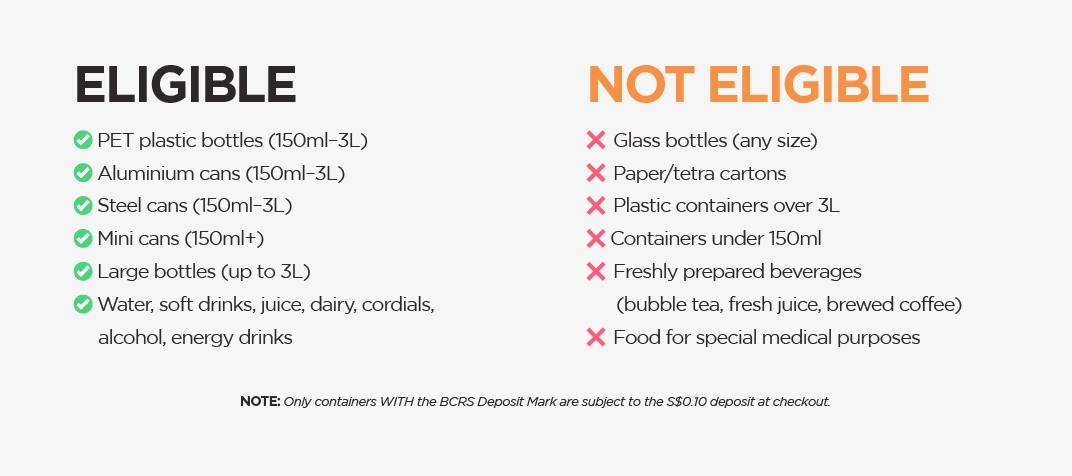
Pre-packaged beverages in plastic (PET) or metal (aluminium/steel) containers, 150ml to 3 litres. Includes water, soft drinks, juices, dairy, cordials, and alcohol. Does NOT include glass bottles, paper cartons, or freshly prepared beverages (bubble tea, freshly squeezed juices, brewed coffee).
The deposit
S$0.10 per container at the point of sale. The deposit is NOT subject to GST; only the underlying beverage price is taxable.
The Deposit Mark
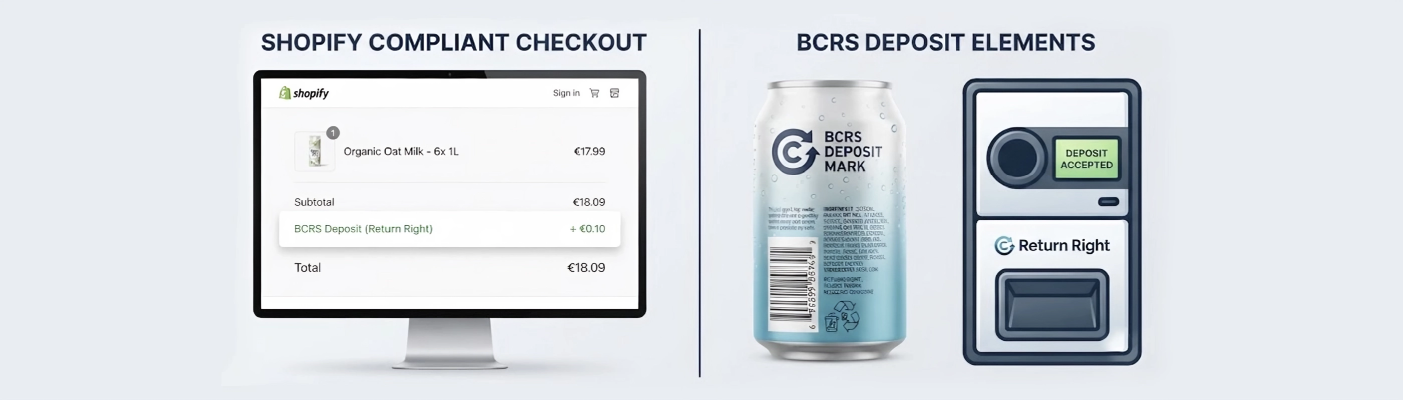
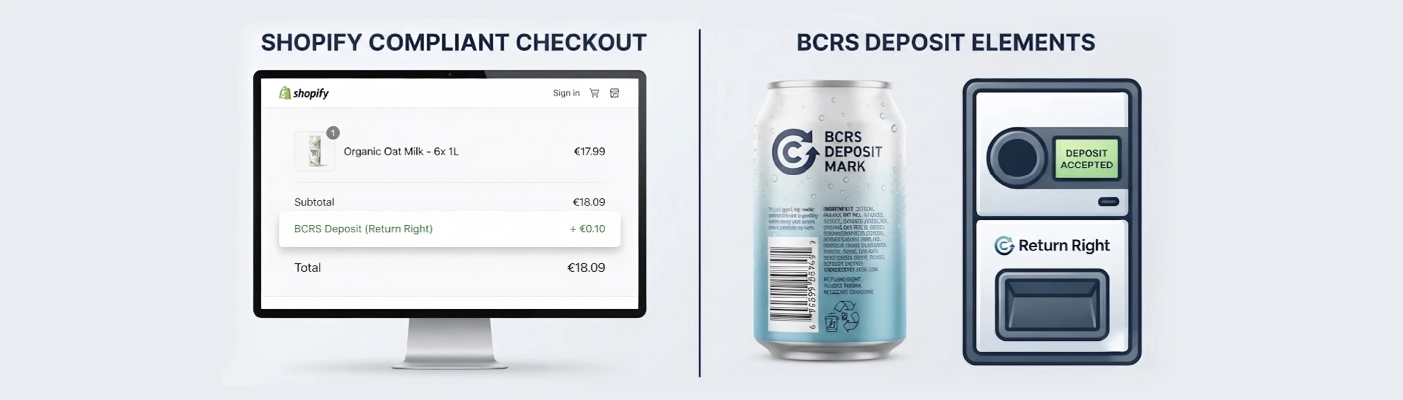
A printed or stickered mark plus a BCRS-approved barcode that must appear on every individual container, including each container within a multipack, before it can be sold with a deposit or refunded at a Return Right machine.
The refund
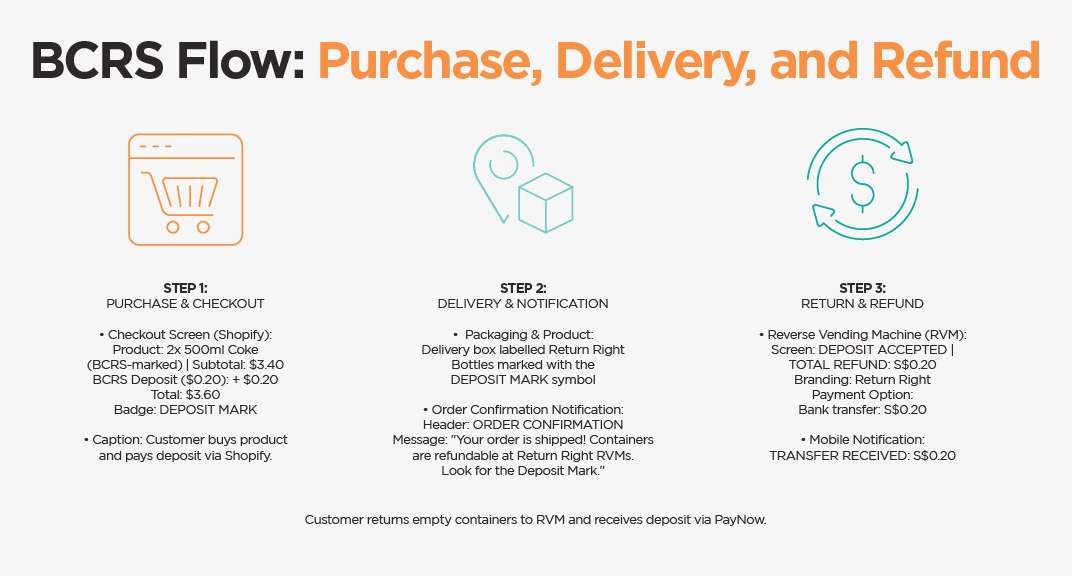
Consumers return empty, uncrushed containers to a Return Right Reverse Vending Machine (RVM) and receive the S$0.10 back instantly via PayNow, bank transfer, or as a charity donation. 1,070 RVMs were deployed across Singapore at scheme launch. (Source: Wikipedia Beverage Container Return Scheme)
Multipacks
Deposit applies per container, not per pack. A 4-pack of 200ml Coke cans carries a total deposit of 4 × S$0.10 = S$0.40, shown as a separate line at checkout. (Source: FairPrice BCRS page)
GST treatment
The S$0.10 deposit is explicitly excluded from GST. Your fee app must not apply GST to the deposit line item.
Singapore’s BCRS target: 60% recycling rate for beverage containers by 2026, rising to 80% by 2028. For context: Singapore currently recycles approximately 12% of household waste via blue bins. Germany’s deposit scheme has achieved around a 97% return rate illustrating what a well-implemented DRS can accomplish. (Source: Packaging Europe, BinWhere.sg, DPG Germany)
The BCRS Timeline: What Each Date Means for Your Shopify Store
Three dates matter for Shopify merchants. Understanding which applies to your current stock is critical before you configure any fee rules.
1 April 2026
1 Apr – 30 Sep 2026
1 October 2026 Onwards
BCRS Launches
Deposit-Marked products go on sale. Charge S$0.10 per eligible container. Non-marked stock can still be sold without the deposit but cannot be returned to an RVM.
Your Shopify action: Install the fee app, tag the marked SKUs, and go live with the deposit logic.
Transition Period
Both marked and unmarked stock can be sold. Marked stock = deposit charged + refundable. Unmarked stock = no deposit + not refundable. You may have both variants in the catalogue.
Your Shopify action: Keep separate SKUs or variants for marked vs unmarked stock. Apply fee only to marked SKUs.
Full Enforcement
ALL regulated beverages (150ml–3L plastic/metal) must carry the Deposit Mark. Selling unmarked stock becomes an offence under the Resource Sustainability Act. No exceptions.
Your Shopify action: Apply the deposit fee to ALL regulated beverage SKUs. Clear remaining unmarked stock before this date.
Note on the transition extension: The original transition period was set to end 30 June 2026. It was extended to 30 September 2026 after manufacturers raised concerns about clearing existing inventory. This extension was confirmed by Singapore’s Senior Minister of State for Sustainability and the Environment on 19 December 2025. (Source: Yahoo News / MSE Singapore)
Does the BCRS Deposit Apply to My Shopify Store?
Official NEA and BCRS Ltd. guidance is written primarily for producers (manufacturers and importers) and physical retailers, and doesn’t specify separate rules for e-commerce checkouts, delivery, or online price display. But two things make this unambiguous for online sellers:
If You’re a Retailer Reselling Third-Party Drinks
‘Supply’ isn’t limited to in-store sales. From 1 October 2026, it’s an offence for any person to supply a regulated beverage without the Deposit Mark, regardless of channel. The BCRS FAQ specifically calls out supermarket operators, but the underlying rule applies to the supply of regulated beverages, whether in-store, via delivery, or through an online storefront. (Source: BCRS FAQ)
For most Shopify merchants reselling third-party-branded drinks, the practical obligation is the same as the one FairPrice has already implemented: charge S$0.10 per eligible container at checkout, show it as a distinct line item, and apply it only to SKUs that actually carry the Deposit Mark.
Want to understand how Singapore’s BCRS works in real-world F&B operations? This overview of the Beverage Container Return Scheme at F&B outlets provides useful context on how the scheme is being implemented across Singapore.
If You Import or Manufacture Your Own Beverage Line
If you privately label or directly import beverages (a D2C juice brand, a health drink line, imported craft beer), you are a ‘Producer’ under the Resource Sustainability Act. This means:
You must register directly with BCRS Ltd. as a producer, separate from just collecting the deposit at checkout.
You must ensure your containers carry the Deposit Mark and BCRS-approved barcode before they can be sold in Singapore from 1 April 2026.
You must submit monthly Put-to-Market declarations to BCRS Ltd. via the Producer Portal.
Barcode placement matters technically: BCRS requires vertical (ladder format) barcodes, with bars horizontal, placed on an even surface of the container for RVM scanning. (Source: BCRS FAQ)
Step-by-Step: Implementing the BCRS Deposit on Shopify
The cleanest way to do this without touching theme code is a dedicated fees-and-deposits app. FeeBee (by codelayer GmbH) is purpose-built for exactly this use case it already lists BCRS by name alongside Pfand (Germany), CRV (US), Statiegeld (Netherlands), and Pant (Nordics) as supported deposit types (Source: FeeBee, Shopify App Store listing).
Step 1: Audit your beverage catalogue
Before touching any app, tag or list every SKU that falls in the 150ml–3L plastic/metal beverage range. Cross-check against BCRS Ltd.’s registered products list, where available, since only Deposit-Marked stock should carry the fee (BCRS FAQ). During the transition period (through 30 September 2026), you may be selling both marked and unmarked versions of the same product; these need different treatment, so keep them as separate variants or SKUs if your supplier hasn’t fully transitioned yet.
Step 2: Install FeeBee from the Shopify App Store
Search for “FeeBee Fees and Deposits” in the Shopify App Store, or go directly to the listing, install it, and run the guided checkout setup, which automatically activates FeeBee’s checkout extension. No theme edits or developer time are required, and it works on every Shopify plan and theme. (Source: FeeBee)
Step 3: Create a BCRS deposit fee rule
Inside FeeBee:
Choose a fixed fee (not a percentage) of S$0.10.
Name it clearly for customers, e.g. ‘BCRS Deposit (Return Right)’. Clarity here matters because, like FairPrice, you want customers to understand this is a refundable deposit, not a price increase. (Source: FairPrice BCRS page)
Set the fee to apply per container so a 4-pack correctly totals S$0.40, not S$0.10.
Confirm the deposit is excluded from GST calculation.
Step 4: Scope the rule to the right products
Apply the fee rule to your tagged beverage collection (or individual SKUs) rather than store-wide. FeeBee supports targeting by product, collection, Shopify Market, or customer segment/tag, which is particularly useful for larger or multi-market stores managing more complex operations. Businesses operating at scale may also benefit from understanding the broader Shopify Plus benefits for business. (Source: FeeBee)
Step 5: Verify it shows up everywhere it needs to
FeeBee is designed to surface the fee consistently across the entire buying journey: product page, cart, checkout, Express Checkout (Apple Pay/Google Pay), order confirmation, and Shopify POS if you also sell in person.
Before going live, place a test order and confirm:
Transparent fee presentation is important because unexpected charges at checkout can create friction and affect conversions. Improving your Shopify store conversion rate also involves making pricing and checkout costs clear before customers complete their purchase.
Multipack quantities are calculated correctly (4 cans = S$0.40 deposit).
The fee is non-removable by the customer in the cart. BCRS is a mandatory regulatory charge, not an optional add-on.
Express checkout (Apple Pay, Shop Pay) shows the deposit correctly before the customer completes payment.
Step 6: Handle the transition period in your catalogue
Since unmarked stock can legally be sold without the deposit until 30 September 2026, don’t apply the fee rule to variants you know are still unmarked. Plan to retag your full catalogue as marked stock arrives. NEA expects widespread availability of Deposit-Marked containers by August–September 2026, and be ready to apply the deposit universally to regulated SKUs from 1 October 2026, when unmarked stock can no longer legally be sold.
Pricing
FeeBee offers a 14-day free trial and is free for development stores. The Premium plan, which includes POS support, Express Checkout (Apple Pay/Google Pay) support, and multi-market targeting, runs S$9.99/month after the trial period.
At under S$10/month, the cost of compliance is minimal against the risk of non-compliance. From 1 October 2026, selling unmarked regulated beverages without the deposit is an offence under the Resource Sustainability Act; a fine or enforcement action from NEA would cost considerably more.
Alternatives to FeeBee for BCRS Compliance
If you want to compare options before committing to FeeBee, two similar Shopify fee apps are worth evaluating:
The underlying setup logic is the same regardless of which app you choose: fixed per-container fee, scoped to eligible SKUs, itemised and non-removable at checkout, excluded from GST. The choice between apps comes down to pricing structure, POS support requirements, and any specific features your store needs.
Which Products Are Eligible and Which Are Not?
One of the most common sources of confusion for Shopify merchants is determining exactly which products in their catalogue require the deposit to be applied. Here’s a clear breakdown:
Pre-packaged beverages but WITHOUT Deposit Mark (transition stock)
NO DEPOSIT until 30 Sep 2026; then cannot be sold after 1 Oct 2026
Multipack (4 x 325ml cans)
YES: S$0.10 per can = S$0.40 total deposit for a 4-pack
What Happens If You Don’t Comply?
Non-compliance with BCRS from 1 October 2026 is not just a technical violation; it’s a criminal offence under the Resource Sustainability Act.
From 1 October 2026: Supplying any regulated beverage without the official BCRS Deposit Mark and barcode is an offence. Selling unmarked stock is non-compliant regardless of whether you collect the deposit or not. The offence is the absence of the Deposit Mark, not the failure to charge the fee.
While the specific penalty schedule for retailers has not been publicly detailed in NEA’s published guidance, enforcement is coordinated by NEA. For businesses in violation, this typically means warning letters in the first instance, followed by escalating consequences for persistent non-compliance, including fines under the Resource Sustainability Act.
The practical risk for Shopify merchants is two-sided:
Operational risk: Selling unmarked stock after 1 October 2026 exposes you to regulatory action.
Inventory risk: Unmarked stock cannot legally be sold in Singapore after 30 September 2026. If you have significant unmarked inventory, plan clearance timelines carefully, particularly for products with longer shelf lives that you may have over-ordered.
Mitigation: Work with your beverage suppliers now to understand their transition timelines. NEA has indicated that widespread availability of Deposit-Marked containers is expected by August–September 2026. Build in a buffer if your supplier transitions in September; that leaves minimal time before the October deadline.
The Unique Challenge of BCRS for Online Sellers Handling Delivery Returns
This is where online sellers face a complication that physical retailers don’t have: customers who order drinks online cannot conveniently return their empty containers to the retailer the way they would return to a FairPrice store.
Return Right machines are placed at fixed, physical locations (supermarkets with over 200m² floor area, community spaces, and public areas). A customer who ordered from your Shopify store receives their delivery, finishes the drinks, and must find a Return Right machine near them to claim the deposit; your store is not involved in that return process.
What This Means for Your Shopify Store?
You collect the deposit at checkout; that’s your obligation. The refund process occurs directly between the customer and BCRS Ltd. when they use an RVM.
You should communicate this clearly in your order confirmation email and/or product page. Customers need to know: (a) why they were charged the deposit, (b) that it’s refundable, (c) where they can find their nearest Return Right machine.
BCRS Ltd. maintains a location finder for Return Right machines. Consider linking to it in your order confirmation or via a dedicated FAQ page. (Source: recycle.gov.sg/materials/beverage)
Handling Damaged Containers from Delivery
Return Right machines require containers to be uncrushed and scannable; the RVM reads the barcode on each container. If a beverage arrives damaged during delivery (dented can, cracked bottle), the customer may not be able to redeem the deposit at an RVM.
Set an internal process for this edge case:
Include a note in your packaging guidelines to ensure beverages are packed with adequate protection.
If a customer reports a delivery-damaged beverage that can’t be returned to an RVM, decide in advance whether your store policy is to refund the deposit on delivery-damaged cases; this is a customer service decision, not a regulatory requirement.
Document any damaged-delivery deposit refund requests separately from regular product returns, mirroring how FairPrice handles this operationally.
Practical note for Shopify subscription boxes: If you run a subscription service delivering beverages regularly, each delivery that includes BCRS-eligible containers must include the deposit per container. Subscription billing configured through Recharge, Bold, or similar apps will need to be verified the deposit applies per container per delivery, not just at the initial subscription setup.
How BCRS Compliance Improves Your Shopify Store’s AI Search Visibility?
There’s a practical GEO dimension to getting BCRS right on your Shopify store that most merchants won’t consider, but it matters for how your products appear in AI-generated search results.
As AI-driven shopping and agentic commerce continue to develop, accurate product data and transparent pricing will become increasingly important for how automated systems understand and transact with online stores. Agentic commerce and Shopify provides a broader look at how AI agents may shape future eCommerce experiences.
Why BCRS Compliance Signals Improve AI Citation?
Structured product data: When your Shopify product pages for eligible beverages clearly state ‘S$0.10 BCRS deposit included’ in the product description and schema metadata, AI systems like Google AI Overviews and Perplexity can accurately cite your products in response to queries like ‘where to buy [beverage] online Singapore’. Incomplete or missing deposit information in your product data creates ambiguity that AI systems resolve by citing more complete competitors.
Structured data depth: Websites with deep schema markup are crawled 17% more deeply by AI bots, with content extracted 12% more reliably. Your product pages should include Product schema (price, availability), AggregateRating schema (reviews), and correct BreadcrumbList schema. FeeBee’s checkout-level implementation handles the deposit logic; your Shopify theme’s schema needs to reflect the correct base price (pre-deposit) to avoid price discrepancies in AI-extracted data.
AI crawler access: Verify that major AI crawlers GPTBot (ChatGPT), OAI-SearchBot, PerplexityBot, Google-Extended (AI Overviews), and ClaudeBot are not blocked in your Shopify store’s robots.txt settings or via Cloudflare Bot Fight Mode. 27% of companies inadvertently block these crawlers. If your product pages cannot be crawled by AI systems, they cannot appear in AI-generated product recommendations.
Trust signals via compliance: A Shopify store that correctly implements BCRS with transparent deposit labelling, government-source product descriptions, and accurate GST-excluded pricing signals trustworthiness to both human buyers and AI systems evaluating product information quality.
BCRS Compliance Checklist for Shopify Sellers
✅ Tag every plastic/metal beverage SKU sized 150ml–3L as BCRS-eligible.
✅ Confirm which SKUs currently carry the Deposit Mark and BCRS-approved barcode (only these should carry the deposit and be refund-eligible).
✅ Install and configure a fee/deposit app (FeeBee or equivalent) with a S$0.10 fixed, per-container fee.
✅ Confirm the deposit is excluded from GST calculation.
✅ Show the deposit as a distinct, non-removable line item across the product page, cart, checkout, and receipts.
✅ If you privately label or import your own beverage products, register separately as a Producer with BCRS Ltd. and track monthly Put-to-Market declarations.
✅ Plan for full transition by 1 October 2026, when selling unmarked regulated beverages becomes an offence.
✅ Advise customers ordering for delivery that damaged/crushed containers may not be accepted at Reverse Vending Machines; set an internal process for damaged-delivery refund requests, mirroring FairPrice’s approach.
Future-Proof Your Shopify Store for BCRS Compliance
Getting your Shopify storefront ready for Singapore’s Beverage Container Return Scheme (BCRS) before October 2026 ensures your business remains fully compliant while delivering a seamless checkout experience. Optimising your Shopify store for clear product information, transparent fees, and a smooth buying journey can also help reduce customer confusion. By setting up fee automation and updating your SKU tags early, you safeguard your store against non-compliance risks and minimise operational friction.
Does the BCRS deposit apply to online orders and delivery, not just in-store purchases?
Yes. The obligation to charge the BCRS deposit is triggered by 'supply' of a regulated beverage, which is not limited to in-store sales. Selling online and fulfilling via delivery still constitutes supply under the scheme. Major Singapore retailers already apply the deposit consistently across in-store and online channels.
Is the 10-cent BCRS deposit taxable?
No. The S$0.10 deposit itself is explicitly excluded from GST. Your fee app must be configured so that GST is not applied to the deposit line item. The underlying beverage price remains taxable as usual.
What happens to unmarked beverage stock I still have after 1 October 2026?
It cannot legally be supplied or sold in Singapore after that date. Plan your inventory clearance before the transition period ends on 30 September 2026. If you have overstocked unmarked products, consider discounting them for rapid clearance or approaching your supplier about return options before the deadline.
Do I need to register with BCRS Ltd. if I just resell branded drinks on Shopify?
No, if you're a pure retailer, registration and monthly Put-to-Market declarations are the producer's (manufacturer's or importer's) responsibility, not yours. You only need to register if you also import or manufacture the beverage yourself.
Can customers remove the BCRS deposit from their Shopify cart?
No, it must be configured as a mandatory, non-removable charge. BCRS is a regulatory requirement, not an optional add-on. FeeBee and similar deposit apps allow you to configure the fee to be non-removable.
About the Author:
Mayank Bhandari
Mayank joins the team as a Technical Consultant, bringing a diverse skill set marked by creativity, discipline, and a strong drive for rapid learning. Known for his adaptability and sense of responsibility, Mayank is a dependable team player who thrives on acquiring new skills and taking on challenges.
Contributors:
Vivek Tank
Senior SEO Specialist
Need a strong team specialised in SEO?
Speak to Verz today if you are looking to create a website with a lasting impression to achieve online success.

 Share
Share