Can an AI tool build you a complete online store in under five minutes? Yes. Should that store be the platform you run a real eCommerce business on? Almost certainly not, and the data from one of the world’s largest eCommerce platforms makes this case very clear.
Shopify generated $378.4 billion in gross merchandise volume in 2025. It processes a sale every 26 seconds across 5.6 million active stores in 175+ countries. That is the scale of what a platform built specifically for eCommerce can achieve. AI website builder tools like Durable, Framer AI, Wix ADI, and Zyro can generate a storefront in minutes, but they are not built to power the operational infrastructure behind a real online business.
This article breaks down the comparison using 2025–2026 data from verified sources, so Singapore business owners can make the right decision for their specific situation without the usual marketing spin.
What Are AI-Made Websites for eCommerce?
AI website builders are tools that use machine learning and generative AI to create a complete website, including a basic online store, from a short text description. You describe your business, and the tool automatically generates pages, copy, images, product grids, and navigation, typically in under five minutes.
In 2026, popular standalone AI eCommerce builders include:
- Durable: ‘The world’s fastest website builder’. Generates a complete site, including a basic shop, from one sentence.
- Framer AI: Design-focused AI builder generating polished-looking storefronts from prompts
- Wix ADI (AI Design Intelligence): Wix’s AI questionnaire-driven store generator.
- Hostinger AI Website Builder / Zyro: Budget-friendly AI builders with basic eCommerce features.
- 10Web: An AI builder that generates WordPress/WooCommerce stores (a different hybrid category).
- Storebuild.ai: Purpose-built AI eCommerce tool that can draft a Shopify-ready store in under 5 minutes.
Important nuance: ‘AI website builders’ and ‘Shopify with AI’ are different things. Shopify has its own built-in AI features (Shopify Magic, Sidekick). When this article says ‘AI-made website’, it refers to standalone AI tools that generate and HOST the entire store on their own platform, not AI features within Shopify.
What Is Shopify?
Shopify is a purpose-built eCommerce platform that provides everything a business needs to sell products online: a storefront, payment processing, inventory management, shipping integration, analytics, customer management, marketing tools, and a 10,000+ app ecosystem for any additional functionality.
It was founded in 2006 when the original team needed a better way to sell snowboards online and couldn’t find an existing platform that was good enough. Sixteen years later, it processes more eCommerce volume than most countries produce in GDP.
Shopify generated $378.4 billion in GMV in 2025, more than triple the $119.6 billion it processed in 2020. Total revenue reached $11.56 billion (up 30% year-over-year). (Source: Chargeflow)
Shopify is not standing still on AI either. It has integrated AI across its platform as ‘Shopify Magic’ , a suite of AI tools for generating product descriptions, editing images, creating marketing copy, and writing emails. In 2025, it launched Shopify Sidekick, an AI assistant that lets merchants update their stores using natural-language commands. Shopify is not an AI website builder but an AI-powered eCommerce platform.
The Critical Nuance: Shopify Already Has AI Built In
Most comparisons of ‘AI vs Shopify’ create a false binary. The reality in 2026 is more nuanced and more favourable to Shopify than the framing suggests.
Standalone AI website builders try to replace the entire website creation and hosting process. They generate everything from a single prompt and serve the results on their own platform.
Shopify has integrated AI into its existing commerce infrastructure through tools such as Shopify Magic for eCommerce, not to replace the platform, but to make using it faster and easier.
| Feature |
What Shopify Magic + Sidekick Do |
| Product descriptions |
Generate SEO-optimised product copy from a product name and basic details instantly |
| Image editing |
Remove backgrounds, generate lifestyle images, and retouch product photos with AI |
| Email marketing |
Draft promotional emails with AI that are optimised for open rate and click-through |
| Sidekick (store assistant) |
Change store colours, update pages, and manage products through natural language chat commands |
| SEO suggestions |
AI-generated title and description suggestions based on product and market data |
| Customer support |
AI-powered Shopify Inbox for automatically answering common customer questions |
The practical outcome: if your comparison is ‘AI-made vs Shopify’, you’re not comparing AI against Shopify. You’re comparing a thin AI storefront generator to a complete commerce platform with AI capabilities. That framing makes the decision considerably clearer.
AI Website Builders vs Shopify: Full Comparison
Here’s a direct, comprehensive comparison across every dimension that matters for running a real online store in 2026:
| Factor |
AI Website Builders (eCommerce) |
Shopify (Purpose-Built Platform) |
| Setup time |
Minutes for AI to generate the storefront |
1–2 days (Shopify setup) to weeks (custom build) |
| Upfront cost |
Free to SGD $50/mo subscription |
$39/mo basic + apps + optional custom theme build |
| Payment processing |
Basic (Stripe or limited gateways) |
Shopify Payments, PayPal, GrabPay, NETS, 100+ gateways |
| Inventory management |
Minimal: basic product listings only |
Full inventory, SKUs, variants, bundles, multiple warehouses |
| App ecosystem |
Minimal |
10,000+ apps in Shopify App Store |
| Checkout conversion |
Basic: no one-tap checkout |
Shop Pay is the highest-converting checkout in eCommerce |
| Abandoned cart recovery |
Not available or very limited |
Built-in: email, SMS, push notification recovery flows |
| AI features |
AI generates initial storefront only |
Shopify Magic + Sidekick: AI across product copy, email, SEO, images |
| Mobile eCommerce |
Basic: not optimised for conversion |
Mobile-optimised checkout; Shop Pay works on all devices |
| SEO and GEO control |
Limited: restricted metadata, no schema |
Full SEO control: schema, meta, URL, sitemap, structured data |
| Analytics |
Basic session data |
Shopify Analytics, Google Analytics integration, real-time dashboards |
| Multi-currency / region |
Not available |
Native multi-currency, multi-language, multi-market |
| Scalability |
Hits limits fast |
Scales from small store to Shopify Plus enterprise |
| Data ownership |
Platform owns your store, locked in |
Your products, customers, orders portable |
| Best for |
Testing a product idea with minimal spend |
Any serious business selling online |
The fundamental gap: AI website builders generate a storefront. Shopify runs a commerce engine. A storefront displays products. A commerce engine handles everything from the moment a customer clicks ‘buy’ to the moment the order arrives at their door and everything after that.
When AI Website Builders Make Sense for eCommerce?
There are genuine use cases where an AI website builder is the right tool for an eCommerce project. Listing them honestly builds credibility and helps readers make the right decision for their situation.
AI Builders Are Reasonable When:
- You are testing a product concept with minimal investment. An AI-built store in 30 minutes lets you validate demand before committing to a proper Shopify build. Treat it as a landing page, not a permanent business.
- You are selling a single product (or very few products) with no inventory complexity. Simple payment + delivery with no variants, bundles, or returns management.
- Your budget is genuinely zero, and you are in the earliest possible stage: pre-revenue, pre-traction, pre-proof. An AI builder on the free tier is better than no presence at all.
- You are running a short-term promotional campaign and need a dedicated product landing page online within hours.
The decision point: If you plan to still be selling this product in 12 months, start on Shopify. The cost of migrating from an AI builder to Shopify, including the loss of domain authority, product data, and customer records, plus rebuilding integrations, almost always exceeds the cost of starting on Shopify from day one.
Why Shopify Wins for Serious Online Stores?
For any business that intends to grow, retain customers, and compete for real market share, Shopify wins across every dimension that matters for eCommerce performance. Here are the seven most significant reasons.
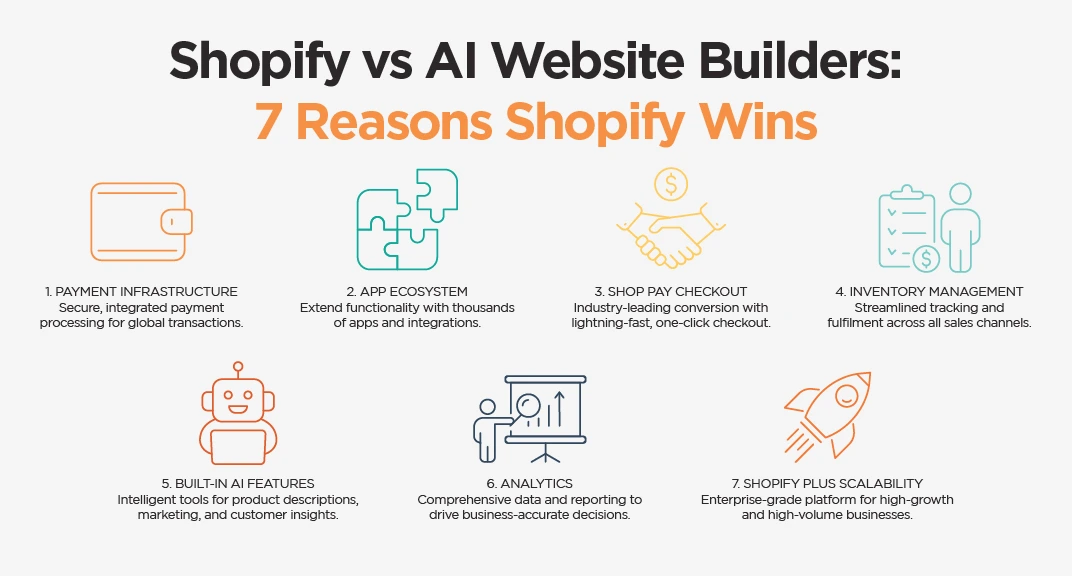
Reason 1: Payment Infrastructure That Works for Singapore
Shopify natively supports 100+ payment gateways across multiple markets, including Singapore-specific options like GrabPay, NETS, and Atome, as well as PayNow integration via third-party apps, in addition to Shopify Payments and all major credit cards.
AI website builders typically support Stripe at most, and sometimes only through a manual integration. For Singapore businesses serving customers who pay with GrabPay or use BNPL, the payment-flexibility gap alone makes Shopify the only viable option.
Shopify’s accelerated checkout processed an annualised run rate of $140 billion in Q1 2026. It consistently outperforms standard checkout by a significant margin in conversion rate. (Source: Shopify Q1 2026 10-Q analysis)
Reason 2: The App Ecosystem: 10,000+ Solutions for Any Requirement
Need abandoned cart recovery? There are six mature Shopify apps for that. Need Klaviyo email marketing integration? One click. A loyalty programme? A subscription offering? B2B pricing tiers? Product reviews that feed your Google star ratings? Every eCommerce function a growing Singapore business might need has a mature, well-supported Shopify app.
AI website builders offer minimal app ecosystems, often fewer than 50 integrations, with no guarantee that the specific tools your business runs on are available.
Reason 3: Built-In AI That Understands eCommerce
Shopify Magic and Sidekick are not generic AI tools; they are eCommerce-specific AI features trained for product selling. However, AI-generated product copy still benefits from human review and brand expertise. The same principle applies when deciding between AI content vs manual content for your wider eCommerce content strategy.
Product description generation that understands conversion copywriting. Image editing that removes product backgrounds and places products in lifestyle settings. Email marketing copy that is optimised for purchase intent, not generic newsletter open rates.
This is AI applied to actual commerce problems, not AI used to generate the initial storefront and then left without further support.
Reason 4: Inventory Management That Scales
Managing 5 products with no variants on an AI builder is manageable. Managing 500 products with multiple size, colour, and bundle configurations, along with real-time stock tracking across multiple warehouses and fulfilment centres, is not something any standalone AI website builder can handle today.
Shopify’s inventory management system handles SKU management, variant tracking, multi-location stock allocation, purchase orders, and supplier management as native features, with even deeper capability available through apps like Stocky, Inventory Planner, and similar tools.
Reason 5: Abandoned Cart Recovery and Customer Retention Tools
The global average eCommerce cart abandonment rate sits above 70%. For Singapore mobile shoppers, the rate is even higher. Recovering even a fraction of abandoned carts directly impacts revenue.
Shopify includes built-in abandoned cart email recovery as a standard feature. By connecting with Klaviyo, Flow, or Postscript, a growing Shopify store can set up multi-touch recovery sequences that convert abandoned carts at rates of 5-15%. No standalone AI website builder has this infrastructure.
Reason 6: Analytics and Reporting That Drive Decisions
Shopify’s built-in analytics cover sales, traffic, conversion rate by product and collection, customer lifetime value, returning customer rate, and dozens of other metrics. Shopify Plus merchants access additional analytics including cohort analysis and customer journey mapping.
AI website builders typically show page views and basic sales totals. The data depth gap makes it impossible to run serious optimisation work on an AI-built store.
Reason 7: Shopify Plus: No Ceiling as You Scale
When a Singapore eCommerce brand outgrows standard Shopify, understanding Shopify vs Shopify Plus becomes important when evaluating enterprise-level GMV, multiple markets, wholesale, and B2B operations.
Shopify Plus powers 47,000+ stores globally in 2026, including major international brands. For Singapore-based brands planning to expand regionally into Malaysia, Indonesia, Australia, and beyond, Shopify Plus natively handles multi-currency, multi-language, multi-market operations.
Shopify merchants generated $14.6 billion in global sales during Black Friday / Cyber Monday 2025, a 27% increase from 2024. This represents the scale that Shopify’s infrastructure is built to handle without performance degradation. (Source: Shopify BFCM 2025 data)
Key Shopify Data for 2025–2026
The following figures from verified 2025–2026 sources illustrate the commercial scale of the Shopify platform and why the comparison with standalone AI builders is, in many ways, not a close one for any business with real growth ambitions.
| Shopify Platform Statistics 2025 to 2026 (Verified Data) |
| Shopify GMV 2025 |
$378.4 billion in merchant sales, up 29% from 2024
|
| Shopify GMV 2020 (comparison) |
$119.6 billion 3x growth in 5 years
|
| US Platform Market Share (2026) |
30% of the US eCommerce platform market
|
| BFCM 2025 Sales |
$14.6 billion in 4 days for Shopify merchants
|
| App Ecosystem |
10,000+ apps in the Shopify App Store
|
| Active Stores (millions) |
5.6+ million active merchant stores globally
|
Source: Marketplace Pulse, FXC Intelligence, Chargeflow, BFCM Data 2025, Business Insider, Podbase Shopify Statistics
Source: Chargeflow / Shopify FY2025 10-K
Which Platform Should You Choose for Your Online Store?
Here’s the honest, situation-specific answer, not a one-size-fits-all recommendation:
| Your Situation |
Best Choice |
Why |
| Testing a product idea pre-revenue, minimal budget |
AI Builder |
Fast, low-cost validation. Treat it as a landing page, not a permanent store. |
| Single product, simple setup, no growth plans |
AI Builder |
Adequate for a very narrow use case with no ambition to scale. |
| Serious eCommerce launch for Singapore or regional market |
Shopify |
Full payment infrastructure, inventory, analytics, and the ability to grow. |
| Need GrabPay, NETS, BNPL, or PayNow for Singapore customers |
Shopify |
Native and app-based Singapore payment options unavailable on AI builders. |
| Apparel, beauty, or lifestyle brand needing UGC and reviews |
Shopify |
Verified review apps, photo review widgets, and trust-building tools built for conversion. |
| D2C brand planning regional expansion into SEA |
Shopify |
Multi-currency, multi-language, multi-market native critical for regional operations. |
| Enterprise or high-GMV brand needing custom checkout |
Shopify Plus |
47,000+ Plus stores globally; custom checkout, B2B pricing, flow automation. |
| Brand that wants AI features in the eCommerce platform |
Shopify |
Shopify Magic + Sidekick are built for eCommerce AI; standalone AI builders are not. |
How Does Your Platform Choice Affect AI Search Visibility in 2026?
AI-powered search is changing how products are discovered. Google AI Overviews now appear for shopping queries. ChatGPT and Perplexity are being used to ask ‘what’s the best [product category] in Singapore?’ Platform choice directly affects whether your store appears in those answers. This makes AEO for AI search an increasingly important part of eCommerce visibility, alongside traditional SEO and product optimisation.
Why Shopify Has a GEO Advantage Over AI Builders?
- Schema markup: Shopify natively generates Product schema (price, availability, SKU, brand) and AggregateRating schema (star ratings from verified reviews). Websites with deep structured data are crawled 17% more deeply by LLM bots, with content extracted 12% more reliably. AI builders cannot implement Product or Review schema.
- Question-format content: Shopify gives you full URL control, allowing product and collection page URLs to be formatted as natural-language queries. AI builders use generated slugs you typically cannot customise.
- LLM bot access: 27% of companies block major AI crawlers via CDN security rules, including some Shopify stores using Cloudflare with default ‘Bot Fight Mode’ settings. Verify that GPTBot, OAI-SearchBot, ClaudeBot, PerplexityBot, and Google-Extended are explicitly allowed in your Shopify store’s robots.txt and Cloudflare settings. Understanding how llms.txt can support AI discoverability can also help businesses prepare their content for AI-driven search.
- Authentic product reviews: Review apps like Okendo, Judge.me, and Trustpilot integration give Shopify merchants verifiable external reviews on trusted platforms. These are exactly the authentic brand signals that Limy.ai’s LLM bot research identifies as disproportionately affecting the probability of AI recommendations.
- Clear product descriptions: LLM bots extract 25–30KB per page visit. Your Shopify product page opening paragraph must immediately state what the product is, who it’s for, and what makes it different. Understanding how AI systems decide which content to cite can help eCommerce brands structure product information for greater visibility in AI-generated answers. Shopify Magic’s AI copywriting tools can help achieve this at scale. AI builder product pages are auto-generated and rarely achieve the clarity needed for AI citation.
GEO takeaway for Singapore eCommerce brands: Shopify’s structured data, review ecosystem, and full technical control make it significantly more AI-search-ready than any standalone AI website builder. An effective AI SEO strategy can further strengthen how your products and brand are discovered across AI-powered search. Choosing Shopify is not just a commerce infrastructure decision; it’s also an AI search visibility decision.
Why Singapore eCommerce Brands Choose Shopify?
Singapore presents specific eCommerce challenges and opportunities that most global platform comparisons don’t address. Here’s why Singapore brands specifically benefit from Shopify over AI website builders:
- Payment diversity: Singapore consumers use PayNow, GrabPay, Atome, and PayLah alongside traditional credit cards. Shopify’s app ecosystem supports all of these. Standalone AI builders do not.
- Regional expansion: Many Singapore brands sell into Malaysia, Indonesia, Thailand, and Australia. Shopify’s multi-currency and multi-language features, combined with regional fulfilment app integrations, make cross-border commerce manageable without a platform rebuild. As these brands expand across search and AI-powered discovery channels, AI SEO strategies for Singapore businesses can also help strengthen visibility beyond traditional Google results.
- IMDA and grant alignment: Verz Design is an IMDA pre-approved digital solutions vendor. Our Shopify builds are eligible to count toward certain digitalisation support schemes, which can significantly offset the initial investment for qualifying Singapore SMEs.
- English + Chinese commerce: Shopify supports bilingual stores natively, important for Singapore brands serving both English- and Mandarin-speaking customer segments across the region.
At Verz Design, our Shopify Plus clients, including regional fashion brands, beauty retailers, and lifestyle product businesses, have experienced significant GMV growth after moving from basic website platforms to well-built Shopify stores. The combination of Shopify’s native commerce infrastructure and a professionally designed, conversion-optimised theme consistently outperforms any AI-built or template-based alternative in both traffic and conversion outcomes.
Which Platform Actually Builds Online Businesses?
AI website builders are fast, cheap, and genuinely useful for testing an idea before committing to building a real store. That is the honest beginning and end of the case for them in the context of serious eCommerce.
Shopify is not just a website. It is an eCommerce operating system that includes payment processing, inventory management, customer retention, marketing, analytics, AI features, and an ecosystem of 10,000+ apps, all built around the specific requirements of selling products to customers. The $378 billion in merchant sales it processed in 2025 is not a marketing statistic. It is the commercial proof that the infrastructure works, at scale, for businesses of every size.
The choice between an AI builder and Shopify is really a question about what you’re trying to build. A proof of concept for a product idea? An AI builder is fine. An online business that you intend to grow, retain customers in, expand into new markets, and run professionally for years? Shopify, set up correctly and designed for your specific audience, is the only rational choice.
Choosing the right platform is also, increasingly, a GEO decision. Shopify’s structured data capabilities, review ecosystem, and full technical control make it significantly more AI-search-ready than any standalone AI tool. That visibility advantage compounds over time.
Ready to build for growth? Let Verz Design build your Shopify store.
Need a strong team specialised in SEO?
Speak to Verz today if you are looking to create a website with a
lasting impression to achieve online success.



 Share
Share