On 16 September 2026, OpenAI announced a set of advertising products for ChatGPT that change how paid advertising works in an AI-native environment. The headline feature is Sponsored Agents, a new ad format where, after clicking an ad inside ChatGPT, a user can choose to start a clearly labelled conversation with a business-sponsored AI agent. That is a fundamentally different post-click experience from anything that currently exists in Google Ads or Meta Ads.
For Singapore businesses, the timing matters. OpenAI announced international market expansion starting 23 September 2026, one week after the US announcement. Singapore, which ranks among Southeast Asia’s highest per-capita ChatGPT user markets, will likely be among the first international markets where ChatGPT Ads become available. This guide explains what you need to understand and what to prepare before that happens.
ChatGPT Advertising: A Brief Timeline
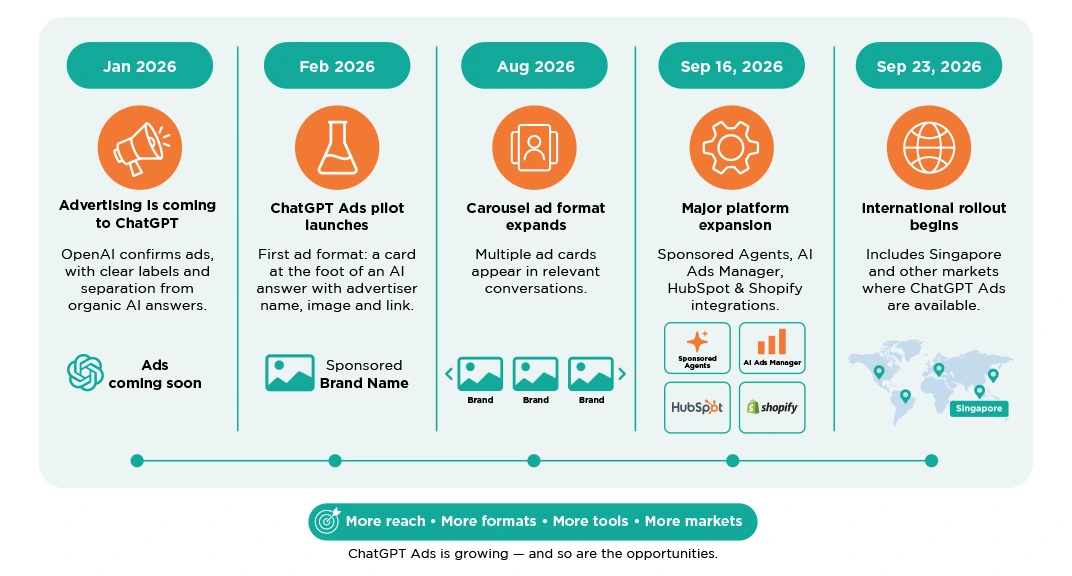
The ChatGPT Ads platform did not appear overnight. It has been built incrementally since early 2026:
Jan 2026
OpenAI officially confirmed that advertising was coming to ChatGPT, committing to clearly labelled ads kept separate from organic AI answers.
Feb 2026
ChatGPT Ads pilot opened. First ad format: a card at the foot of an AI-generated answer with advertiser name, image, and link.
Aug 2026
Ad format expanded to include a carousel of ad cards with multiple advertisers appearing in relevant conversations.
Sep 16, 2026
OpenAI announced Sponsored Agents, AI Ads Manager tools, HubSpot and Shopify integrations, the largest single expansion of the ChatGPT Ads platform.
Sep 23, 2026
International market rollout begins, including Singapore and other markets where ChatGPT Ads are available.
What Are ChatGPT Ads?
ChatGPT Ads are paid advertisements that appear inside ChatGPT conversations. This creates another layer of visibility alongside the growing importance of ChatGPT-driven search. When a user asks ChatGPT a question, the AI generates an answer, and relevant ad cards may appear below or alongside it. These are clearly labelled as paid placements and are separate from ChatGPT’s independent, organic answers.
The key difference from a Google search ad: a Google user is searching for something and receives ads alongside search results. A ChatGPT user is having a conversation with an AI and receives ads alongside that conversation. The mindset difference is significant: ChatGPT users are in an active information-gathering or decision-making mode, not just browsing. That tends to correlate with higher purchase intent.
ChatGPT has more than 900 million weekly active users globally (OpenAI, early 2026). AI-referred traffic to brand websites has grown 527% year over year (Search Engine Land, 2025). In Singapore specifically, ChatGPT traffic to brand websites grew approximately 340% between early 2024 and early 2026 (Elite Asia, 2026). These are not fringe numbers; ChatGPT is a mainstream consumer platform, and advertising on it reaches a significant and growing audience in Singapore.
What Is a Sponsored Agent and How Is It Different?
Sponsored Agents are the most significant new feature in the September 16 announcement and the most important for Singapore businesses to understand, because they change the post-click experience of digital advertising.
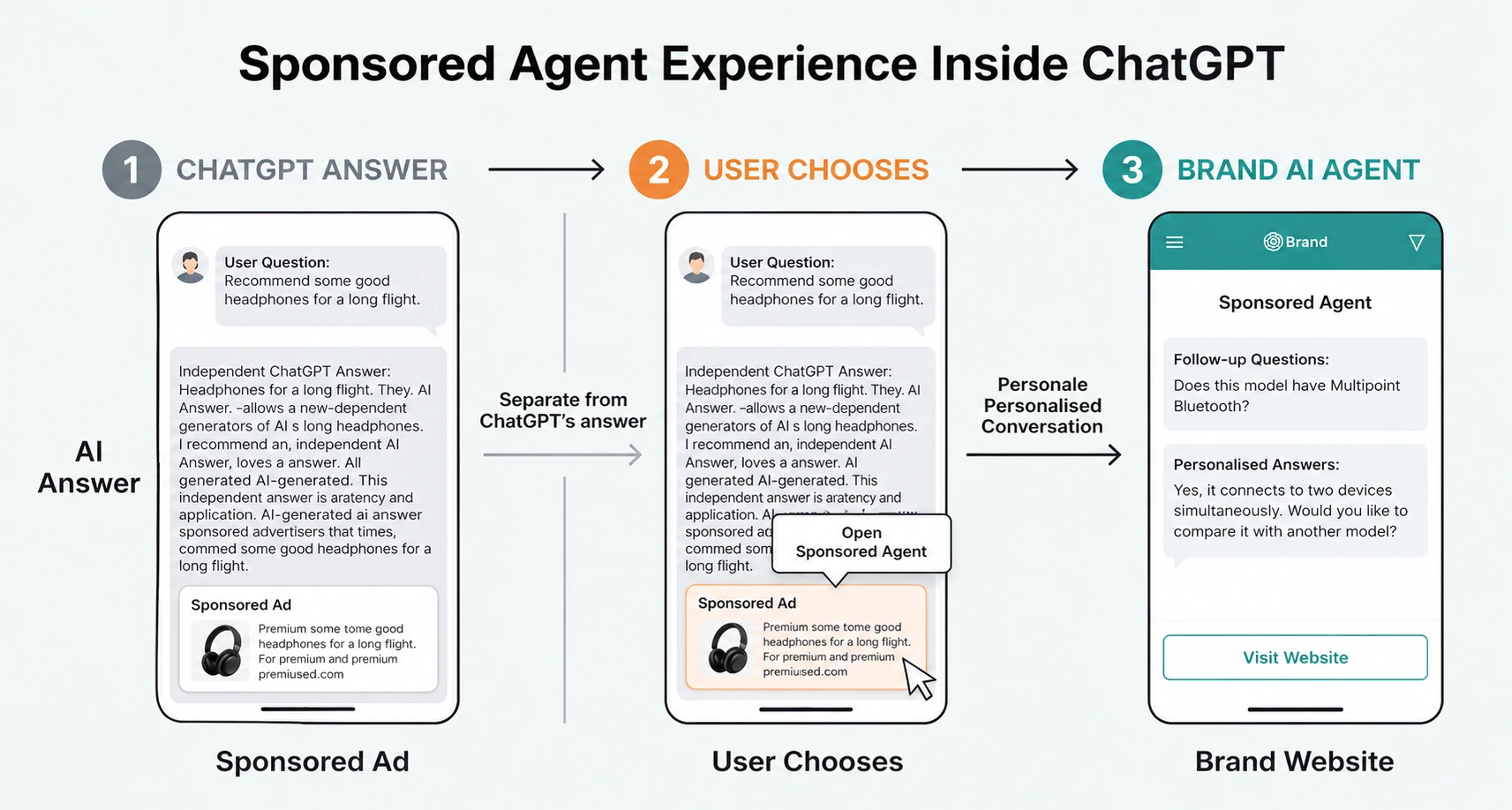
Here is how they work. A user inside ChatGPT sees an ad card for, say, a Singapore furniture retailer. Rather than immediately being sent to the retailer’s website, the user has the option to start a separate, clearly labelled conversation with the retailer’s Sponsored Agent inside ChatGPT. In that conversation, the user can ask questions: Does this dining table fit a four-person household? What is the delivery timeline? Can it be customised? Is it available in white? And receive answers from the brand’s agent. When the user is ready to buy, they follow a link to the retailer’s website.
Three things are worth noting about the architecture. First, the Sponsored Agent conversation is completely separate from ChatGPT’s own responses; ChatGPT’s organic system does not see a user’s questions to the Sponsored Agent. Second, the conversation is clearly labelled so users know they are talking to a business, not to ChatGPT itself. Third, the entire interaction is driven by user choice; users opt into the Sponsored Agent conversation; they are not automatically redirected.
The commercial implication: a user who reaches your Sponsored Agent has already clicked your ad and chosen to ask questions. That is a materially different level of purchase intent from someone who merely saw your ad. The conversation acts as a pre-qualification step. Users who talk to your Sponsored Agent and then visit your website are closer to a buying decision than users arriving via a standard ad click.
Singapore businesses on Shopify with a product catalogue already loaded can connect to Sponsored Agents most easily. The Shopify Catalog integration means product data is already available to power product-specific Q&A in a Sponsored Agent conversation.
The Full ChatGPT Ads Platform: What Was Announced on 16 September 2026
Sponsored Agents were the headline feature, but the September 16 announcement covered four distinct product updates. Singapore businesses need to understand all four to assess what matters to them.
1. Sponsored Agents
As described above, users can choose to enter a clearly labelled AI conversation with a brand after clicking an ad inside ChatGPT. Currently being tested with select US advertisers. International rollout from 23 September 2026.
2. Ads Manager with Natural-Language Campaign Creation
Advertisers can now create, update, and analyse ad campaigns by writing natural-language prompts inside ChatGPT. This removes much of the technical interface complexity from ad management. A marketing manager can type “create a campaign for our new women’s running shoes targeting users in Singapore aged 25-40,” and the AI generates the campaign structure. No specialist ad platform training required.
AI-suggested copy and imagery are also now available directly in Ads Manager: when drafting an ad, advertisers receive suggested headlines, descriptions, and image ideas based on their landing page and campaign objective. Advertisers review and edit all suggestions before publishing; the AI assists but does not publish autonomously.
An opt-in AI text customisation feature adapts headline and description copy to better fit the context of each conversation, and automatically translates ad copy into the reader’s preferred language. For Singapore businesses targeting a multilingual audience (English, Mandarin, Malay, Tamil), this has practical value.
3. HubSpot Integration: First CRM Partner
HubSpot is OpenAI’s first official CRM partner for ChatGPT Ads. Singapore businesses managing their contacts and sales pipeline in HubSpot can now connect their ChatGPT Ads account directly. From within HubSpot: create ChatGPT ad campaigns, track performance, follow up on ad-generated leads, and trigger existing HubSpot workflows when a ChatGPT Ads lead comes in. The integration keeps ChatGPT Ads activity inside the same dashboard where the rest of your marketing and sales data lives.
4. Shopify Integration: First eCommerce Partner
Shopify is OpenAI’s first official eCommerce partner. A free ChatGPT Ads app is now available in the Shopify App Store (apps.shopify.com/chatgptads). US-based merchants can install it now. International markets, including Singapore, will be available from 23 September 2026. Once installed, your Shopify product catalogue automatically syncs with ChatGPT Ads, allowing you to run product-specific campaigns without manually building creative from scratch. Performance tracking happens within Shopify; no need to manage a separate ad dashboard for your ChatGPT campaigns.
23 September 2026 Singapore included in international market expansion
Shopify ChatGPT Ads app (SG availability)
Free app available to Singapore Shopify merchants from 23 September 2026
These numbers point to a clear strategic reality for Singapore businesses. ChatGPT is already sending measurable traffic to brand websites in Singapore, and that traffic is growing faster than any other AI referral source. ChatGPT Ads are the paid layer that allows brands to actively target and appear in those conversations, rather than waiting for organic visibility.
The Singapore market is particularly well-positioned for ChatGPT Ads to perform. Singapore has among the highest AI tool adoption rates in Southeast Asia, a sophisticated e-commerce ecosystem (with strong Shopify penetration), and a business community that is already tracking AI search as a strategic marketing issue. Businesses that adopt ChatGPT Ads early in Singapore will have an advantage over competitors who adopt later, as with any new advertising channel.
How ChatGPT Ads Compare to Google Ads and Meta Ads?
ChatGPT Ads are not a replacement for Google Ads or Meta Ads they serve a different function in the customer journey. Understanding where each platform fits is important before deciding how to allocate budget.
Factor
Google Ads
ChatGPT Ads
Meta Ads
User intent
Search intent keyword-based
Conversational intent: user in active research mode
Interest and behaviour-based
Ad format
Search results, display, shopping, video
Card at foot of answer or carousel; Sponsored Agent conversation (testing)
Image, video, carousel, Reels, stories
User mindset when seeing ad
Ready to search, may or may not be in buying mode
Already asking AI for help; highest purchase readiness
Browsing/socialising may not be in buying mode
Post-click experience
Lands on advertiser website
Lands on website OR enters Sponsored Agent conversation (new)
Lands on advertiser website or lead form
AI creative tools
Performance Max, Smart Bidding, AI creative
Natural-language campaign creation, AI-suggested copy and imagery
Practical Singapore guidance: ChatGPT Ads should be treated as an additional channel, not a substitute. The audience overlap with Google and Meta is partial but not complete ChatGPT’s user base skews toward higher-income, tech-forward, English-proficient users, which is well-matched to Singapore’s demographics. For most Singapore businesses, ChatGPT Ads work best as a complement to existing Google and Meta campaigns.
Who Should Consider ChatGPT Ads in Singapore?
Not every Singapore business should prioritise ChatGPT Ads immediately. Your readiness to benefit depends on your current tech stack, audience, and digital marketing foundation.
Business Type
Readiness
Why ChatGPT Ads Are Relevant
eCommerce on Shopify
High start now
Shopify Catalog integration is native and free. Products sync automatically. Run ChatGPT Ads from the Shopify App Store without rebuilding workflows.
B2B businesses using HubSpot
High start now
HubSpot integration is live. ChatGPT Ads leads enter your existing workflows. Campaign performance sits alongside other channel data in one dashboard.
Professional services (law, finance, medical)
Medium prepare now
ChatGPT users researching professional services are at the consideration stage. Sponsored Agents allow a qualifying conversation before a website visit.
F&B and hospitality
Medium wait and test
Singapore users ask ChatGPT for restaurant recommendations. ChatGPT Ads can appear in those conversations when Sponsored Agent format expands.
Software / SaaS companies
High start now
SaaS buyers compare tools in ChatGPT conversations. A Sponsored Agent that answers feature and pricing questions reduces the research-to-trial gap.
Retail and consumer goods
Medium prepare
Product discovery via AI is growing. ChatGPT Ads with Shopify Catalog enable product-specific ads without building new ad creative from scratch.
Local SMEs without Shopify or HubSpot
Lower build foundation first
Start with Google and Meta. Establish ChatGPT organic visibility via GEO. Add ChatGPT Ads once your digital foundation and CRM infrastructure are in place.
ChatGPT Ads and GEO: Paid and Organic: Two Ways to Be Visible in ChatGPT
This is the connection that most marketing blogs covering the September 16 announcement have missed. ChatGPT Ads are the paid way to appear in ChatGPT. But there is also an organic way, and it is one that Verz Design has been helping Singapore businesses build for the past two years.
GEO (Generative Engine Optimisation) is the practice of building your brand’s digital signals so that ChatGPT, Perplexity, Gemini, and Copilot include your brand in their organic, unpaid recommendations when users ask relevant questions. If you want to understand how GEO differs from SEO and AEO, see our detailed comparison of the three approaches. When a user asks ChatGPT, ‘which digital marketing agency in Singapore should I use?’, the agencies that appear are the ones with strong GEO, not the ones running the most ChatGPT Ads. Understanding how AI systems select content and sources is therefore an important part of building organic visibility in ChatGPT.
The relationship between ChatGPT Ads (paid) and GEO (organic) is similar to the relationship between Google Ads and SEO. Both place your brand in front of users on the same platform. Paid placement is immediate but costs per click. Organic placement requires sustained investment but compounds over time and reaches users who actively distrust ads. The strongest brands in any channel use both paid for immediate visibility and testing, organic for long-term authority.
Factor
GEO (Organic ChatGPT Visibility)
Cost
No per-click cost; requires investment in content, schema, entity signals
Timeline
3-6 months to build consistent citation frequency
Trust signals
Organic AI recommendations are perceived as endorsements
Targeting
AI systems choose when to cite your brand based on relevance
Foundation required
Quality content, schema markup, entity signals, AI crawler access
ChatGPT Ads synergy
Strong GEO = better AI understanding of your brand = more relevant ChatGPT Ad placement
The practical implication for Singapore businesses: if you haven’t worked on GEO yet, the arrival of ChatGPT Ads is a strong signal to start. A business running ChatGPT Ads on a brand with weak organic AI visibility is essentially paying to introduce itself in conversations where it has no established credibility. A business with strong GEO running ChatGPT Ads appears in both paid and organic positions, significantly increasing the share of ChatGPT conversations where that brand is visible.
How Singapore Businesses Can Prepare for ChatGPT Ads?
Six things to do right now before and immediately after the Singapore rollout on 23 September 2026.
Step 1: Create an Account at ads.openai.com
Sign up at ads.openai.com to get notified when ChatGPT Ads expand to Singapore. Creating an account now puts you in a position to activate campaigns immediately on rollout day, before competitors have set up their accounts.
Step 2: Connect Shopify Through the ChatGPT Ads App
If you are a Singapore Shopify merchant, install the ChatGPT Ads for Shopify app from the Shopify App Store (apps.shopify.com/chatgptads) from 23 September 2026. The app is free, and your product catalogue syncs automatically, removing the manual campaign setup work that slows down most new ad channel onboarding.
Step 3: Connect HubSpot if You Use It
If your business uses HubSpot, connect your ChatGPT Ads account through the HubSpot integration now available. This means leads generated by your ChatGPT Ads enter your existing follow-up workflows automatically, rather than sitting in a separate platform your team has to check.
Step 4: Audit Your Website for AI Crawler Access
ChatGPT reads your website to serve relevant ads and to power Sponsored Agent conversations. Make sure your robots.txt isn’t blocking GPTBot, OAI-SearchBot, or Google-Extended. Check yourwebsite.com/robots.txt directly. Blocked crawlers mean ChatGPT cannot read your product pages which limits both the relevance of your ChatGPT Ads and the quality of what a Sponsored Agent can say about your products.
Step 5: Prepare a Brief for Your Sponsored Agent
If you plan to use Sponsored Agents when they expand internationally, prepare a brief now. Define the questions your target customers typically ask before purchasing, your key differentiators, your pricing or delivery terms, and what you want the agent to say when a user is ready to buy. The quality of a Sponsored Agent conversation depends on how well the brief defines the brand’s voice, knowledge, and boundaries.
Step 6: Build Your GEO Foundation Alongside Paid Ads
ChatGPT Ads are a paid shortcut to visibility. AI SEO and GEO provide the organic foundation for appearing across AI-generated search experiences. GEO is the organic foundation that keeps your brand visible in ChatGPT conversations, with or without an active ad campaign. Running both together produces compounding returns; your brand appears in paid ad placements when you are running campaigns, and in organic AI responses when you are not. Building GEO now means your organic ChatGPT presence grows while your paid campaign data accumulates.
Want to Be Found in ChatGPT Organically and Through Ads?
ChatGPT Ads represent a meaningful shift in how paid advertising works. For the first time, a business can pay to appear in the same conversational AI environment Singapore consumers already use to research purchases, compare products, and make decisions. The Sponsored Agent format, where users can ask follow-up questions to a brand’s AI before visiting its website, is particularly significant: it brings the brand into the research conversation, not just the awareness stage.
For Singapore businesses already on Shopify or HubSpot, the setup barrier is low. The integrations are free, the campaign creation is natural-language driven, and the product catalogue can sync automatically. The question is not whether to explore ChatGPT Ads; it is how quickly to move, and how to build the organic GEO foundation that makes paid ChatGPT Ads more effective.
The businesses that will get the most from ChatGPT Ads in Singapore are the ones that enter with both layers in place: a strong GEO presence that gives their brand organic credibility in ChatGPT, and a well-structured paid campaign that targets the high-intent conversational moments where their products or services are most relevant.
Contact Verz Design to build your GEO presence and boost your visibility in ChatGPT.
Frequently Asked Questions
What are ChatGPT Ads?
ChatGPT Ads are paid advertisements that appear inside ChatGPT conversations. They are clearly labelled as paid placements and are separate from ChatGPT's own organic, unpaid answers. First introduced as a pilot in February 2026, they appear as cards at the bottom of an AI-generated response. Advertisers pay to have their brand, product, or service appear when users ask ChatGPT questions relevant to their business. The latest development (announced 16 September 2026) adds Sponsored Agents, AI campaign creation tools, and integrations with HubSpot and Shopify.
What is a Sponsored Agent in ChatGPT?
A Sponsored Agent is a business-backed AI agent that users can choose to talk to after clicking an ad inside ChatGPT. The interaction is clearly labelled and takes place in a separate conversation window; it is distinct from ChatGPT's independent answers and does not mix with the user's main ChatGPT conversation. For example, a user might click a furniture retailer's ad and choose to ask the Sponsored Agent whether a specific table fits a certain room size, how many people it seats, and what the delivery lead time is. The Sponsored Agent answers these questions, then provides a link to the retailer's website. Currently in US testing; international expansion from 23 September 2026.
Are ChatGPT Ads available in Singapore?
The international rollout of ChatGPT Ads begins 23 September 2026. Singapore is expected to be included given its high ChatGPT adoption rate and strong digital advertising market. The Shopify ChatGPT Ads app, confirmed free in the Shopify App Store, becomes available internationally in markets where ChatGPT Ads are available from 23 September 2026. Create an account at ads.openai.com to be notified when Singapore access is confirmed.
How much do ChatGPT Ads cost?
OpenAI has not publicly confirmed ChatGPT Ads pricing as of the September 2026 announcement. Based on available information, businesses sign up at ads.openai.com, and Shopify merchants can access a free ChatGPT Ads app. OpenAI has not officially stated campaign-level pricing (cost per click or CPM). Pricing information will likely be shared through the ads.openai.com platform on account creation. Based on industry norms for new AI advertising platforms, expect pricing to start competitively with Google Ads and Meta Ads, with rates potentially adjusting as demand grows.
How do ChatGPT Ads compare to Google Ads?
Google Ads target users who are actively searching for something high-intent, but competitive. ChatGPT Ads target users in conversational research mode, potentially with higher purchase readiness, especially for considered purchases where users have follow-up questions. ChatGPT Ads currently don't have Google's audience scale, but Sponsored Agents offer a post-click experience Google Ads cannot match: a pre-purchase Q&A conversation with the brand's AI agent inside the platform where users are already comfortable asking questions.
Should I use ChatGPT Ads or GEO (Generative Engine Optimisation)?
Ideally both. ChatGPT Ads are the paid layer that gives you immediate, targeted visibility in ChatGPT conversations. GEO is the organic layer that builds your brand's credibility and citation frequency in ChatGPT responses without ongoing ad spend. The two strategies reinforce each other: strong GEO makes your brand more recognisable when a user sees your ChatGPT Ad, and ChatGPT Ads campaign data tells you which conversations your audience has, which informs your GEO content strategy. For Singapore businesses with limited budgets, build GEO first and add ChatGPT Ads once your digital foundation is in place.
Do I need Shopify to use ChatGPT Ads?
No, but Shopify significantly speeds up setup. The free ChatGPT Ads for Shopify app (apps.shopify.com/chatgptads) automatically syncs your product catalogue, so product-specific campaigns require no manual creative build. Non-Shopify businesses can still access ChatGPT Ads directly at ads.openai.com, where the Ads Manager with natural-language campaign creation is available. However, HubSpot and Shopify are the only confirmed integrations as of the September 2026 announcement.
How do I track ChatGPT Ads performance?
Performance tracking for ChatGPT Ads happens in several places depending on your setup. For Shopify merchants, performance tracking is built into the ChatGPT Ads for Shopify app using the Shopify pixel and conversion events. You track ChatGPT Ads results from within Shopify alongside other channel data. For HubSpot users, ad-generated leads and campaign performance appear in HubSpot. OpenAI's Ads Manager also provides campaign performance data. Standard web analytics (Google Analytics 4) will show ChatGPT-referred sessions, which should increase if ChatGPT Ads are driving click-through traffic.
What is the difference between ChatGPT Ads and ChatGPT organic recommendations?
ChatGPT organic recommendations are unpaid; they appear when ChatGPT's AI system independently decides to mention or recommend a brand in response to a user's question. This is what GEO (Generative Engine Optimisation) helps achieve: building the digital signals that cause ChatGPT to cite your brand organically. ChatGPT Ads are paid. Your brand appears in a conversation because you have paid to be there, regardless of whether ChatGPT would have mentioned you organically. Both are valuable. Organic citations are perceived as more trustworthy; paid ads provide reliable, targetable visibility. The strongest Singapore brands in 2026 will build both at the same time.
Where can Singapore businesses sign up for ChatGPT Ads?
Businesses can sign up at ads.openai.com. Shopify merchants can install the free ChatGPT Ads app from the Shopify App Store (search “ChatGPT Ads” or visit apps.shopify.com/chatgptads), available to Singapore merchants from 23 September 2026. HubSpot users can connect their account through the ChatGPT Ads for HubSpot integration. If you need help setting up ChatGPT Ads alongside a GEO foundation for your Singapore business, Verz Design offers consultation on AI advertising strategy and GEO implementation.
About the Author:
Vivek Tank
Senior SEO Specialist with a strong background in digital marketing and content strategy. With expertise in keyword research, on-page SEO, and backlink building, Vivek creates results-driven strategies tailored to each brand’s goals.
Need a strong team specialised in SEO?
Speak to Verz today if you are looking to create a website with a lasting impression to achieve online success.



 Share
Share