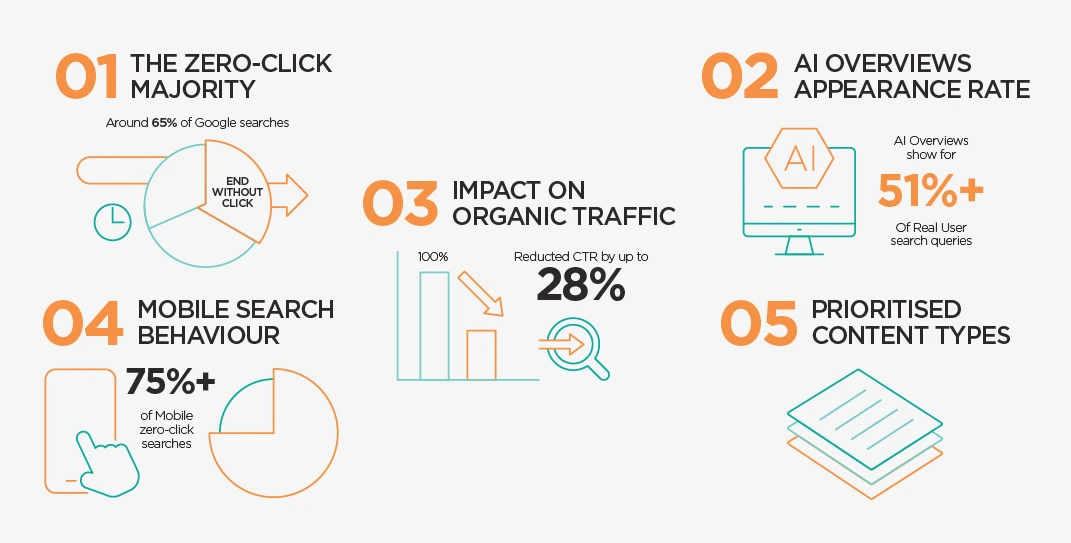
AI-powered search experiences are changing how users discover information online. Platforms like OpenAI ChatGPT, Google AI Overview, and Microsoft Copilot no longer rely only on displaying a list of blue links. Instead, they generate direct answers by extracting and summarising information from selected sources.
This shift is changing the role of SEO. Ranking on search engines is still important, but visibility alone is no longer enough. Today, brands also need to earn AI citations by publishing content that AI systems can easily understand, trust, and reference.
The reality is simple: Not every webpage gets cited.
AI systems prioritise content that demonstrates clarity, relevance, topical authority, and credibility. Websites that structure their content effectively have a much higher chance of appearing in AI-generated answers, featured snippets, People Also Ask (PAA), and AI Overviews.
In this guide, we will explore how AI systems select content, what makes a page citable, and how businesses can optimise their content using Answer Engine Optimisation (AEO) and Generative Engine Optimisation (GEO) strategies.
Why AI Citations Matter More Than Rankings?
Traditional SEO mainly focused on rankings and clicks. The higher a webpage ranked, the greater its chances of receiving organic traffic. However, AI-powered search is changing user behaviour significantly.
Many users now receive complete answers directly within AI-generated responses without visiting multiple websites. This creates a new visibility challenge. Instead of competing only for rankings, businesses are now competing to become the source AI systems choose to reference.
Why AI citations matter:
- They improve brand visibility even in zero-click searches
- They increase trust and perceived authority
- They strengthen brand recall in AI-generated conversations
- They position your business as a reliable industry source
- They improve long-term discoverability across AI platforms
In many cases, being cited by AI systems can create stronger authority signals than simply ranking on page one.
This is why businesses are increasingly investing in:
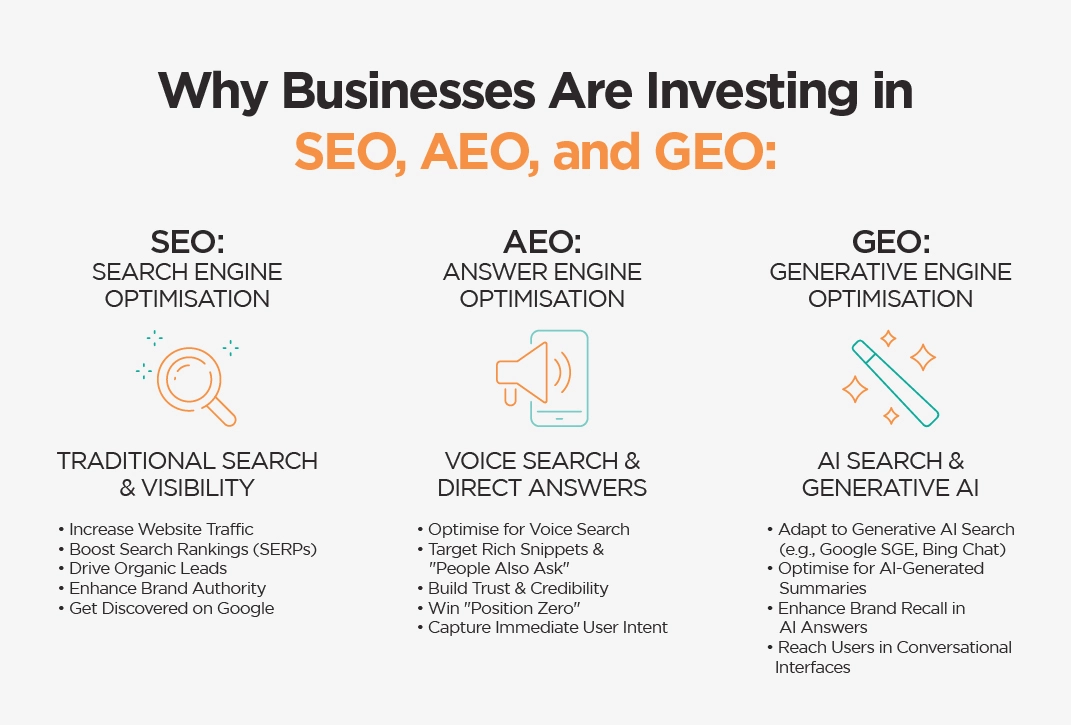
These three approaches now work together rather than separately.
How AI Systems Retrieve and Select Content?
AI systems do not randomly select webpages. They follow a layered retrieval and evaluation process that combines search indexing, language understanding, relevance scoring, and trust assessment.
Understanding this process is essential for improving your chances of earning AI citations.
1. Query Understanding and Intent Matching
The first step involves understanding the user’s intent.
AI systems analyse:
- What is the user asking?
- Whether the query is informational or transactional
- How detailed should the response be?
- Whether the user expects definitions, comparisons, tutorials, or opinions
Content that directly aligns with user intent is significantly more likely to be cited.
Example:
Query: “What is Answer Engine Optimisation?”
AI prefers concise definition-focused content.
Query: “How to optimise content for AI search in 2026?”
AI prefers updated, actionable, step-by-step guides.
This is where properly structured AEO content becomes highly valuable.
2. Retrieval from High-Authority and Relevant Sources
Once intent is understood, AI systems retrieve content from indexed webpages and trusted domains. They commonly prioritise:
- High-authority websites
- Frequently referenced sources
- Topically relevant pages
- Pages with strong engagement and trust signals
However, domain authority alone is not enough anymore. A highly authoritative website with poorly structured content may still lose citations to a smaller website with clearer and more extractable information.
AI systems increasingly prioritise:
- Content clarity
- Structured formatting
- Semantic relevance
- Ease of extraction
This is why smaller niche websites can still earn AI citations when their content is genuinely useful and well organised.
3. Content Extraction and Answer Fit
AI-generated answers rely heavily on content extraction. AI systems prefer content that:
- Answers questions directly
- Uses logical heading structures
- Provides concise explanations
- Includes contextual depth without unnecessary fluff
This is where Answer Engine Optimisation (AEO) plays a major role. Content formats AI systems commonly prefer:
- Direct answers immediately below headings
- Short explanatory paragraphs
- Structured comparisons
- FAQ sections
- Step-by-step instructions
- Context-rich examples
Pages that bury answers inside long, unstructured paragraphs are far less likely to be cited.
4. Trust, Accuracy, and Credibility Evaluation
AI systems evaluate whether content appears trustworthy before referencing it. This aligns closely with Google’s E-E-A-T principles:
- Experience
- Expertise
- Authoritativeness
- Trustworthiness
Trust signals AI systems commonly evaluate:
- Accuracy and factual consistency
- Topical expertise
- Author reputation
- Brand credibility
- External references and mentions
- Content depth and completeness
Websites that consistently publish reliable, high-quality information build stronger citation potential over time.
5. Cross-Source Validation
AI systems rarely rely on a single source. Instead, they compare information across:
- Multiple webpages
- Different domains
- Industry references
- Consistent explanations
If several trusted sources explain a topic similarly, AI systems gain more confidence in that information.
This means:
Content aligned with industry consensus is more likely to be cited than content making unsupported or exaggerated claims.
Key Factors That Influence AI Citations
To improve your chances of appearing in AI-generated answers, your content needs to meet specific quality and formatting expectations.
1. Clarity Over Complexity
AI systems prefer content that explains concepts clearly and naturally. Content should:
- Use simple language
- Avoid unnecessary jargon
- Answer questions quickly
- Focus on readability
If readers struggle to understand your explanation, AI systems may also struggle to extract it accurately. Human readability and machine readability now work together.
2. Structured Content Format
Well-structured content is significantly easier for AI systems to process. Best practices include:
- Clear heading hierarchy (H1 → H2 → H3)
- One topic per section
- Logical information flow
- Descriptive subheadings
- Readable paragraph lengths
Proper structure improves:
- AI extraction
- Featured snippet eligibility
- PAA visibility
- User experience
3. Direct Answer Placement
One of the biggest AEO mistakes is hiding the answer too deep within the content.
Instead:
- Place the direct answer immediately after the heading
- Keep the first few lines concise
- Expand with context afterwards
Example:
Query: “What is Generative Engine Optimisation (GEO)?”
Generative Engine Optimisation (GEO) is the process of optimising content so AI-powered systems can easily understand, extract, and cite it within generated answers. GEO focuses on visibility across AI-driven search experiences rather than traditional rankings alone.This structure improves extractability for AI systems.
4. Depth and Completeness
Thin content rarely earns citations. AI systems prefer content that:
- Covers the topic comprehensively
- Includes practical explanations
- Provides contextual understanding
- Answers related subtopics
Instead of publishing shallow articles, focus on building genuinely useful resources. Comprehensive content increases:
- User trust
- Dwell time
- Topical authority
- Citation potential
5. Topical Authority and Content Clusters
Publishing one article is usually not enough to establish authority. AI systems look for consistent topical coverage across your website.
Example content cluster:
Main Topic: AI Search Optimisation
Supporting articles:
- Answer Engine Optimisation(AEO) for conversational search experiences
- GEO strategies for AI search
- AI SEO best practices
- Zero-click search optimisation
- How AI systems select sources
- Optimising for AI citations
Interlinking related articles helps AI systems understand your expertise more effectively.
6. Freshness and Content Relevance
For evolving industries like AI and SEO, freshness matters significantly. AI systems often prioritise:
- Recently updated content (AEO)
- Current best practices
- Relevant examples
- New data and insights
Outdated pages gradually lose citation potential over time. Regular content updates help maintain visibility in:
- AI Overviews
- Featured snippets
- PAA sections
- AI-generated search experiences
What Makes Content “Citable” in AI Systems?
Citable content usually shares three important characteristics.
1. It Answers Real Questions
AI systems prioritise content that mirrors how users naturally search. Your content should address:
- Real search intent
- Conversational queries
- Practical user problems
Using question-based headings improves both:
- Human readability
- AI extraction capability
2. It Is Easy for AI Systems to Extract
AI systems favour content that can be:
- Summarised easily
- Broken into sections
- Quoted accurately
- Reused without confusion
This is why structured formatting is essential. Clear formatting improves:
- AI parsing
- Snippet extraction
- Citation visibility
3. It Builds Trust Instantly
Users and AI systems should immediately recognise your content as credible. Trust-building elements include:
- Accurate explanations
- Original insights
- Clear examples
- Expert positioning
- Consistent terminology
The stronger the perceived trustworthiness, the greater the likelihood of citation.
How to Optimise Content for AI Citations?
AI systems do not “rank” content the same way traditional search engines do. Instead, they extract, interpret, and cite information that is clear, trustworthy, and easy to understand.
To increase your chances of being cited, you need to structure your content in a way that AI systems can quickly process and reuse.
Here is a practical framework you can apply:
Step 1: Start with Question-Based Headings
AI models are heavily trained on question-answer patterns. Structuring your headings as questions makes it easier for AI systems to identify what your content is solving.
Why this works:
- Matches how users search (especially in voice and conversational queries)
- Aligns with formats used in People Also Ask and AI-generated answers
- Helps models extract intent quickly
How to implement:
- Use natural, conversational questions
- Focus on one clear intent per heading
Examples:
- What is Answer Engine Optimisation (AEO)?
- How do AI systems select sources?
- Why do some websites get cited more often?
Pro tip:
Look at Google’s “People Also Ask” or your Search Console queries to find real questions users are asking.
Step 2: Give a Direct Answer First
Before adding depth, always provide a clear, concise answer in the first 2–3 lines.
AI systems prefer content that:
- Answers immediately
- Avoids fluff
- Uses simple, factual language
Structure to follow:
- First 1–2 sentences → Direct answer
- Next 1–2 sentences → Add clarity or context
Example:
Answer Engine Optimisation (AEO) is the process of structuring content so it can be directly extracted and displayed as answers by AI systems and search engines. It focuses on clarity, structure, and intent rather than just rankings.
Why this matters:
- Increases chances of being pulled into AI summaries
- Improves visibility in featured snippets
- Reduces ambiguity for machine interpretation
Step 3: Expand with Context and Examples
Once the direct answer is given, expand your content to build depth and authority. AI systems prefer content that doesn’t just define something but explains it in context.
What to include:
- Real-world scenarios
- Avoids fluff
- Use cases
- Comparisons
- Simple breakdowns
Example expansion:
Instead of just defining AEO, explain:
- How does it differ from traditional SEO?
- Where does it appear (ChatGPT, Gemini, Google AI Overview)?
- Why should businesses care?
Add practical examples:
- “A SaaS company structuring FAQs saw increased visibility in AI-generated answers”
- “Content with clear definitions is more likely to be cited in summaries”
Why this works:
- Builds topical authority
- Signals expertise (E-E-A-T)
- Gives AI more context to trust and reuse your content
Step 4: Use Supporting Formats
AI systems process structured content more efficiently than long, unbroken paragraphs.
Use multiple formats to improve extractability:
- Bullet points → for quick facts
- Numbered lists → for steps/processes
- Tables → for comparisons
- Short paragraphs → for readability
- FAQs → for direct Q&A extraction
Example:
Instead of writing:
“AI systems consider many factors like clarity, authority, and relevance…”
Break it into:
- Content clarity
- Source credibility
- Context relevance
- Structured formatting
- Content clarity
Why this matters:
- Makes your content easier to scan (for both users and AI)
- Increases chances of partial extraction (AI may cite just a section)
- Improves engagement and readability
Step 5: Build Topic Clusters
AI systems prefer websites with strong topical depth, not just isolated articles. Instead of writing one-off content, build a connected content ecosystem.
Example cluster:
Main topic: AI Search Optimisation
- Supporting articles:
- AI SEO strategies
- Answer Engine Optimisation (AEO)
- Zero-click search trends
- How AI selects sources
- Optimising for AI citations
How to implement:
-
- Interlink related articles naturally
- Use consistent terminology across pages
- Cover subtopics in depth
Why this works:
- Builds topical authority
- Helps AI understand your domain expertise
- Increases likelihood of multiple pages being cited
Think like this:
- One article answers a question
- Multiple articles establish authority
The Shift from SEO to AEO and GEO
Search optimisation is evolving rapidly. Traditional SEO alone is no longer enough for maximum visibility.
| Strategy |
Primary Focus
|
Goal
|
| SEO (Search Engine Optimisation) |
Rankings and organic traffic
|
Improve visibility in search engines
|
| AEO (Answer Engine Optimisation) |
Direct answers and extractable content |
Improve answer visibility
|
| GEO (Generative Engine Optimisation)
|
AI-generated citations and brand mentions |
Improve AI search presence
|
Modern content strategies should combine all three approaches together. Businesses that adapt early will have a stronger advantage in AI-driven discovery environments.
Final Thoughts
AI systems are changing how information is discovered, interpreted, and referenced online. Today, success is no longer only about ranking webpages. It is about becoming a trusted source that AI systems choose to cite.
Content that performs well in AI-driven search experiences usually:
- Solves real user problems
- Provides direct and structured answers
- Demonstrates expertise and authority
- Uses clear formatting and logical hierarchy
- Builds topical depth over time
The shift is already happening:
From optimising pages for rankings → to optimising content for citations, answers, and AI visibility.
Businesses that invest in SEO, AEO, and GEO together will be better positioned for the future of search. If you want to improve your visibility in AI-powered search experiences and strengthen your AI citation potential, feel free to contact us for a consultation.
Need a strong team specialised in SEO?
Speak to Verz today if you are looking to create a website with a
lasting impression to achieve online success.


 Share
Share